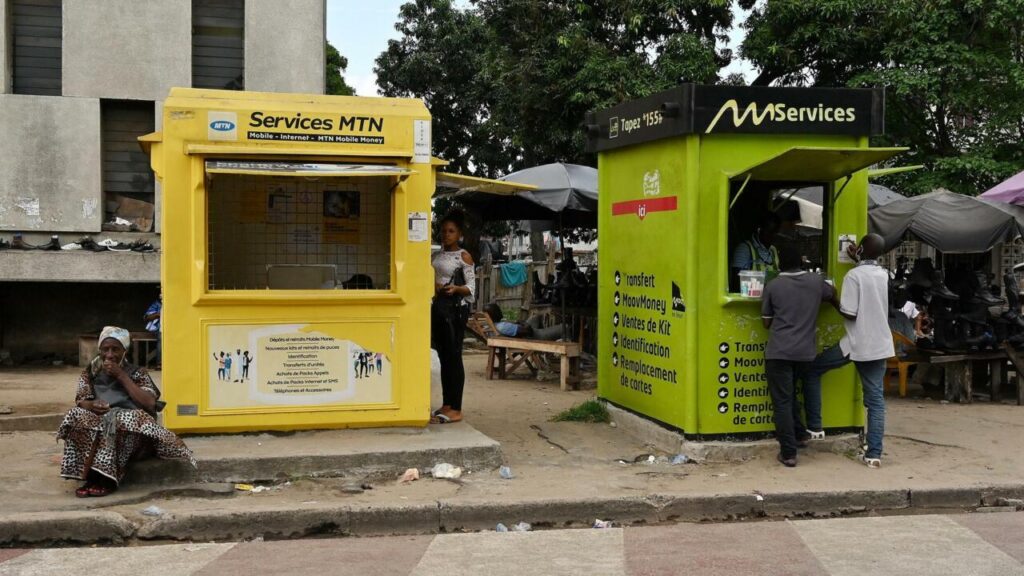
Mobile money transfer agencies are seen on May 6, 2020 in a district of Abidjan in the Ivory Coast. (Photo by ISSOUF SANOGO / AFP)
The bustling streets of Abidjan are a testament to Côte d’Ivoire’s rapid embrace of digital finance. With over 400,000 mobile money service points scattered across the country—outnumbering traditional ATMs by a staggering 300 to 1—these outlets have become the lifeblood of financial transactions for millions. Yet, the very agents who power this ecosystem are facing a growing challenge: chronic cash shortages that threaten their livelihoods and the reliability of the service.
daily struggles at the service points
At a busy intersection in the Angré Château neighborhood, Rosette stands in line, hoping to withdraw 10,000 West African francs—about 15 euros—from a local mobile money booth. The agent, Nema, sighs apologetically, explaining the day’s shortfall: «There are times when withdrawals surge unexpectedly, and we simply run out of cash. We have to turn clients away or switch to deposit mode, which isn’t ideal.»
Frustrated, some customers leave to find another outlet. Affoué, the booth’s manager and a former accountant, knows the stakes: «Losing a client isn’t just about immediate revenue—it’s the commission we forfeit. Every transaction counts, and without cash, we can’t deliver the service that keeps clients coming back.»
the ripple effect on earnings and service
Mobile money operators like Orange, Moov, MTN, and Wave pay agents commissions for transactions, typically ranging from 20 to 60 West African francs (3 to 9 cents) per 10,000-franc transfer. Higher transaction volumes and values translate to greater earnings. However, when cash runs low, agents are forced to temporarily close their booths to replenish funds from operators or banks, disrupting service and eroding trust.
Gertrude Yapi, operations director at Leya, a Abidjan-based fintech startup, has witnessed these disruptions firsthand. Leya’s motorcycle-based cash delivery service aims to solve the problem: «We replenish credit within four minutes and deliver cash within 30 minutes, ensuring booths stay operational and clients aren’t turned away. This reliability boosts our partners’ turnover by up to 50%.» Leya now serves over 3,000 active clients across four Ivorian cities: Abidjan, Bondoukou, Bouaké, and Korhogo.
why continuity matters for Ivory Coast’s economy
Economist Kassoum Timité emphasizes the critical role of mobile money in Côte d’Ivoire’s informal sector, which accounts for up to 40% of the country’s GDP, according to the International Monetary Fund. «When liquidity dries up, transactions stall, and economic activity slows. The informal sector relies on mobile money for salaries, transfers, and daily commerce—without it, the entire system falters.»
In 2024 alone, Côte d’Ivoire processed over 140 billion West African francs—over 210 million euros—in mobile money transactions daily, nearly four times the volume recorded in 2020. This explosive growth underscores the need for robust, uninterrupted service at every level of the mobile money chain.
For agents like Nema and Affoué, the stakes couldn’t be higher. Their ability to serve clients directly impacts their income, the success of their businesses, and the broader economy. As Côte d’Ivoire’s digital finance revolution continues, addressing the cash crunch at service points isn’t just a matter of convenience—it’s the foundation of financial inclusion.