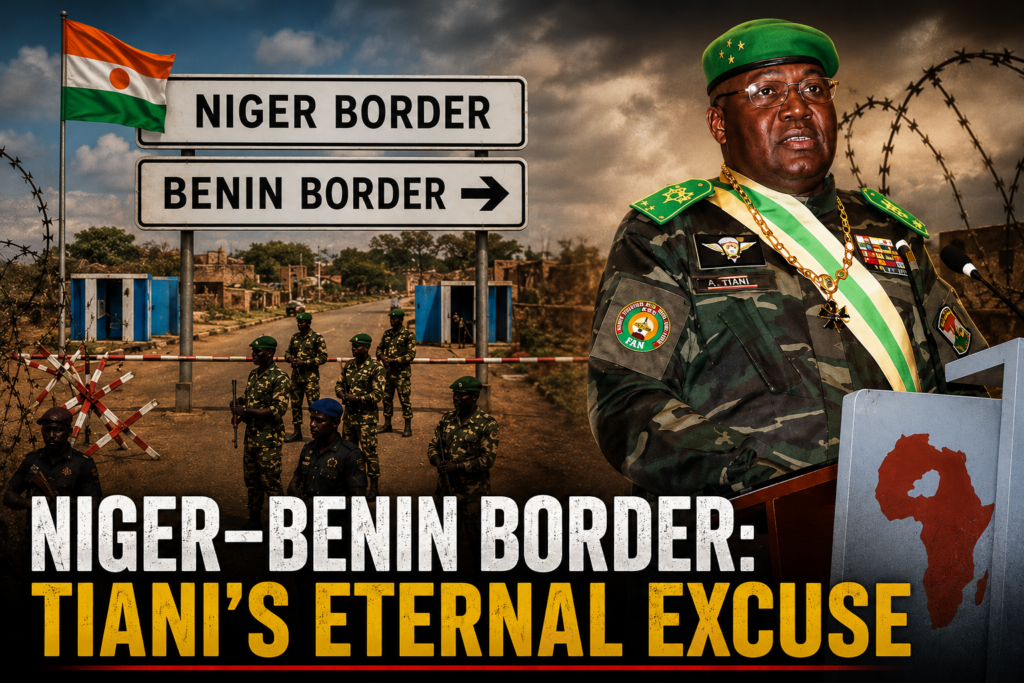
The prolonged border closure between Niger and Benin, now spanning three years, has evolved from a logistical issue into a calculated political instrument. Despite technical discussions between experts from both nations, the general stance of Niger’s leadership remains uncompromising, leaving the future of cross-border relations uncertain.
Diplomatic dialogue overshadowed by political rhetoric
Following the visit of Beninese President Romuald Wadagni to Niamey and subsequent expert-level meetings, hopes for a swift resolution had briefly resurfaced. However, the outlook shifted dramatically on July 26, when General Abdourahamane Tiani, during a national address, dismissed any immediate possibility of reopening the border. His statement—’there are prerequisites that must be addressed before making the irreversible decision to reopen’—revealed a strategy rooted more in ambiguity than in concrete negotiation.
Unclear demands, indefinite postponement
The absence of specific criteria for these so-called ‘prerequisites’ has granted Niger’s military leadership a significant political advantage. By failing to define measurable conditions or a timeline, the government can indefinitely postpone normalization without accountability. Each new demand can be introduced or altered, ensuring the border remains a tool for maintaining tension rather than facilitating cooperation.
A security narrative losing its credibility
Since the 2023 coup, Niger’s authorities have repeatedly cited security concerns, alleging that Benin serves as a rear base for armed groups or foreign actors threatening national stability. Yet, these claims lack verifiable evidence, while attacks in Tillabéri, Tahoua, and Diffa persist unabated. The contradiction raises a critical question: if border closure were an effective security measure, why does insecurity within Niger remain unchecked?
Expert consensus sidelined in favor of political posturing
Prior to the latest declaration, Beninese and Nigerien experts had engaged in productive discussions to outline technical frameworks for gradually reopening trade while addressing security considerations. The rejection of these efforts underscores a stark reality: the ultimate decision rests not on technical feasibility but on political will. The dialogue now appears to serve merely as a delaying tactic rather than a pathway to resolution.
Economic fallout: a burden shared, but unevenly
The closure has inflicted severe economic consequences on both nations. Benin’s port of Cotonou, a vital transit hub, has seen reduced traffic and customs revenue, while transporters and traders face mounting losses. For landlocked Niger, the impact is far more devastating.
Extended detours through alternative routes have inflated operational costs, leading to:
- Soaring food prices;
- Increased construction material costs;
- Escalated prices for imported medicines and essential goods;
- Supply chain disruptions for local businesses;
- Diminished competitiveness for Nigerien enterprises.
Small-scale traders and border communities bear the brunt of this crisis, with many livelihoods eroded and once-thriving border towns now experiencing economic stagnation.
Regional cooperation weakened by prolonged isolation
Beyond economic losses, the closure has strained broader regional collaboration. Academic exchanges, cross-border municipal partnerships, joint development initiatives, and anti-trafficking efforts have all been hindered. Ironically, the vacuum created by closed legal channels has not eliminated illicit trade—instead, it has often exacerbated it, complicating enforcement and fueling instability.
Sovereignty as a political shield
General Tiani’s reference to an ‘irreversible’ decision reflects an attempt to frame the closure as a sovereign act of defiance against external pressures. Yet, this narrative prompts reflection: does sovereignty manifest in economic isolation or in the effective protection of citizens’ welfare? Many analysts argue that the prolonged closure increasingly serves domestic political messaging rather than tangible security outcomes.
The human cost of a political standoff
The repercussions extend far beyond economic indicators. Families are divided, students face travel restrictions, transporters lose their livelihoods, and businesses operate under persistent uncertainty. Each passing week deepens these hardships, pushing the prospect of normalized relations further out of reach.
An impasse with no end in sight
Three years into the crisis, the Niger-Benin border remains less a security imperative and more a lever for political control. By cloaking decisions in vague ‘prerequisites,’ the Nigerien leadership retains full discretion to prolong the status quo indefinitely. Meanwhile, citizens on both sides of the border endure the mounting social and economic toll of a dispute whose benefits remain elusive at best.