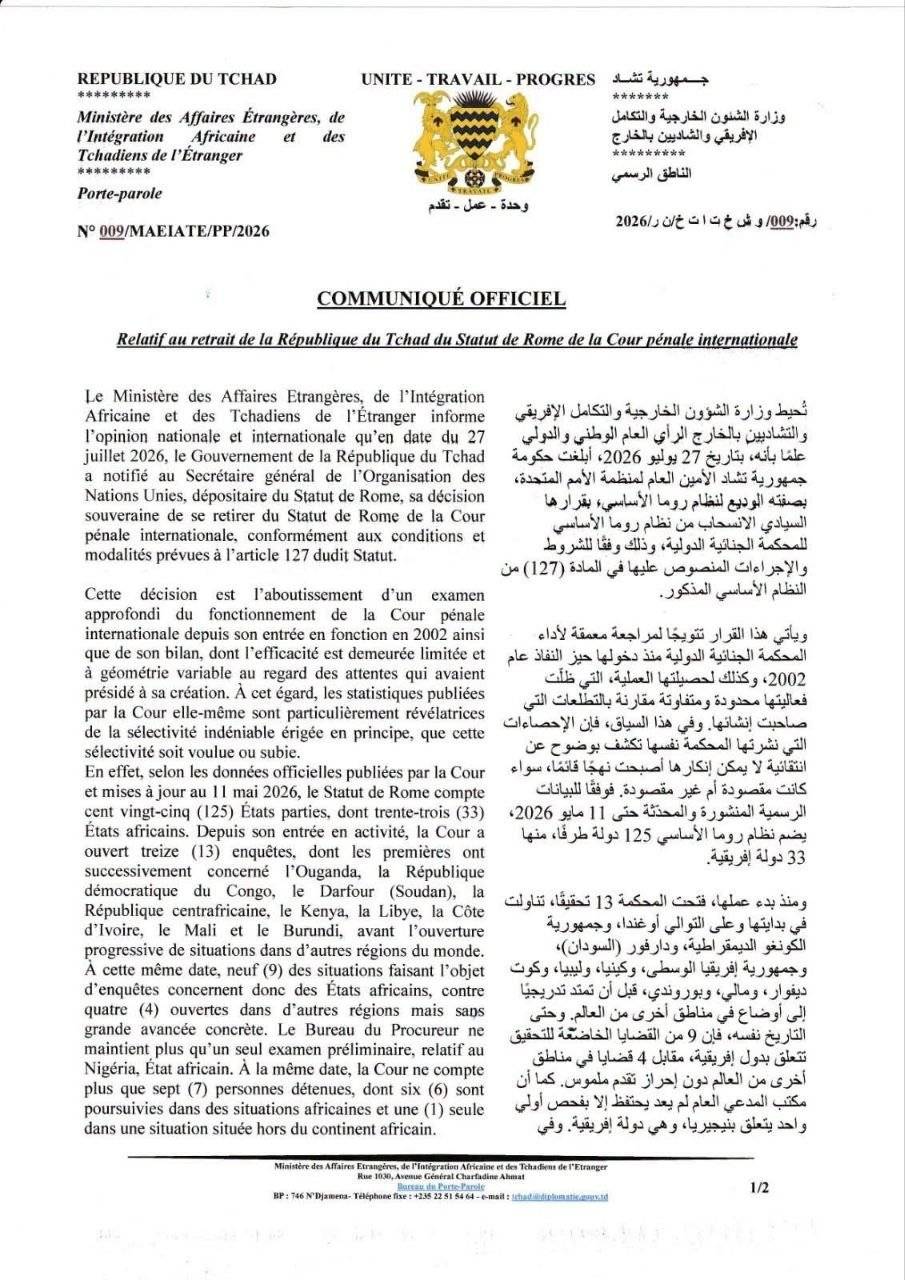
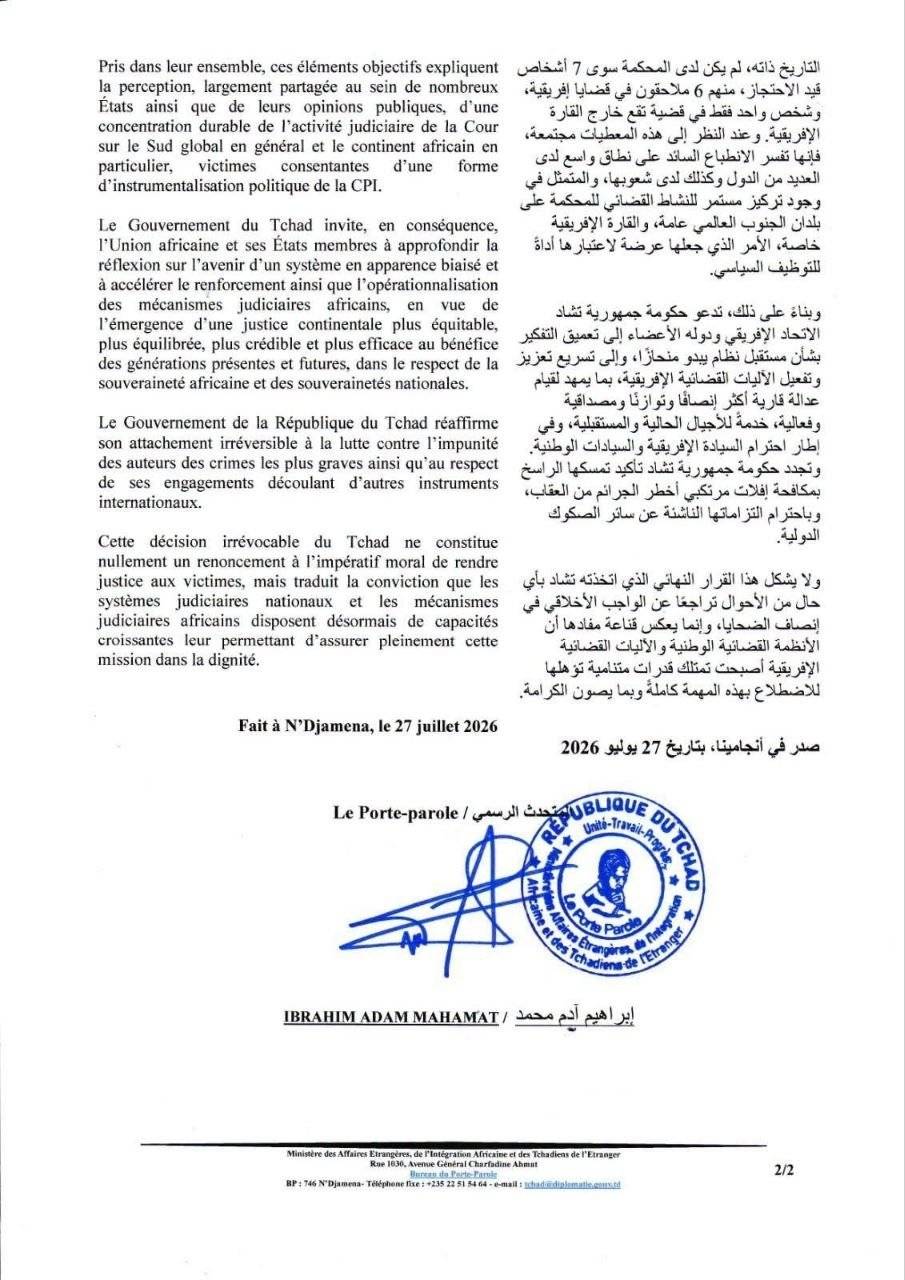
The government of Chad has formally initiated the process to withdraw from the Rome Statute, the foundational treaty of the International Criminal Court (ICC), sending a formal notification to the United Nations Secretary-General. This landmark decision, announced on July 27, reflects deep dissatisfaction with the tribunal’s perceived bias, particularly its focus on African nations while overlooking crimes elsewhere.
Breaking ties with The Hague
The withdrawal process is now underway, with Chad officially requesting the termination of its obligations under the Rome Statute. Authorities have criticized the ICC for what they describe as a systemic imbalance, arguing that the court disproportionately targets leaders from the Global South while failing to address major international crises. This move places Chad in a growing wave of African states re-evaluating their relationship with the Hague-based institution, originally designed to combat impunity for war crimes, crimes against humanity, and genocide.
What this means for Chad’s citizens
The decision sends ripples far beyond diplomatic corridors, directly impacting the justice system available to ordinary Chadians. By leaving the ICC framework, N’Djamena removes a critical layer of international oversight, leaving victims of grave human rights abuses with fewer legal recourses when national courts fail to act.
The erosion of a final safeguard
The ICC operates under the principle of complementarity, intervening only when domestic judiciaries are unwilling or unable to prosecute. With its departure, Chad closes the door on this last line of defense against mass atrocities, shifting full responsibility onto national institutions. For victims of state-sponsored violence or armed groups, justice now hinges entirely on the independence and capacity of local courts—a prospect that civil society groups view with growing apprehension.
Will justice survive the transition?
With the ICC’s jurisdiction over Chad set to lapse in one year, the coming months will be decisive. During this period, the court retains theoretical authority over crimes committed before the withdrawal, but practical cooperation from N’Djamena may dwindle. Meanwhile, local activists fear a rise in impunity, as documentation of abuses and witness protection become harder without the threat of international prosecution.
A gamble on sovereignty or a step backward?
Beyond domestic concerns, Chad’s move resonates across West Africa and the Sahel, where debates over national sovereignty and resistance to foreign influence dominate political discourse. By severing ties with the ICC, N’Djamena signals a bold assertion of judicial autonomy—but at a potential cost. Western donors and financial partners have long tied aid to human rights compliance, while foreign investors often rely on the presence of independent legal recourse before committing to long-term projects. Despite past criticism of the ICC by the African Union, member states remain divided, with Chad taking a notably radical stance.
Can Chad’s justice system fill the void?
The government contends that domestic courts are fully equipped to handle such cases, emphasizing the need to strengthen national institutions. However, achieving this will require substantial reforms: increased funding for courts, stronger safeguards for judicial independence, and robust mechanisms to protect witnesses and victims. The outcome of this transition will not be judged in international courtrooms or diplomatic forums, but in the everyday lives of Chad’s people—will they find justice within their own borders?
A turning point for African justice
The announcement marks a pivotal moment in Africa’s relationship with global governance structures. While criticism of the ICC’s perceived double standards finds broad support, the practical consequences of this withdrawal raise serious concerns. By turning away from The Hague, Chad has placed its bet on sovereignty. Whether this gamble pays off will depend on whether its citizens can still access fair and effective justice at home.