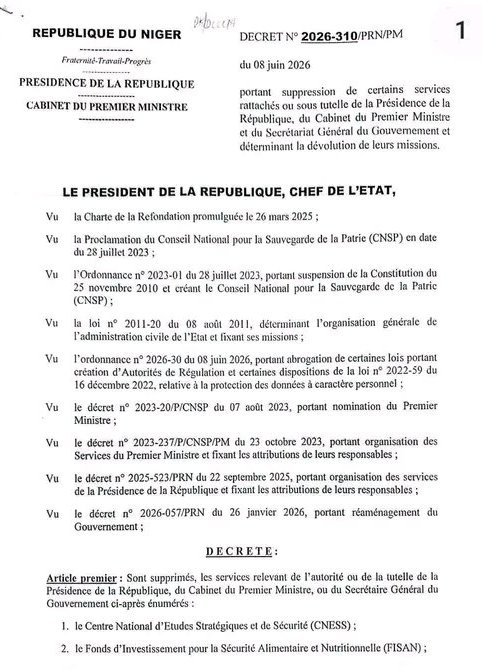
In a concerted effort to rationalize public finances, Nigerien authorities have enacted the dissolution of several entities previously linked to the Presidency of the Republic and the Prime Minister’s Office. The declared objective is to drastically reduce state operational costs and eliminate administrative redundancies.
A significant structural overhaul
This initiative represents a comprehensive cleansing within Niamey’s corridors of power. The Nigerien government has formally dismantled numerous services and structures that had historically revolved around the two principal executive offices. Far from being a mere superficial adjustment, this decision mandates the immediate transfer of all their responsibilities and competencies to the naturally competent sectoral ministries.
This restructuring aims to break away from what was deemed excessive centralization, thereby restoring to ministries their full mandate in steering public policies. By eliminating these ‘parallel administrations,’ the government intends to optimize the efficiency of the state apparatus.
Personnel management and asset reallocation
The decree establishes clear guidelines concerning the fate of personnel and assets impacted by these dissolutions:
- Civil servants and public agents: Detached personnel are immediately reassigned to their original ministries of attachment.
- Auxiliary and contractual agents: Their employment is terminated, with the government committing to the full payment of their legal entitlements.
- Assets and equipment: All movable and immovable assets belonging to these structures are transferred to the Ministry of Finance for inventory and subsequent redistribution.
Focus on rationalizing public expenditure
This decision is central to a broader strategy aimed at reducing the state’s operational footprint. By directly targeting the functioning budgets of the Presidency and the Prime Minister’s Office, which have often been scrutinized for their high costs, the authorities are conveying a strong signal of fiscal discipline.
The critical imperative is to alleviate the central administration’s operational burden, thereby enabling the redirection of saved financial resources towards priority social sectors and the nation’s economic development.
This institutional austerity measure lays the groundwork for a governance model that the authorities envision as more streamlined, transparent, and resolutely focused on optimizing public resources.