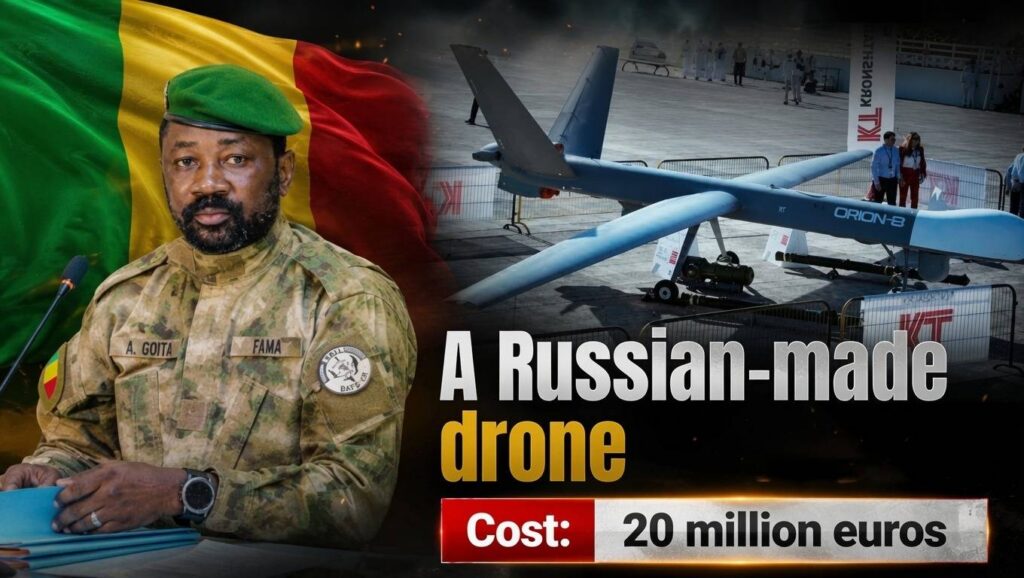
In a bid to strengthen its air power, Bamako has received a Russian-made Orion drone for reconnaissance and attack. While the transitional government celebrates this as a step toward regaining control of the territory, the unique and highly expensive acquisition has prompted strong doubts among military analysts. Between technical mismatch for asymmetric war and potential financial waste, the drone’s real effectiveness on the ground remains to be seen.
New acquisition underscores Bamako’s ties with Moscow
The Malian Armed Forces (FAMa) now add the Orion drone to their fleet. This MALE (Medium Altitude Long Endurance) aircraft is built for extended surveillance and precision strikes. It joins other Russian-supplied equipment received in recent years. Supporters of the current military strategy see this delivery as proof of Mali’s growing military power and its break from Western influence. The Orion is touted as a tool to monitor the vast desert expanses. However, behind the triumphant official statements, the reality of the battlefield and the machine’s specifications demand a more nuanced look.
The Orion paradox: a noisy giant facing an invisible war
The first challenge lies in the nature of Mali’s conflict. The FAMa are not fighting a conventional army but mobile, scattered, highly adaptable terrorist groups – the essence of asymmetric warfare. The Orion drone suffers from a major flaw for such operations: its loud acoustic signature. The Orion is noisy, very noisy. This noise makes it easily detectable by ear well before it reaches its target area. For fighters used to blending into the terrain and using the landscape, this sound gives them time to scatter or hide. Moreover, the illusion of total impunity in the air is dangerous. Armed groups in northern and central Mali have shown they can acquire and use anti-aircraft weapons capable of threatening low- and medium-altitude aircraft. Such a heavy, detectable platform becomes a prime target. The risk of this single drone being quickly shot down by portable surface-to-air missiles (MANPADS) or concentrated fire is especially high.
Twenty million euros for one drone: investment or waste?
The financial cost of the operation stirs heated debate among economic and military observers. The price of one Orion drone is around 20 million euros (over 13 billion CFA francs). In Mali’s current economic climate, with budget constraints and urgent social needs, such an expenditure is questionable. Spending so much on a single drone seems, to many analysts, a poor investment or even a waste of public funds. For the same amount, Mali could have bought an entire fleet of lighter, quieter, easier-to-deploy tactical drones. By focusing on a showcase piece of equipment, Bamako seems to have prioritized political prestige over tactical efficiency.
The impossible gift of ubiquity: one drone against a vast territory
Mali is a large country, and many regions remain beyond state control, under the grip of terrorist groups. From the remote areas of Taoudénit to the forests of Kayes, the threat is diffuse. Here the mathematical limit of this purchase becomes clear: one drone cannot cover all regions. Despite its endurance, the Orion cannot be everywhere at once. If it flies over Gao, it cannot watch over Tombouctou or Mopti. A single machine cannot provide continuous aerial coverage. As soon as the drone lands for maintenance or refueling, Mali’s skies are empty again, allowing enemy movements to go unchecked.
The trap of hidden costs: maintenance and infrastructure
The purchase price is only the tip of the iceberg. Operating a drone of the Orion class requires heavy logistics and continuous, astronomical expenses on top of the purchase cost. Developing ground infrastructure is the first material challenge: sophisticated control stations, climate-controlled shelters to protect sensitive electronics from Sahelian heat, and suitable runways. Added to that are ongoing costs for specific fuel, spare parts imported exclusively from Russia, and guided munitions needed to make the drone operational. Finally, maintenance and technical expertise weigh heavily on the national budget, as Malian technicians still need training, meaning expensive Russian instructors and subcontractors must remain on the ground. Without a continuous financial flow to cover these needs and keep the system running at all times, this 20-million-euro drone risks staying permanently grounded in a hangar, becoming a costly technological wreck.
The delivery of the Orion drone shows visible efforts to equip the FAMa, but it also exposes the limits of a procurement strategy focused on prestige tools. Facing a terrorist threat characterized by mobility and surprise, introducing a single heavy, noisy, excessively expensive drone seems like an ill-suited response. To secure Mali in the long term, the army needs less costly symbols and more agile, discreet, and economically sustainable means.