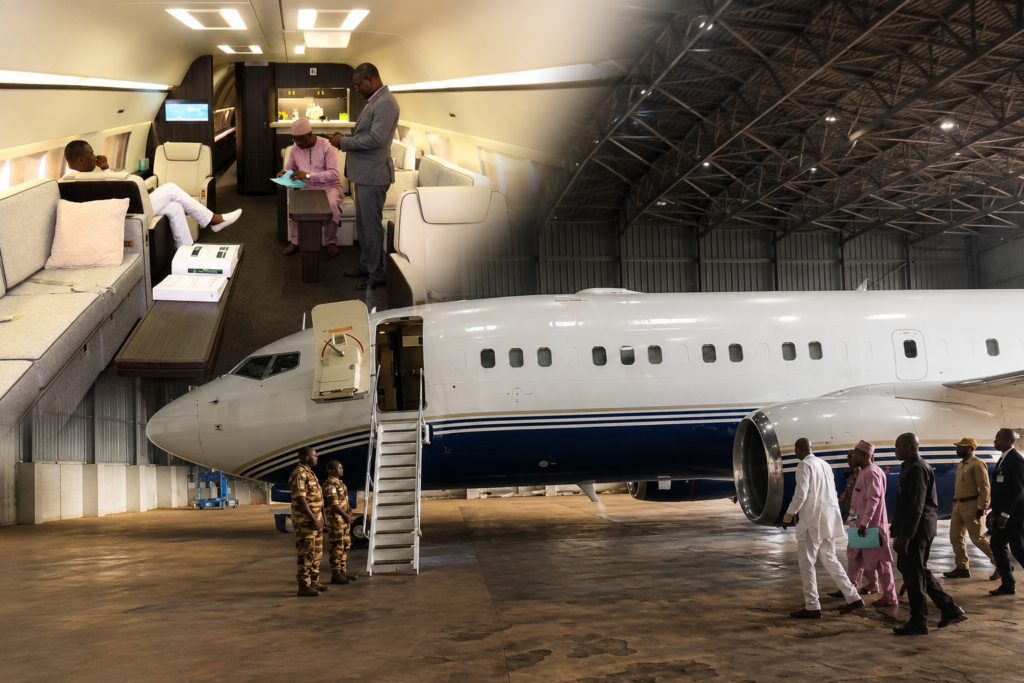
The unveiling of Mali’s newly acquired Boeing 737 presidential aircraft on national television last Wednesday has ignited a wave of public skepticism. Government officials framed the purchase as a financially sound decision, citing a net expenditure of approximately 6 billion West African CFA francs after accounting for insurance payouts and the resale of components from the previous aircraft.
Timing raises eyebrows in a country under strain
While authorities call for national resilience and shared sacrifice, the timing of this acquisition has drawn sharp criticism. The presentation of a state-of-the-art presidential jet, delivered at a moment when Mali grapples with escalating insecurity, economic hardship, and strained public finances, has left many questioning the alignment of governance priorities with the immediate needs of the population.
Across several regions, the security situation remains volatile. Military outposts continue to face attacks, road ambushes persist, and civilian casualties rise, reinforcing an environment of instability. Numerous communities remain isolated, as state institutions struggle to assert control over large parts of the territory.
Unmet security challenges fuel public discontent
Three years into the Transition, the government’s stated priority of reclaiming national territory remains an elusive goal.
In the northern reaches, the Cadre stratégique permanent, including the Front de Libération de l’Azawad (FLA), maintains a formidable operational capacity and contests control over key zones. Meanwhile, in central and southern Mali, the Jama’at Nusrat al-Islam wal Muslimin (JNIM) continues to expand its influence, launching repeated attacks on military installations, critical infrastructure, and state representatives. Several vital transport corridors remain perilous, crippling commerce, mobility, and economic activity.
This stark reality starkly contrasts with the image of strength and stability that the regime seeks to project.
Budget allocation in the spotlight
Though officials assert that the financial outlay was significantly reduced through compensatory measures, observers argue that billions in public funds could have been redirected toward more pressing needs, including:
Bolstering the operational capacity of Mali’s armed forces;
Acquiring armored vehicles, advanced communication systems, and protective gear;
Enhancing intelligence and aerial surveillance capabilities;
Supporting injured soldiers and the families of fallen personnel;
Addressing the needs of displaced populations and restoring damaged infrastructure.
The controversy extends beyond fiscal figures; it strikes at the heart of governance priorities.
Legitimacy built on austerity now under scrutiny
Since assuming power, the Transition authorities have cultivated legitimacy through a discourse of fiscal prudence and national service. However, the acquisition of a high-capacity presidential aircraft risks undermining this narrative. To many citizens, the purchase symbolizes a return to the very excesses associated with past administrations priorities that appear increasingly disconnected from the hardships endured by ordinary Malians.
The timing is especially jarring as economic pressures mount: rising living costs, tightening public finances, pressing social needs, and a sluggish economic landscape continue to weigh heavily on the population.
Diplomatic convenience vs. national sovereignty
Proponents of the aircraft argue that a modern presidential jet facilitates high-level diplomatic engagements, official missions, and international representation. Yet detractors contend that a nation’s credibility on the global stage is rooted not in the size of its presidential fleet, but in its ability to guarantee internal stability, protect its people, and uphold the functioning of its institutions.
For many, sovereignty is measured not by the luxury of state transport, but by the state’s capacity to assert control over its territory and secure the safety of its citizens.
Political symbolism fuels dissent
Within critical circles and opposition circles, the acquisition has become a potent symbol of perceived misplaced priorities. Some interpret it as evidence of a leadership more invested in its own mobility than in the mobility of the state. Others suggest that the long-range aircraft serves as both a prestige symbol and a potential lifeline for top officials in the event of a severe security deterioration an assertion that, while unproven, reflects the deep-seated mistrust surrounding the regime’s decision-making.
A governance milestone that tests public trust
The arrival of the Boeing 737 transcends a mere procurement decision. It has reignited a fundamental debate about the strategic direction of the Transition.
As security threats persist, attacks escalate, and economic hardships deepen, every high-profile expenditure is scrutinized with growing intensity. For many Malians, the true measure of sovereignty lies not in the modernization of state aircraft, but in the government’s ability to protect its citizens, restore its authority nationwide, and improve the daily lives of its people. Until these benchmarks are met, prestige investments risk being perceived as a widening gap between the priorities of power and the aspirations of the people.