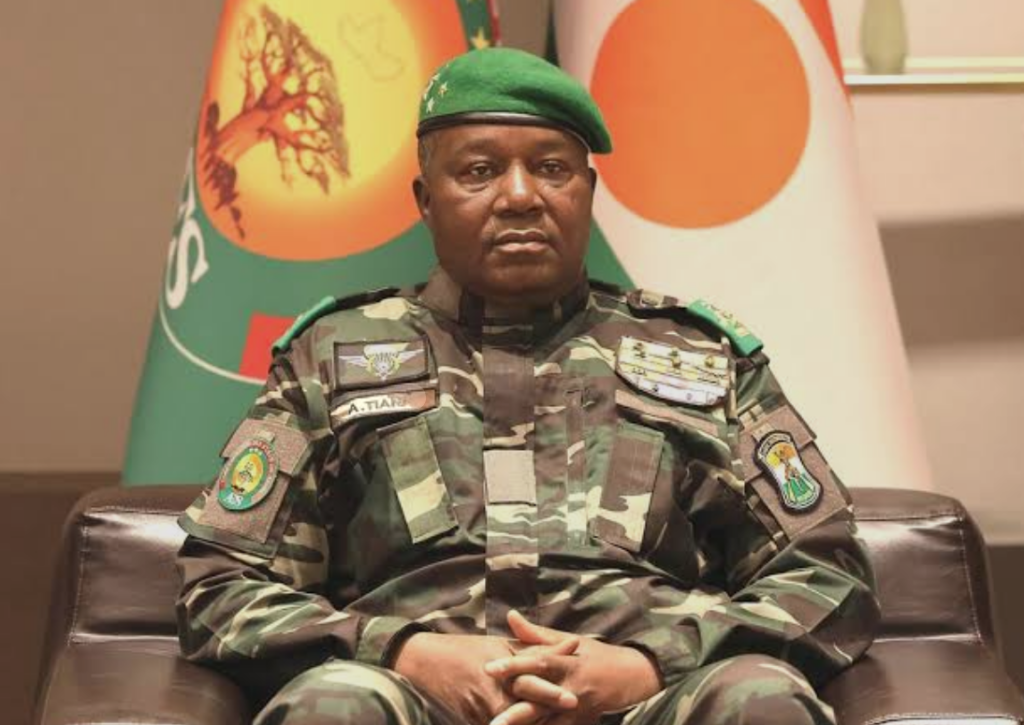
The abrupt removal of General Moussa Salaou Barmou from the top of Niger’s armed forces, coming just days after the failed putsch of 28-29 August, opens a far deeper question than the usual reshuffling of a military hierarchy. In this crisis, Barmou embodies a single fault line: how far can Niamey let a foreign force take part in a gunfight between Nigeriens?
The 11 September decree, and the silence wrapped around it
Moussa Salaou Barmou is no stranger inside the Nigerien army. A former commander of the special forces and chief of defence staff since 2023, he belongs to the tight military circle born out of Mohamed Bazoum’s overthrow. Until his departure, he was a central piece in the CNSP’s machinery of power.
On 11 September, Abdourahamane Tiani still chose to hand his post to General Mamane Sani Kiaou. The decree attached no official reason to the decision.
What that silence leaves wide open
Punishment? A tightening of political control? An effort to rebuild the chain of command after the mutiny? Or the fallout of deeper disagreement over how the military response should be handled?
One point stands firm: nothing in the public record supports the claim that Barmou took part in the attempt to bring down Tiani. Nigerien authorities have never publicly accused him of betrayal either.
The night of 28 August belonged to Nigeriens first
During the night of 28-29 August, dissident troops struck several strategic targets in Niamey, among them air base 101, the presidential palace and the premises of the public broadcaster.
The mutineers came in large part from the special forces and from garrisons in the country’s interior. For hours, the balance of forces stayed unclear. Some units went as far as refusing to join the assault against their own brothers in arms.
So the substance of the crisis was Nigerien above all else. Nigerien soldiers lined up against other Nigerien soldiers. Their grievances touched on power, on the way the war against armed groups is being fought, on living conditions for troops and, more broadly, on the state of the country.
And that is exactly where a decisive question surfaces: why did a foreign military power need to step directly into a confrontation inside Niger’s own forces?
Africa Corps: from security partner to player in the fighting
The answer is now documented. Russia’s Africa Corps gave decisive backing to the loyalist side.
Roughly 200 Russian personnel deployed at base 101 were involved in retaking the site, with ground and air support. Moscow itself has acknowledged that its soldiers assisted the response to the putsch.
Kamikaze drones, and the limits of what is known
Details that came to light around 14 September also indicate that Russian forces used kamikaze drones during the clashes. That aspect deserves cautious handling, because the operational picture remains only partly documented.
The political problem, however, is untouched by that caution. When foreign soldiers intervene in a confrontation between the troops of one and the same state, sovereignty can no longer be sidestepped.
Niger is entitled to invite foreign partners to fight the armed groups striking its territory. That is ordinary military cooperation. Striking Nigerien soldiers caught inside an internal political and military crisis is something of a different order altogether. At that point, a security partnership turns into direct participation in deciding which faction of the state apparatus gets to prevail.
If his men are to die, their commander should know
Here, the position attributed to Barmou takes on its full political weight.
A military commander can accept leading his soldiers into battle, and accept the risk of losing them. What is hard to imagine is that he would be kept away from the decisions that determine whether they live or die, particularly when foreign military assets are being turned against them.
If Nigerien soldiers are going to fall, their commander should know who is striking them, with what means and on whose order. That is a basic question of military responsibility.
Which is why reducing Barmou to a traitor or to a man who sold out would be far too easy. His removal can be read another way: as a sign of disagreement over the chain of command, over the terms on which foreign forces are deployed, or over the space granted to Africa Corps in Niger’s military affairs.
At this stage, though, that remains a hypothesis. No public document yet establishes that Barmou actually turned down a drone operation, or that he resigned for that reason.
Sovereignty proclaimed, sovereignty tested
The discussion should not stay stuck on one man’s fate. It should be about the political choice made by General Abdourahamane Tiani.
Since 2023, the CNSP has marketed itself as the defender of Nigerien sovereignty. It broke with France, demanded the withdrawal of American forces and deepened its alliance with Russia.
That sovereignty narrative becomes difficult to hold when, in an internal crisis, the government has to lean on a foreign force to regain control of a strategic military base.
The paradox is blunt: in the name of sovereignty, Niamey scaled back certain Western partnerships; in the name of regime survival, it now accepts direct Russian involvement in a face-off between Nigeriens. Such a contradiction deserves more than an official statement.
A general sidelined, questions that stay in place
Barmou has been replaced. General Kiaou now leads the armed forces. Officially, no explanation was attached to the reorganisation.
The timing, though, draws attention. Less than a fortnight after a mutiny laid bare deep fractures inside the army, the CNSP reshuffles two of the highest rungs of its military ladder.
The underlying problem does not disappear: the cohesion of the army, the accountability of command, the role played by foreign forces and, above all, the real sovereignty of Niger.
Salaou Barmou may not have been a hero. He has not been publicly established as a traitor either. He is now a general set aside, after a military crisis in which a Russian force helped crush a rebellion mounted by Nigerien soldiers.
The real subject is not whether to smear or sanctify Barmou. The real subject is whether, in Niger, the sovereignty proclaimed by the CNSP also applies when the survival of the government hangs in the balance. And on that point, General Tiani’s silence may weigh heavier than General Barmou’s exit.