Mali conflict escalation: jihadists and rebels push Bamako to the brink, civilians caught in the crossfire
The war in Mali enters a new phase with offensives targeting the north and then the capital. For residents, the threat expands as the junta hardens its response without restoring control.

How Mali’s war reshapes diplomacy
In Mali, one question now dominates: who still controls the ground, and at what cost to civilians? In the north and around Bamako, the answer depends less on a clear camp than on a tangle of rebellions, jihadist groups, government forces and external backers.
The Malian conflict is not recent. It traces back to the 2012 crisis, when the north fell to a Tuareg rebellion and jihadist expansion amid state collapse after the March 2012 coup. Since then, the war has changed form but never disappeared.
The army’s recapture of Kidal in November 2023 was a symbolic turning point. This northeastern town, a historic Tuareg rebel stronghold, was a fulcrum in the balance of power. Yet taking the town did not close the crisis. Instead, it fueled a new cycle of clashes and reprisals.
What the facts on the ground reveal
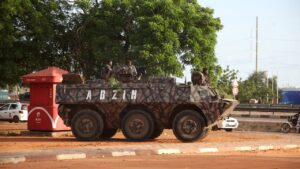
Since 2024, the situation has worsened. In September 2024, the GSIM, a jihadist group linked to Al-Qaeda, claimed attacks in Bamako near the Faladié gendarmerie school and the military airport. Then in spring 2026, a coordinated offensive again struck several sites across the country, reaching the capital.
At the same time, Malian authorities multiplied emergency measures. In early June 2026, they banned the sale and use of large motorcycles outside major cities and created military zones off-limits to civilians. The stated goal: to complicate attacks by mobile groups that often strike and vanish quickly.
For residents, the effect is immediate: riskier travel, a slowed local economy, and harder access to aid. The UN human rights office warned in May 2026 that the situation was rapidly deteriorating, with civilians killed, displaced, and cut off from food and assistance after the coordinated attacks.
The core problem remains military. The Malian junta wants to regain territorial control. Armed groups bank on attrition. Jihadists seek to weaken the state. Tuareg rebels claim Azawad, the northern region they want autonomous or independent. The two agendas are not identical, but they sometimes converge on the ground against Bamako.
Ukraine-France controversy: accusations, denials and power dynamics
Here the political reading blurs. In 2024, the Malian junta accused Ukraine of backing Tuareg rebels after a heavy defeat of Malian forces and Russian mercenaries near Tinzaouaten. Kyiv rejected those claims and said Bamako provided no evidence. The Azawad Liberation Front also denied receiving Ukrainian help.
This issue then served the junta to harden its rhetoric against Ukraine and its allies. But based on available information, it does not allow the conclusion that France is “in the same camp” as jihadists. On the contrary, known French official positions focus on support for Ukraine and the end of defense cooperation with Bamako, after Malian authorities denounced military agreements in 2022.
France has reduced then ended its military footprint in Mali after the break with the junta. This left a security vacuum that Bamako tried to fill by turning to Russia, first with Wagner and then with the Russian arrangements that succeeded it. That choice reinforced the junta’s sovereignist rhetoric but did not halt the insurgency.
Who wins, who loses
The junta gains politically when it frames the crisis as a war against external enemies and foreign plots. This narrative allows it to tighten national discourse, justify security restrictions, and solidify its support. But it does not address local fractures or daily insecurity.
Tuareg rebels gain when they appear as a force capable of retaking ground in the north. Their movement also benefits from the vacuum left by the departure of MINUSMA and the weakening of international arrangements. Yet their tactical, sporadic alliance with jihadist groups blurs their image and worries local populations.
Jihadists, finally, profit from chaos. They do not need to conquer Bamako to matter. They aim above all to exhaust the state, spread insecurity on roads, and show that the junta no longer controls everything. Experts and recent assessments indicate they now strike far from their original strongholds.
For civilians, the toll is heaviest. People in the north live with fighting, displacement, and fear of reprisals. In Bamako, the 2024 attacks shattered the idea of a protected capital. And the security announcements of 2026 show that the Malian state remains on the defensive.
What to watch now
The next question is not only military. It is also diplomatic. Watch the evolution of relations between Bamako, Kyiv, Moscow and West African capitals, as well as the junta’s real capacity to contain offensives from the GSIM and Tuareg rebels. What follows will tell whether Mali enters a phase of fragile stabilisation or a new escalation.