Ibrahim Traoré challenges silenced truths about arab slave trade in Sahel
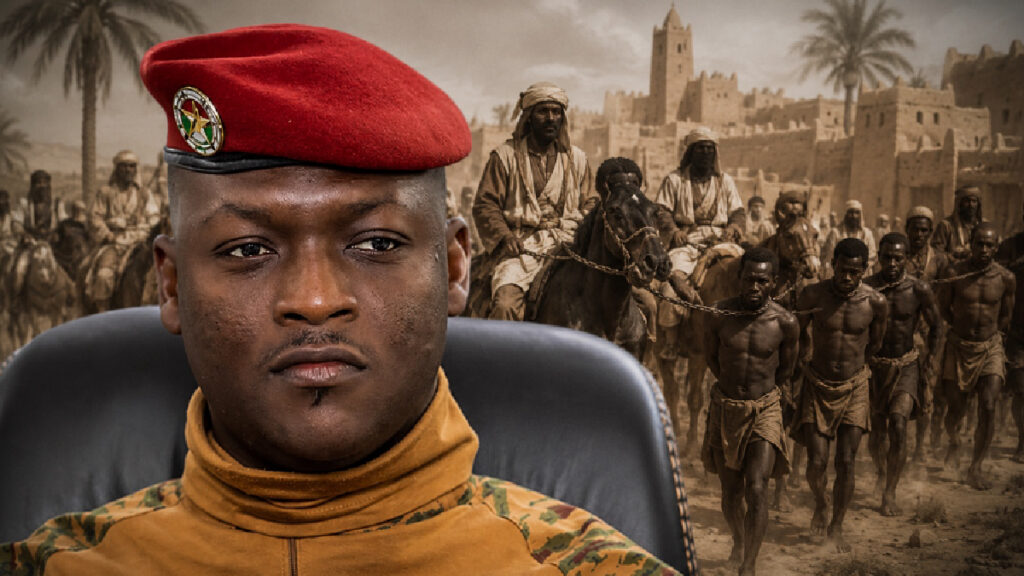
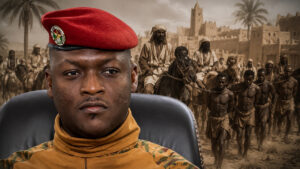
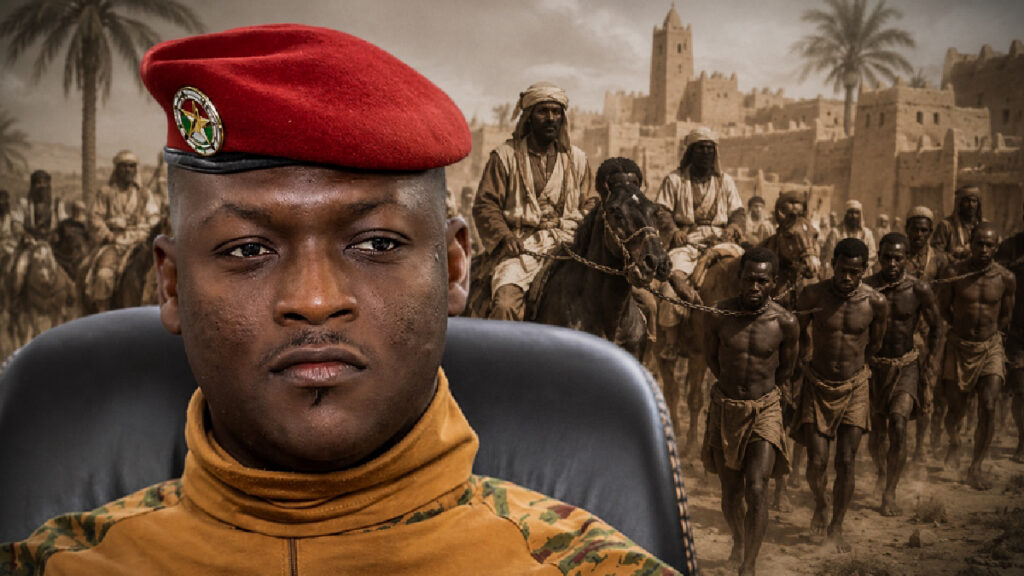
When Captain Ibrahim Traoré, Burkina Faso’s transitional leader, directly linked the region’s ongoing jihadist violence to the centuries-old Arab slave trade, he didn’t just spark controversy—he shattered a long-standing taboo that has shaped Sahelian politics for generations.
For over a thousand years, caravans carried millions of enslaved Africans from the Sahel’s heartland—near Lake Chad, Niger’s valleys, and Mali’s ancient cities—toward markets in Cairo, Tripoli, and Zanzibar. While the transatlantic slave trade has been widely documented and condemned, this eastern counterpart remains a glaring omission in both African and Western historical narratives. Why? Because acknowledging it forces a reckoning with an uncomfortable truth: political Islam, often framed as a force of anti-colonial resistance, has also been, throughout history, an instrument of racial subjugation.
Uncovering a millennia-old silence
Traoré’s remarks in Ouagadougou were not mere rhetoric. They exposed a deliberate amnesia that has allowed generations of African elites—both civilian and military—to sidestep a painful chapter. While the Atlantic slave trade has inspired reparations movements, museums, and global condemnations, the Arab-Muslim slave trade has been relegated to footnotes, if mentioned at all. Historians like Olivier Pétré-Grenouilleau have long documented this system using Ibn Battuta’s chronicles, Timbuktu’s manuscripts, and Sahelian sultanate archives. Yet no truth commission has ever convened in Agadez or Timbuktu. No national museum in the region dedicates space to this history. Why? Because confronting it risks alienating powerful allies—particularly in the Gulf—and disrupting the post-colonial narrative of a unified Black Africa united against former colonizers.
How political Islam inherited a legacy of conquest
The silence has come at a cost. By avoiding this history, African leaders have inadvertently ceded interpretive control to jihadist groups like those active in Mali and Niger. These organizations frame their violence as a rebellion against neo-colonialism, erasing their ideological roots in a tradition that, for centuries, justified domination through religious superiority. From the Almoravids to modern-day extremists, this narrative has been weaponized to legitimize conquest, subjugation, and enslavement under the banner of faith.
Traoré’s intervention was not just historical—it was strategic. By reframing the fight against terrorism as a struggle against an inherited system of racial oppression, he sought to rally rural communities, which have borne the brunt of jihadist violence while watching urban elites benefit from foreign (particularly Gulf) funding. His message was clear: the enemy is not just a foreign insurgent group—it is the heir of a centuries-old enterprise of domination.
A high-stakes gamble with regional consequences
Yet this approach is fraught with risks. By invoking the specter of Arab slavery, Traoré risks isolating Burkina Faso diplomatically. Gulf states, whose religious and financial influence has shaped Sahelian Islam for decades, may respond by tightening their grip on local religious institutions. Meanwhile, a segment of West African intellectuals could accuse him of dividing the Black African front against Western colonialism—a narrative that has long been central to pan-African solidarity.
Historically, African leaders have tread carefully around this topic. Traoré, however, chose confrontation over caution. His stance exposes the contradictions of Western memory politics, where condemnation of slavery is selective. Western institutions and universities have mastered the art of repentance—but only for the transatlantic trade. The Arab-Muslim slave trade, when acknowledged, is often framed as ancient history, not a living legacy with modern political implications.
Confronting uncomfortable truths
Traoré’s call for Africans to confront their own history—without waiting for apologies from former colonial powers—is as bold as it is rare. He is not asking for reparations or foreign validation. He is demanding intellectual sovereignty: the right to examine Africa’s past through its own lens, not through the distorting prism of Parisian salons or Gulf-funded narratives.
This independence is what unsettles Western observers the most. It signals that Africa is no longer content to let others dictate the terms of historical reckoning. It is a reminder that the continent’s future will be shaped by its ability to reclaim its own story—flaws, contradictions, and all.
The stakes for the Sahel
Traoré has taken a stand. But can Burkina Faso—and the wider Sahel—endure the fallout? A decade of asymmetric warfare has already drained the region’s resources and resilience. Reopening old wounds tied to slavery risks deepening divisions at a time when unity is most needed. Historians may argue that Traoré oversimplifies a complex tragedy. Politicians may accuse him of playing with fire. But one thing is certain: in the Sahel, as elsewhere, nations that fail to shape their own narratives are doomed to be shaped by others.
While European commentators debate repentance and intersectionality, a battle-hardened Sahelian soldier has just unlocked a cage that many thought was sealed forever. The truth, as Traoré reminds us, is a force that liberates—but in the Sahel, it is also a lion that must be tamed with care. Whether he has the strength to carry this burden remains to be seen. But one thing is clear: the guardians of political correctness will not forgive him.