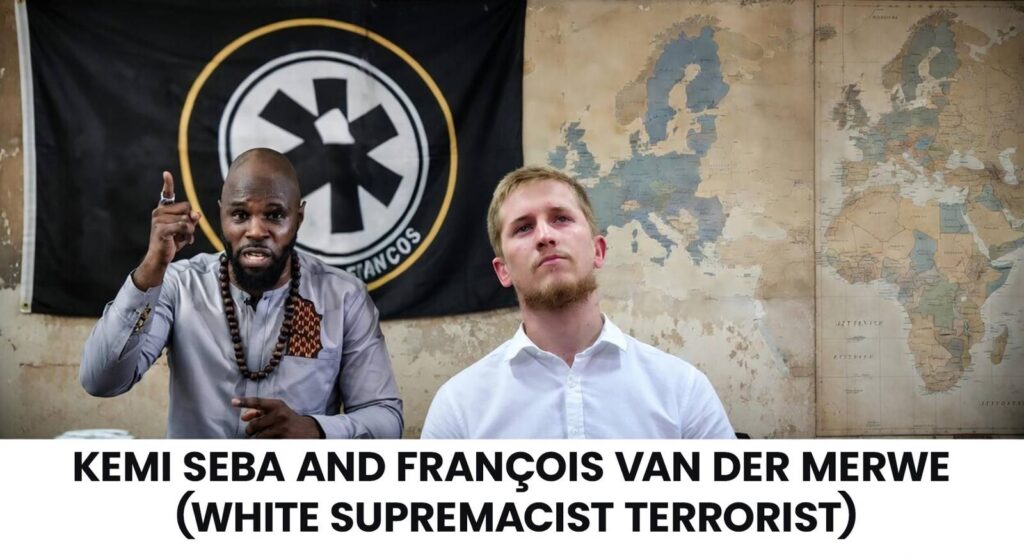
Some arrests are merely unexpected, while others serve as a profound revelation. The detention of activist Kemi Seba on South African soil on Wednesday, April 15, falls into the latter category. This incident has drawn intense scrutiny not only because of Seba’s own actions but because of the individual captured alongside him and the financial transaction that allegedly took place between them.
The man in question is François van der Merwe, a 26-year-old from Pretoria who serves as the head of the Bittereinders. This organization is not merely a political fringe group; it has been officially designated as a terrorist entity by South African authorities. To grasp the gravity of this association, one must look into the history and the radical objectives of the Bittereinders movement.
The roots of a radical ideology
The name “Bittereinders” is a reference to the final, uncompromising phase of the Second Boer War (1899–1902). During that conflict, the original Bittereinders were Boer guerrillas who refused to accept defeat or negotiate with British forces, viewing any form of surrender as a betrayal of their race and civilization. Van der Merwe’s modern organization has intentionally adopted this name to signal a continuation of that fanatical struggle.
The contemporary movement was sparked by the 2020 murder of Brendan Horner and the subsequent unrest in Senekal. Van der Merwe identified a perceived void in the national landscape for young Afrikaner men, which he filled with a movement rooted in a singular, extremist conviction: that Black political leadership in South Africa constitutes an existential threat to the Afrikaner people.
The vision of a racially exclusive Volkstaat
The Bittereinders’ agenda is stark and uncompromising. Van der Merwe campaigns for the establishment of a Volkstaat—a sovereign, racially exclusive state carved out of South African territory. In this proposed enclave, Black South Africans would be stripped of their citizenship and rights. This objective mirrors the demands of the most violent Afrikaner nationalist factions from the early 1990s, such as the AWB, who used bombings to attempt to derail South Africa’s transition to democracy.
Since the group’s formation in 2021, Van der Merwe has been a vocal critic of the post-Apartheid constitutional order, which he describes as an “occupation” rather than a democracy. He views policies intended to address historical economic disparities as forms of anti-white discrimination. Consequently, the State Security Agency has kept the Bittereinders under constant surveillance, particularly as they conduct paramilitary-style tactical training sessions and circulate footage of these operations online.
A history of violence and legal trouble
Van der Merwe’s personal legal record reflects the volatility of his movement. He has faced multiple arrests, including a 2023 assault charge and a 2024 incident where he led followers to break through police lines at a courthouse in Groblersdal. Despite these legal setbacks, he has used his time in custody to further radicalize his image, often quoting Afrikaner nationalist poetry to signal his commitment to the “struggle.”
It is this specific individual that Kemi Seba allegedly sought out for assistance. According to the Hawks, South Africa’s elite organized crime unit, Seba is suspected of paying Van der Merwe approximately 250,000 rands (roughly 13,000 euros). This payment was reportedly intended to facilitate an illegal crossing of the Limpopo River into Zimbabwe, allowing Seba and his son to eventually reach Europe.
The collapse of a political narrative
The legal implications for Kemi Seba are severe. Under South African counter-terrorism laws, providing funds to a designated terrorist organization—regardless of the reason—is a major criminal offense. Beyond the charges of illegal immigration and conspiracy, Seba now faces the potential charge of financing terrorism.
For a man who has built a global reputation as a champion of Pan-Africanism and a defender of Black dignity against Western systems of oppression, this alliance is catastrophic. By allegedly funding the leader of a movement that seeks to restore a form of Apartheid, Seba’s public persona has collided with a contradictory reality. The activist who claimed to fight for the sovereignty of the African continent is now accused of bankrolling a group that views the political existence of Black South Africans as an injustice to be corrected.
As the legal proceedings move forward, Kemi Seba faces a reckoning that is as much about his historical legacy as it is about his current criminal charges.