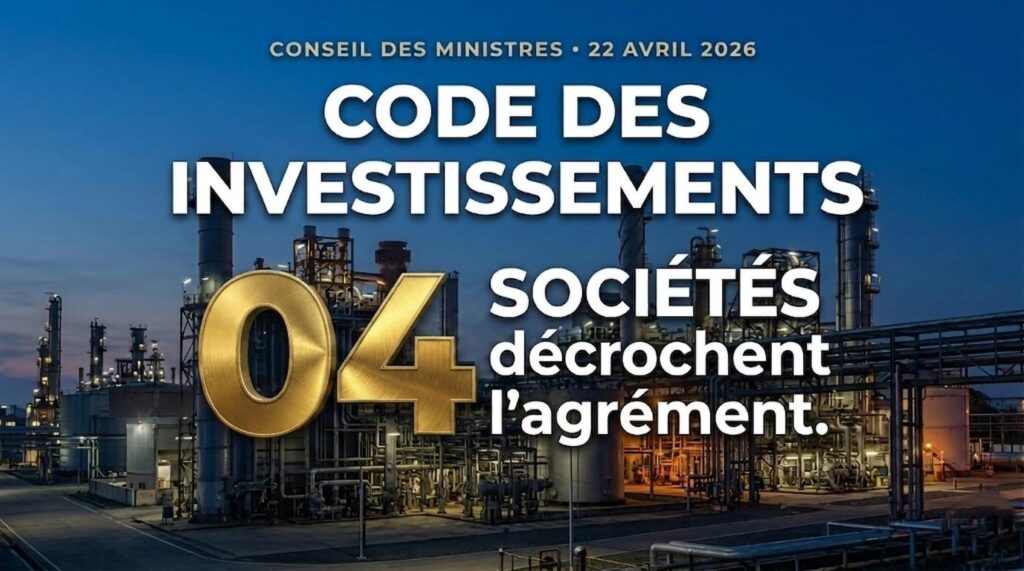
Following a cabinet meeting led by President Patrice Talon on Wednesday, April 22, 2026, the Beninese government authorized four major industrial entities to operate under the national Investment Code. These projects span various sectors, including water production, chemical manufacturing, and agribusiness, signaling a significant shift in the country’s productive capacity.
The Beninese administration is transparent about its goal to transform the nation into a regional industrial powerhouse. By granting these four companies access to preferential status, the state is providing tax breaks, customs exemptions, and administrative support to draw in capital and, most importantly, foster local employment.
Four sectors across strategic regional sites
The establishment of these units follows a strategy of territorial coverage and sector diversification:
- EAU TECHNOLOGIE ENVIRONNEMENT SA has been granted a specific investment status to scale up mineral water production in the Gakpé industrial zone, aiming to satisfy rising domestic needs.
- The construction industry will see a boost from SOCIÉTÉ BÉNINO-TUNISIENNE DE COMMERCE SARL. Operating under “Regime A,” this firm will set up a paint manufacturing plant in the strategic hub of Sèmè-Podji, a vital commercial crossroads.
- Soybeans, a cornerstone of Beninese agriculture, will be processed in Azonsa. BNS AGRI INDUSTRIE SARL, benefiting from “Regime B,” will convert soybean seeds into crude oil and meal, thereby strengthening the local agricultural value chain.
- Finally, the commune of Allada is set to welcome LIBS BENIN SARL. Also under “Regime B,” this industrial complex will produce both mineral water and canned beer to serve a rapidly expanding market segment.
Expected social and economic impact
Beyond the projected revenue, the social benefits of these investments are being closely monitored by the authorities. These initiatives are viewed as vital tools for generating both direct and indirect jobs for the youth of Benin.
By streamlining these installations, the state reaffirms its commitment to a structural economic overhaul. The objective is to transition from a model reliant on imported goods to a competitive “Made in Benin” production ecosystem.