The economic outlook for January 2026 reveals a stark reality for the West African Economic and Monetary Union (WAEMU). Although the regional banking sector has reached significant growth milestones, it is increasingly threatened by rising financial risks. At the center of this turbulence is Niger, which has recorded a record level of non-performing loans, highlighting a widening economic gap within the region.
Niger: A critical peak in asset degradation
As the Union strives to maintain financial equilibrium, Niger presents the most concerning indicators in the zone. Despite a marginal improvement in its figures, the country remains the most vulnerable link in the regional banking framework.
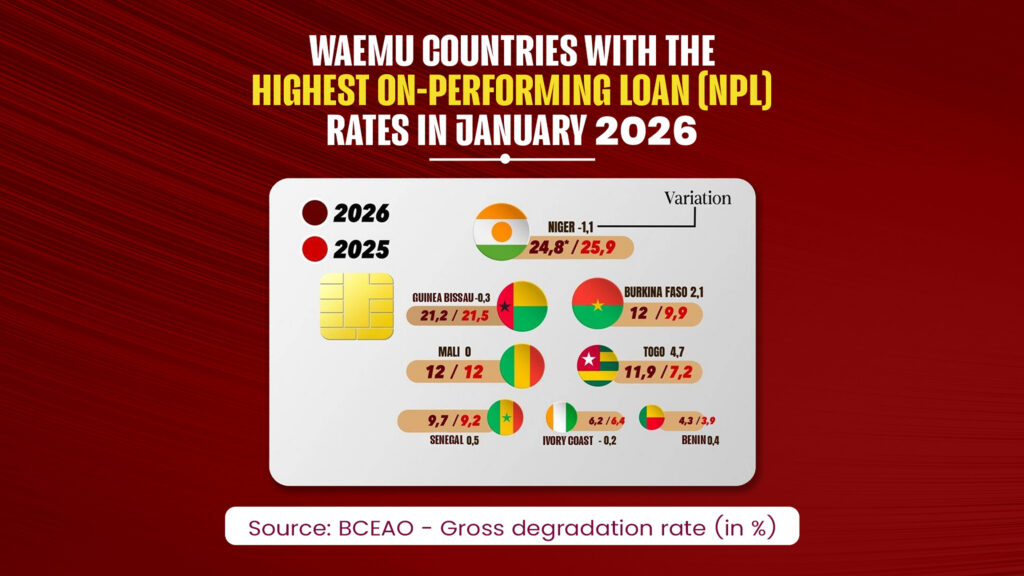
- A dominant share of defaults: With a gross degradation rate of 24.8% in January 2026, Niger holds the highest percentage of bad debt. In practical terms, nearly one out of every four loans issued in the country is currently in default.
- Deep-seated vulnerability: While this figure shows a slight decrease from the 25.9% recorded in 2025, the massive discrepancy compared to regional averages points to extreme risk exposure, driven largely by political instability and security challenges.
A divided union: The Sahelian fracture
Data from early 2026 confirms a distinct separation between coastal economies and the Sahelian bloc, where Niger serves as the focal point of the credit crisis.
1. The Sahelian bloc under pressure
Beyond Niger, other Sahelian nations are seeing their financial health indicators decline:
- Mali and Burkina Faso: Both nations have reached a 12% default rate. Burkina Faso is of particular concern, experiencing a sharp increase of 2.1 percentage points within a single year.
- Guinea-Bissau: The country remains in a high-risk zone with 21.2% in unpaid debts.
2. The relative stability of coastal nations
In contrast, coastal countries generally maintain better portfolio quality, though some fluctuations exist:
- Benin: Stands as the union’s top performer with the lowest default rate at 4.3%.
- Ivory Coast and Senegal: Both show relative resilience with rates of 6.2% and 9.7%, respectively.
- The Togolese exception: Togo has broken the coastal trend, witnessing a massive surge in defaults from 7.2% to 11.9%, an increase of 4.7 points.
Global overview: Record lending overshadowed by caution
While total outstanding credit to the economy surpassed the historic threshold of 40,031 billion FCFA (a 4.7% year-on-year increase), the momentum is being hampered by rising caution.
The total volume of non-performing loans has reached 3,631 billion FCFA. Furthermore, the coverage ratio has slipped to 59%, indicating that banks are struggling to provision for losses as quickly as new defaults emerge.
Shift in banking strategy
Faced with the deteriorating risk profiles of countries like Niger, financial institutions have adjusted their approach:
- Stricter requirements: Banks are demanding higher personal contributions and more rigorous guarantees.
- Increased selectivity: Financial establishments are now prioritizing balance sheet security over credit expansion, a move that could potentially restrict funding for local small and medium-sized enterprises (SMEs).
As 2026 begins, the WAEMU banking system finds itself at a crossroads. While the overall structural integrity remains intact, the situation in Niger and the spreading risk across the Sahel demand constant vigilance to prevent a broader regional liquidity crisis.