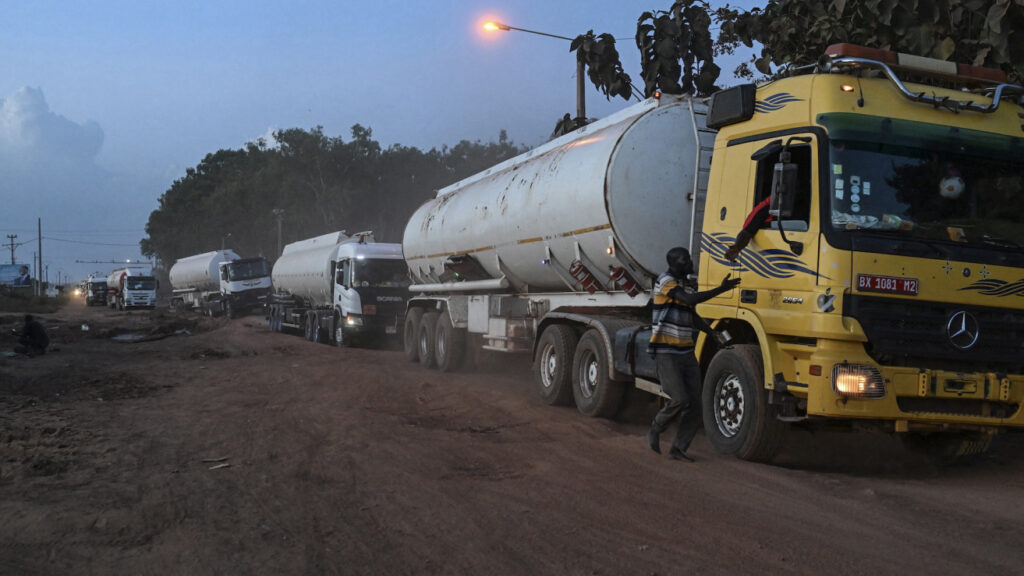
Malian tankers trucks drives at the entrance of Boundiali, northern Ivory Coast, on October 30, 2025 on the way to Yamoussoukro and Abidjan to load oil. In northern Ivory Coast, truck drivers prepare to head back to neighbouring Mali, aboard their tanker trucks loaded with fuel and anxiety. One acronym strikes fear into the hearts of all the truck drivers: JNIM, the name of the jihadist group affiliated with Al-Qaeda that decreed two months ago that no more tanker trucks would be allowed to enter Mali from a neighboring country. Since then, hundreds of trucks have been set ablaze, selling fuel from Abidjan or Dakar, and are part of JNIM’s economic jihad strategy, which aims, among other things, to strangle Bamako and the ruling military junta. In 2023, more than half of the petroleum products exported by Côte d’Ivoire were destined for Mali. Malian trucks load up in Yamoussoukro or Abidjan before crossing one of two corridors into the country: the Tengréla corridor or the Pogo corridor, where military escorts take over on the Malian side, all the way to Bamako. An escort can consist of several hundred tankers. But even under escort, convoys are frequently targeted. The most dangerous areas in southern Mali are the Kadiana-Kolondiéba and Loulouni-Sikasso axes. (Photo by Issouf SANOGO / AFP)
JNIM blockade intensifies security and trade challenges across west africa
Recent terrorist actions in Mali have significantly disrupted vital commercial arteries linking coastal and Sahelian nations.
chercheur boursier Bosch, bureau régional pour l’Afrique de l’Ouest et le Sahel, ISS
On April 25, Mali experienced a series of coordinated assaults carried out by the Jama’at Nusrat al-Islam wal Muslimin (JNIM) and the Azawad Liberation Front (FLA). These operations, which targeted the cities of Kati, Mopti, Sévaré, Gao, and the capital, Bamako, resulted in numerous casualties and tragically led to the assassination of Sadio Camara, the Minister of Defense.
In response, Malian authorities initiated a robust counter-offensive against the positions held by these groups. The military prosecutor in Bamako also confirmed the apprehension of several suspects, including civilians, active-duty military personnel, and individuals previously discharged from the army.
Just five days after the initial attacks, the JNIM imposed a blockade on the capital, specifically targeting routes situated in the western part of the country. The complete obstruction of the road connecting Kita to Bamako left hundreds stranded and severely complicated the delivery of essential food and water supplies.
This siege has also significantly disrupted commercial flows, bringing all traffic on the Kayes-Bamako axis to a halt. Furthermore, the expansion of the blockade now includes attacks on transport convoys along the Conakry-Bamako route, a corridor that had previously been considered relatively secure.
|
Mali and its coastal neighbors
|
Since September 2025, the JNIM has systematically targeted fuel convoys along strategic supply routes in western and southern Mali. These escalating attacks are destabilizing crucial commercial exchanges and, if allowed to expand further, threaten to severely impact the economies of West Africa.
West African nations are intrinsically linked through their vibrant commercial networks. The ports of coastal states serve as the primary gateways for imports and exports for the landlocked countries of the Central Sahel. Consequently, the road corridors connecting these ports to Sahelian capitals and beyond function as vital lifelines, many of which unfortunately traverse areas where JNIM operates.
The Dakar-Bamako corridor stands as a strategic artery for both Senegal and Mali, and it currently appears to be the most severely affected by the pervasive insecurity gripping western Mali.
In 2024, Mali was Senegal’s leading client, accounting for a substantial 26.5% of Senegalese exports, valued at approximately 802.8 billion FCFA (1.42 billion dollars). During the first nine months of 2025, cumulative Senegalese exports to Mali reached an estimated 662 billion FCFA (1.17 billion dollars).
Data from Senegal’s Directorate of Forecasting and Economic Studies (2025) indicates that JNIM attacks in western Mali have had a profound impact on trade between the two nations compared to 2024 levels. Between September and November 2025, the port of Dakar recorded a daily blockage of approximately 120 containers destined for Mali, resulting in an estimated monthly loss of 15 billion FCFA (26.54 million dollars) for Senegal. By the end of November 2025, over 2,000 containers remained immobilized in Dakar. In February 2026, roughly 4,000 empty containers were stranded in Bamako, as truck drivers hesitated to undertake the perilous return journey to Dakar.
This critical situation has drastically reduced Mali’s supply of petroleum products, refined goods, hydraulic cement, and foodstuffs. It also severely threatens the livelihoods of thousands of drivers, traders, and freight forwarders. Other vital corridors, particularly those connecting the ports of Côte d’Ivoire, Ghana, Togo, and Bénin to the Sahel, face similar escalating risks.
In 2025, Mali maintained its position as Côte d’Ivoire’s primary client within the West African Economic and Monetary Union (UEMOA). The Abidjan-Bamako corridor is indispensable for supplying Mali with petroleum and food products. By the end of 2025, approximately 1.47 million tons of goods had transited this route, which is now increasingly targeted by JNIM attacks in the Sikasso region.
Côte d’Ivoire also serves as Burkina Faso’s top African supplier, primarily providing petroleum products, electricity, and fertilizers. Burkina Faso’s imports originate from, or transit through, Côte d’Ivoire, Ghana, and Senegal. On February 14, seven Ghanaian tomato traders were killed during a JNIM attack in Titao, northern Burkina Faso, starkly illustrating the security risks on the road connecting the two countries. Currently, the terrorist threat is most pronounced within Malian territory, prompting authorities to implement several countermeasures. Since November 2025, fuel convoys have benefited from military escorts, enabling 200 to 300 tanker trucks to enter weekly, a significant drop from the nearly 1,200 trucks that transited before the attacks began.
The Malian government has entered into a memorandum of understanding with Malian petroleum groups to streamline and expedite customs procedures. A fuel rationing system has been established to combat black market activities. Authorities are also actively exploring options to alleviate pressure on the ports of Dakar and Abidjan by redirecting a portion of commercial flows to alternative port infrastructures.
A reported truce between Bamako and jihadist groups, said to last until Eid al-Adha in exchange for the release of over a hundred prisoners accused of terrorism, was quickly overshadowed by continued attacks. Malian authorities subsequently officially refuted the existence of any such agreement.
The April 25 attacks underscore the limitations of the military-centric response favored by Malian authorities in confronting terrorism. While JNIM and FLA successfully set aside their differences to execute these large-scale offensives, Sahelian and coastal states continue to struggle in forging robust alliances.
The regional repercussions of the JNIM-imposed blockade highlight the urgent need for a unified, joint protection strategy for cross-border commercial corridors. Governments and regional organizations, including the Economic Community of West African States (ECOWAS), the Alliance of Sahel States (AES), the Conseil de l’Entente, the Mano River Union, and UEMOA, must act decisively to prevent the expansion of this phenomenon to other critical road axes.
Indeed, the collective fight against terrorism could serve as the crucial catalyst for an essential revitalization of regional cooperation among the Sahelian and coastal states of West Africa.