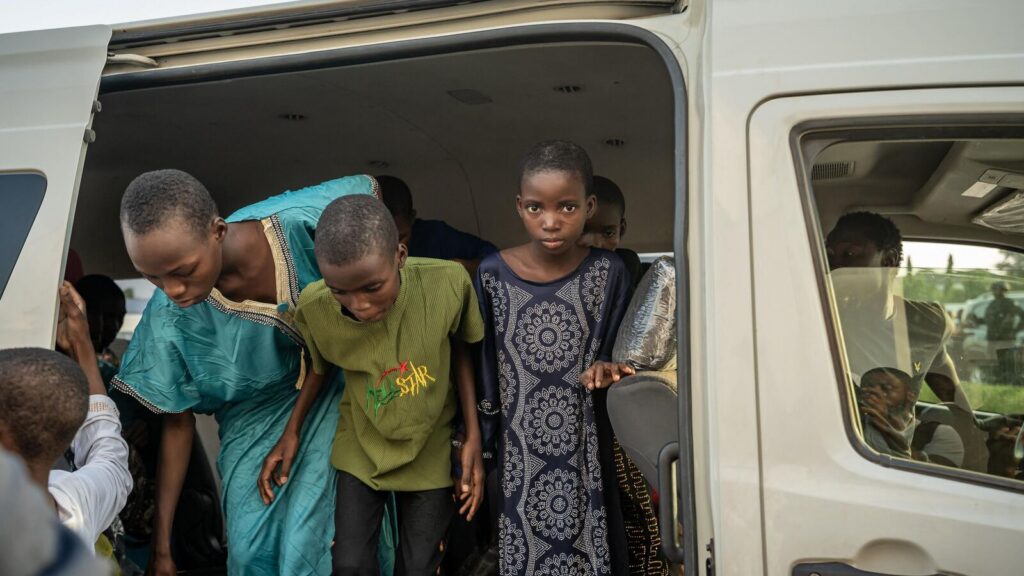
(FILES) Schoolchildren leave a minibus as they arrive at the local Governor's office in Minna on December 8, 2025. Around a hundred schoolchildren who were abducted last month by armed men from a Catholic school have arrived at the government headquarters in Minna, the capital of Niger State in central-northern Nigeria, as observed by AFP journalists on Monday. However, the fate of the 165 others abducted with them remains unknown. The students, mostly aged between 10 and 17, arrived in five white buses escorted by about ten military and armored vehicles and were received by Niger State Governor Mohammed Umaru Bago. (Photo by Light Oriye Tamunotonye / AFP)
Borno State, Nigeria — Hundreds of civilians abducted earlier this year by the jihadist group Boko Haram in Nigeria’s volatile Borno State have been freed, military officials confirmed Saturday. Among those rescued were 416 women and children from the village of Ngoshe, near the Cameroon border, though two infants perished during their prolonged captivity.
The Nigerian Armed Forces announced the liberation of 360 individuals following a carefully planned operation driven by intelligence and psychological tactics. According to military reports, the victims had been held in harsh conditions after being seized from multiple communities, particularly in the Ngoshe area.
Boko Haram’s long-running insurgency, which began in 2009, has devastated Nigeria’s northeastern region, claiming tens of thousands of lives and displacing millions. The group’s brutal tactics include mass abductions, often used to extract ransoms or exert control over local populations.
Operation succeeds amid persistent threats
Military sources revealed that the rescue mission relied on advanced intelligence gathering and psychological operations to sow discord among insurgents before launching the assault. The operation targeted hideouts where hostages were reportedly held in deplorable conditions.
Two infants, too weak to survive the ordeal, succumbed to exhaustion, according to Daniel Bwala, spokesperson for President Bola Tinubu. Authorities confirmed the death toll but did not disclose further details about the circumstances of their demise.
Controversy over ransom payments
The release of captives through negotiations has become a recurring strategy for Boko Haram, with reports suggesting that both families and government intermediaries have paid substantial sums to secure freedom for abducted relatives. Between July 2024 and June 2025, an estimated $1.66 million was reportedly paid to various armed factions, including jihadist groups, bandits, and separatist militias, according to security analysts.
While officials deny government involvement in ransom deals, local youth leaders and community representatives have played a pivotal role in brokering releases. The Borno South Youth Alliance (BOSYA), for instance, facilitated the liberation of 416 individuals from Ngoshe, though the exact terms of their freedom remain undisclosed.
Ngoshe, situated in the Gwoza Hills—a historic stronghold of Boko Haram—has been repeatedly targeted by the group, underscoring the persistent insecurity in the region. The village’s proximity to the Cameroonian border has made it a flashpoint for cross-border attacks and kidnappings.