Libreville, Monday 8 June 2026 – The bet may seem audacious. Yet it is now at the heart of Gabon’s economic strategy.
As the country aims to drastically reduce its dependence on food imports and end the massive influx of foreign broiler chickens by 2027, the battle is now being fought far from markets and ports. It is taking place in the experimental fields of the National Centre for Scientific and Technological Research in Kougouleu.
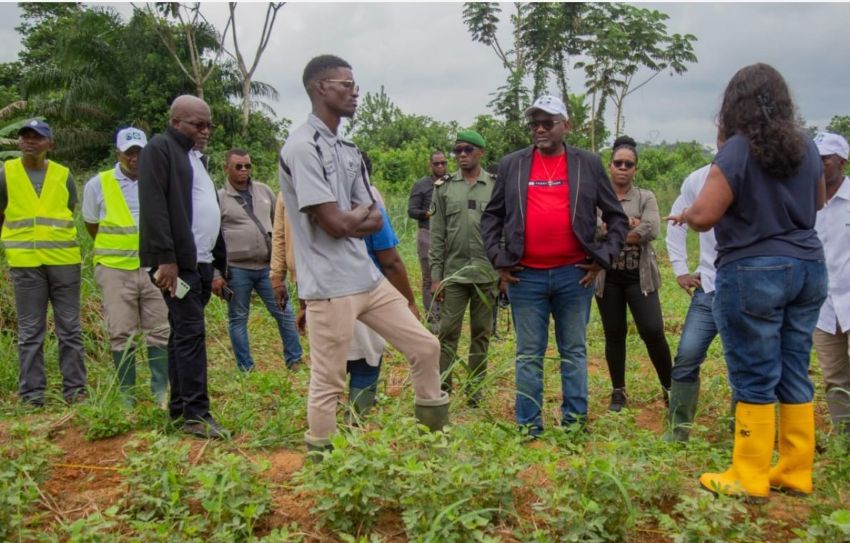
The visit by the Minister of Higher Education, Scientific Research and government spokesman, Charles Edgar Mombo, to this strategic site marks far more than a simple administrative inspection. It reveals a new direction where scientific research becomes a direct tool for economic transformation and a lever for national sovereignty.
In a country where food imports still absorb a significant share of external spending, the ability to locally produce the raw materials needed for livestock farming now appears as strategic an issue as mining or energy exploitation.
Research at the heart of the national project
The objective set by the authorities is clear: build a poultry sector capable of meeting national demand while gradually reducing imports.
To achieve this ambition, the question of animal feed is central. Maize and soya are indeed the main components of feed used in industrial poultry farming. As long as these raw materials remain largely imported, the sector’s autonomy remains fragile.
In Kougouleu, researchers at CENAREST are working precisely on this equation. Eleven varieties of maize are currently being tested in experimental programmes designed to identify the seeds best suited to Gabon’s soil and climate conditions.
The stakes go far beyond simple agricultural performance. It is about selecting varieties capable of providing sufficient yields to sustainably feed a growing national poultry industry.
The scientific teams have also begun trials on eleven varieties of soya introduced through international cooperation with research centres in Malawi. Additional experiments are being carried out in the Nyanga province, notably in Tchibanga, to evaluate performance according to the country’s different ecosystems.
This approach reflects an important shift. Long perceived as a sector remote from immediate economic concerns, research is now becoming an operational player in development.
The ambition of an integrated sector
The government strategy is based on a simple logic: produce locally the essential inputs for livestock farming in order to reduce production costs and strengthen the competitiveness of Gabonese producers.
This vision aligns with a trend observed in several African countries facing exploding food bills. According to international institutions, dependence on imports remains one of the main factors of economic vulnerability on the continent.
Gabon nevertheless has considerable assets: fertile land, abundant water resources and climatic conditions favourable to many crops.
For Charles Edgar Mombo, the results observed in the field already demonstrate the country’s potential. The minister praised the commitment of researchers and highlighted the ability of the national higher education system to concretely support the major guidelines set by President Brice Clotaire Oligui Nguema.
Beyond the agricultural aspect, the message is political. Science is no longer called upon solely to produce knowledge. It must now directly contribute to national priorities.
Sovereignty still to be built
The advances recorded are encouraging. However, they should not mask the challenges that remain.
The researchers themselves stress the need to expand experimental areas in order to improve the quality of trials and increase production volumes. The transition from scientific experimentation to industrial production is often the most delicate step.
The financial challenge also remains significant. Agricultural modernisation requires massive investments, adapted infrastructure, accessible financing mechanisms for producers, and better organisation of value chains.
But for the first time in a long while, Gabon seems to be engaging in a coherent reflection linking research, agriculture, industry and economic sovereignty.
The ministerial visit to Kougouleu thus symbolises a paradigm shift. In the new vision promoted by the authorities, food independence will not only be the result of investments or administrative decisions. It will also pass through laboratories, research centres and scientific innovation.
By 2027, if objectives are met, Gabon could demonstrate that in Africa, food sovereignty is built as much with researchers as with farmers. A silent but potentially decisive transformation for the country’s economic future.