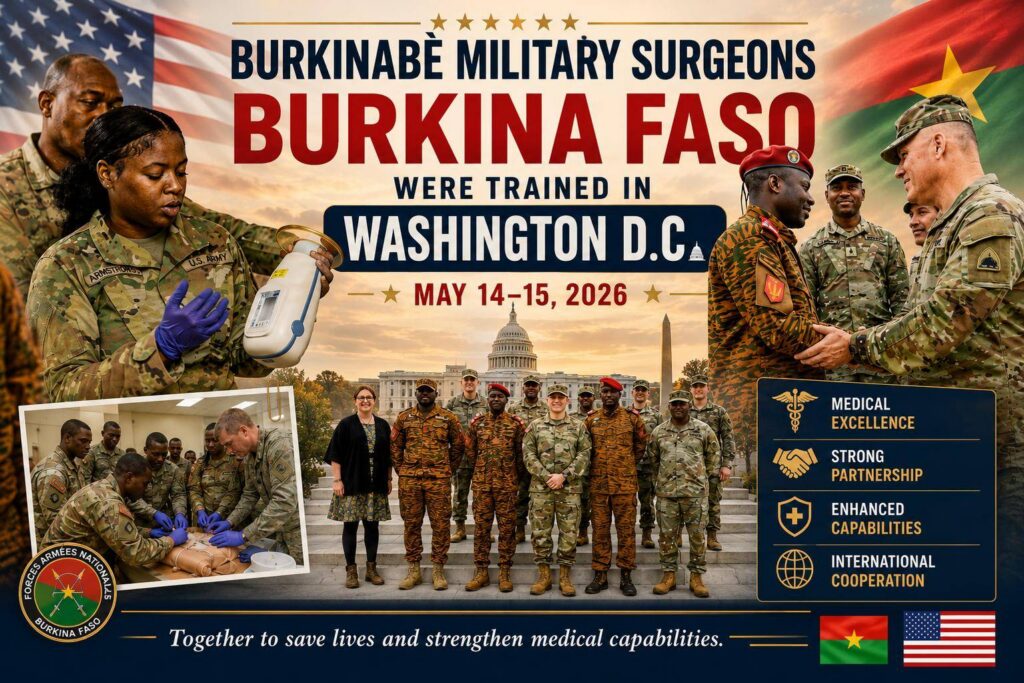
Despite the increasingly hostile official rhetoric towards Western powers within the Alliance of Sahel States (AES), the reality on the ground and technical cooperation tells a more nuanced story. On May 14 and 15, 2026, Burkinabe military surgeons took part in a high-level exchange session with the United States National Guard in Washington, D.C., under the State Partnership Program (SPP). The US Embassy in Ouagadougou announced this medical meeting on June 6, 2026. It raises a key question: why, at a time of strategic rapprochement with Moscow, do Sahel states continue to rely on the expertise of traditional partners they publicly criticize? This is an exploration of a Sahelian paradox.
A discreet but highly strategic medical mission
Through a sober statement on June 6, 2026, the US diplomatic mission in Ouagadougou informed the public. In mid-May, a delegation of Burkinabe armed forces surgeons spent two days in the US federal capital. The mission fell under the State Partnership Program (SPP), a cooperation mechanism linking US National Guard capabilities with those of partner countries. Over two days, Burkinabe and American specialists exchanged expertise on treating war wounds, combat trauma, and managing surgical emergencies in hostile environments. In a national context marked by an exhausting asymmetric conflict, this direct skills transfer is a vital asset for the survival of soldiers on the Burkinabe front.
The AES paradox: between sovereignty discourse and technical pragmatism
This trip to Washington shines a harsh light on a major contradiction in current Sahel geopolitics. Since the formation of the Alliance of Sahel States (AES), grouping Burkina Faso, Mali, and Niger, political discourse has hardened towards the West. Transition authorities in the region regularly accuse Western powers, especially France and sometimes its allies, of passivity or even complicity and indirect support for the terrorist groups plaguing the Sahel. Yet behind the scenes, the channel of technical cooperation with the United States remains not only open but active. How can senior Burkinabe officers travel to the heart of American institutions while the official AES doctrine advocates a break with old influence patterns? This tightrope walk shows that, faced with the harsh realities of war, operational pragmatism sometimes overrides ideological posture.
Why the Russian alternative finds limits in war medicine
Since the break with France, Ouagadougou and its AES neighbors have massively invested in their partnership with the Russian Federation. Moscow provides combat equipment, air platforms, instructors, and direct security assistance on the ground. So why not turn to the Russians for this surgical training? The answer lies in the very nature of the traditional partnership and the structure of Western militaries. The US National Guard, through the SPP, possesses a highly effective combat medicine model, honed by decades of overseas interventions and documented to global academic standards. Moreover, Western military medicine enjoys historical continuity with African armies: evacuation protocols, equipment formats, and the initial training of Burkinabe doctors are historically compatible with Western standards. In military health and combat life-saving, the Russian offer, more focused on pure tactical support and hard security, is for now less adapted or less structured to meet these specific advanced needs.
A shadow diplomacy mutually beneficial
For Washington, maintaining this program is a golden opportunity to keep a foothold in Burkina Faso and, by extension, in the AES space. As US influence wavers in the region, illustrated by the forced withdrawal of their troops from neighboring Niger, medical diplomacy allows preserving a trust link with the Burkinabe military elite without stirring public opinion. For Captain Ibrahim Traoré and the Burkinabe command, this discreet collaboration is proof that Burkina Faso refuses total isolation. While reaffirming a façade of sovereignty and an unwavering alliance within the AES, the Burkinabe authorities know how to capitalize on the best of each bloc to strengthen troop effectiveness.
A sovereignty with variable geometry?
Ultimately, this exchange session in Washington reminds us that Sahel geopolitics is not just about rupture declarations and protest slogans. Behind the communication war and the game of global alliances, the priority remains the survival of the Burkinabe state against terrorism. By accepting to train its surgeons with the US National Guard, Burkina Faso chooses medical effectiveness over political consistency. A life-saving paradox for wounded soldiers, but it shows that in the art of war, health diplomacy follows far more pragmatic rules than the politics of podiums.