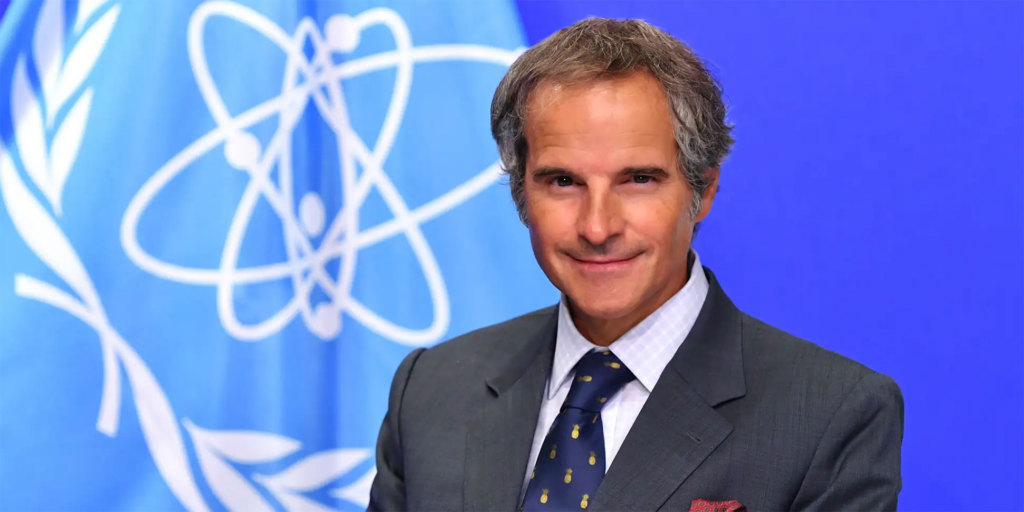
Buenos Aires formally approached Rabat to secure its endorsement for Rafael Grossi’s bid for the Secretary-General position of the United Nations (UN). This significant request was made during the eighth meeting of the joint commission and the sixth session of political consultations between Argentina and Morocco, which convened on June 11 in the Argentinian capital.
The administration of President Javier Milei aims to see the current Director General of the International Atomic Energy Agency (IAEA) succeed António Guterres. Argentina is actively working to garner support from Morocco, whose diplomatic influence across Africa and within various multilateral forums lends considerable weight to its backing, extending beyond mere bilateral considerations, according to a report from the Argentinian Ministry of Foreign Affairs.
The appeal was made during discussions led on the Argentinian side by Roberto Salafia, Undersecretary for International Economic Negotiations and Integration, and Juan Manuel Navarro, Undersecretary for Foreign Policy. Representing the Kingdom, Fouad Yazourh, Director General of International Political Affairs at the Moroccan Ministry of Foreign Affairs, headed his delegation. Both parties thoroughly reviewed their political relationship, key international issues, and potential avenues for expanding their cooperation.
Buenos Aires presented the candidacy as “one of Argentina’s primary diplomatic priorities within the multilateral system, championed by a seasoned official adept at navigating international crises, facilitating dialogue among major powers, and leveraging the mechanisms of international organizations.” This outreach to Rabat inaugurates a decisive African chapter in Argentina’s campaign, given that the appointment of the next Secretary-General first requires a recommendation from the Security Council, followed by a formal nomination by the General Assembly.
Moroccan influence sought in the security council contest
Since assuming leadership of the IAEA in 2019, Rafael Grossi has built a formidable international reputation. His stature grew through his critical involvement in monitoring nuclear facilities in conflict-prone regions, his contributions to discussions concerning Iran’s atomic program, and his dedicated efforts to ensure the safety of Ukrainian nuclear power plants amidst the Russia-Ukraine war. Argentina officially announced his candidacy for late 2025, subsequently launching a broad campaign to engage governments across multiple regions.
The decision to approach Morocco stems from precise diplomatic calculations. The Kingdom maintains an active presence within international institutions, boasts an extensive network across Africa, and engages in dialogue with pivotal global decision-making centers. The Argentinian side believes that “Moroccan support could significantly enhance Mr. Grossi’s credibility on the African continent and foster convergences with states poised to play a crucial role in both the Security Council and the General Assembly.”
The competition for the top UN post features several prominent figures from Latin America and Africa. Former Chilean President Michelle Bachelet has already secured the endorsement of Brazil. Other notable contenders include Rebeca Grynspan of Costa Rica, Secretary-General of the United Nations Conference on Trade and Development (UNCTAD), Ecuador’s María Fernanda Espinosa, and former Senegalese President Macky Sall. This diverse field of candidates underscores the necessity for Buenos Aires to cultivate support far beyond its immediate regional neighbors.
Argentinian diplomacy highlights Mr. Grossi’s robust technical and political credentials. His tenure at the helm of the IAEA has granted him access to the most sensitive negotiations concerning proliferation, nuclear security, and armed conflicts. Buenos Aires positions him as “a diplomat capable of engaging major powers, preserving channels of dialogue during periods of heightened tension, and restoring a more decisive political capacity to the UN.”
Within this strategic framework, Morocco occupies a singular position. Its significant standing in the Maghreb, its extensive relationships with numerous African states, its active participation in multilateral institutions, and its partnerships with Europe, the United States, and Southern powers collectively establish it as a highly sought-after interlocutor. Rabat’s endorsement would provide Argentina with a vital political conduit in a region where the accumulation of votes could prove decisive.
Bilateral trade projected to hit $1.092 billion by 2025
The consultations in Buenos Aires also served to broaden the scope of economic dialogue between the two nations. Trade exchanges between Argentina and Morocco reached an impressive $1.092 billion in 2025, positioning the Kingdom as Argentina’s second-largest African market for exports. The delegations meticulously explored strategies to increase the proportion of higher value-added products and to unlock new avenues for cooperation.
Key sectors such as agriculture, energy, health, tourism, food safety, and air connectivity were central to the discussions. Officials underscored “the imperative to establish a more robust structure for bilateral trade, to foster closer collaboration between relevant administrative bodies, and to encourage joint projects in areas where both economies possess immediate complementarities.”
For Argentina, Morocco represents a valuable market, a strategic gateway to the African continent, and a crucial political ally. Morocco’s burgeoning automotive industry, its thriving fertilizer sector, its advancements in aeronautics, and its textile production have collectively enhanced its standing within regional production chains. Buenos Aires perceives this industrial foundation as fertile ground for forging new trade agreements, engaging in technical cooperation, and expanding the footprint of Argentinian enterprises across Africa.
Conversely, Rabat views Argentina as a significant agricultural supplier and a promising partner capable of strengthening its ties with South America. Discussions encompassed sanitary regulations applicable to agri-food products, the exchange of expertise in the energy sector, and the establishment of direct air links designed to diminish commercial and diplomatic distances between the two sides of the Atlantic.
Ultimately, the Argentinian delegation emphasized that “the relationship with Rabat now transcends mere commerce, offering a vital space for political consultation on critical international balances, South-South cooperation, and the broader representation of Southern countries within global institutions.”