the Sahel: a shifting geopolitical landscape
Geopolitical shifts in the Sahel are unfolding quietly. As European forces gradually withdraw from Mali, Burkina Faso and Niger, and Russia strengthens its presence through quasi-state structures, the United States appears to be regaining momentum in the region. However, Emmanuel Dupuy, president of the Institute for Strategic and International Studies (IPSE), cautions against interpreting this as a resurgence of American influence. Instead, he suggests it reflects a strategic patience, stating, “it’s not a show of force, but confirmation that Washington never fully exited the region, waiting for the decline of other actors before repositioning itself.”
The United States has not abandoned the Sahel; rather, it has adopted a more discreet approach, allowing internal dynamics to realign and the influence of European partners to diminish.
a pragmatic and transactional approach
Washington’s strategy is rooted in pragmatism, prioritizing security and economic interests over ideological alignment. “Americans are pragmatic. They negotiate with actors whose positions they may not share,” Dupuy explains. This transactional mindset enables the U.S. to engage with military regimes in the Sahel, a stark contrast to European reluctance to engage with post-coup governments.
Dupuy adds, “the U.S. does not view Russia as a threat; rather, it complements actors who have benefited from the strategic vacuum left by departing Western powers, particularly Europeans.” This coexistence between Russia and the U.S. is not one of confrontation but of mutual adjustment, with each power leveraging opportunities created by the withdrawal or weakening of other partners.
opportunities amid eroding credibility
Several factors are aligning to create a window of opportunity for the U.S. in the Sahel. “Everything aligns in America’s favor. The UN’s credibility is eroded, and Russia struggles to effectively counter armed terrorist groups,” Dupuy notes. The decline of the UN’s legitimacy and Russia’s operational limitations open indirect avenues for American re-engagement.
The U.S. methodology relies on structured dialogue with ruling authorities, regardless of how they came to power. Dupuy highlights a key differentiator from European approaches: “Americans engage directly with military leaders in the Sahel, unlike Europeans who refuse to recognize ‘juntas’ as legitimate.” This pragmatic acceptance of political realities underscores a willingness to work within existing frameworks.
cross-regional partnerships and economic leverage
The U.S. strategy extends beyond direct engagement with Sahelian regimes. It includes convergences with other actors, particularly Turkey. Dupuy also points to China’s relatively limited presence in certain security sectors as an additional opportunity for Washington.
Commercially, the U.S. is revitalizing the African Growth and Opportunity Act (AGOA), a trade preference program benefiting 30 African countries. This framework complements the broader economic anchoring strategy alongside security initiatives.
security outsourcing and indirect influence
The question of U.S.-Russia coexistence in the Sahel is often debated. Dupuy dismisses concerns of direct rivalry: “coexistence is more likely because neither the U.S. nor Russia will intervene directly. Instead, private military companies (PMCs) and defense service providers will operate.” This outsourcing model, he argues, is the core of the American approach.
Citing the facilitation of a deal between the Democratic Republic of Congo (DRC) and Rwanda, Dupuy notes, “Americans are involved, but not with regular forces. This is Blackwater-style engagement.” The use of PMCs aligns with practices tested in other conflict zones.
Morocco’s strategic role in the Sahel
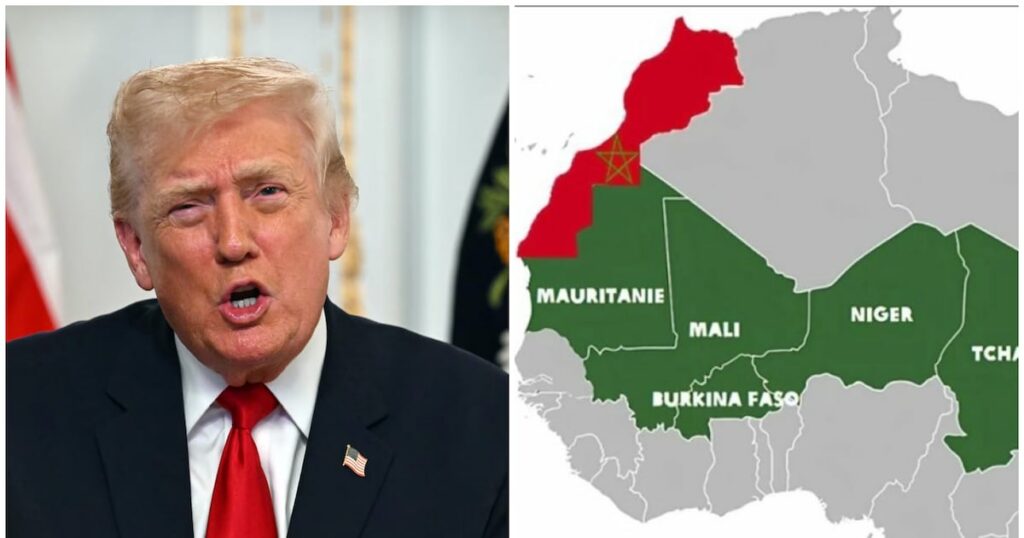
In this evolving landscape, Morocco occupies a unique position. Bilateral cooperation between Rabat and Washington has intensified across military, economic, and diplomatic spheres. Dupuy suggests broader convergence in the Sahel: “Morocco is the ideal partner the U.S. needs.”
The U.S. cannot intervene openly in the region, but it can leverage Morocco’s strong regional image to engage with governments in Mali, Niger, and Burkina Faso that emerged from military coups. Dupuy adds, “Bamako views Morocco’s privileged status positively, even as Mali’s authorities denounce external interference.”
Morocco’s influence also extends through soft power. Since 2015, the Mohammed VI Institute for the Training of Imams has educated religious leaders from across the region, promoting a moderate, Maliki-Sufi Islamic framework. “This is an extremely effective tool for subtle influence,” Dupuy states. Additionally, Morocco offers economic prospects, such as logistical corridors linking Burkina Faso, Niger, and Mali via Mauritania, alongside investments in banking, telecommunications, and industry.
Dupuy emphasizes the constancy of Morocco’s engagement in Euro-Mediterranean integration since the 1995 Barcelona Declaration and the subsequent EuroMed partnership and Union for the Mediterranean. This continuity enhances Rabat’s credibility as a stable interlocutor.
regional dynamics and Algeria’s constrained position
Algeria’s leverage in the Sahel appears diminished, particularly regarding the Western Sahara issue. Dupuy notes, “the U.S. has reiterated that the only basis for discussion is the autonomy plan.” Algeria’s initiatives, he argues, serve only to maintain diplomatic status quo or create temporary tensions without altering power dynamics.
The Madrid meeting marked a turning point in the Sahara dossier, shifting debates from ideological stances to practical implementation. Discussions now focus on local governance, economic development, maritime zones, agriculture, and exclusive economic zones.
In this complex setting, the Sahel is less a theater of security rivalries and more a space for strategic realignment. Interests intertwine: extractive industries, military outsourcing, religious diplomacy, and logistical corridors. Washington is recalibrating its posture, and Morocco is emerging as a pivotal regional actor, bridging the Atlantic, Mediterranean, and African depth.