Sonko clears up constitutional revision rumors in Senegal
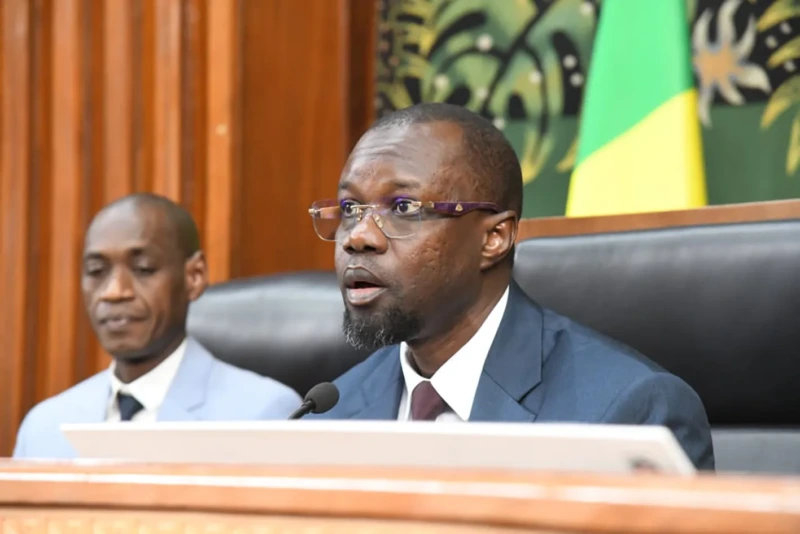
Ousmane Sonko, President of Senegal’s National Assembly, firmly dismisses rumors of an ultimatum issued to the President of the Republic. He clarifies the Parliament’s role in the constitutional revision process, urging calm understanding of the institutional steps being taken.
During a plenary session dedicated to labor and social security code revisions, Ousmane Sonko, President of Senegal’s National Assembly, addressed a growing political controversy surrounding the constitutional amendment process. He immediately refuted claims suggesting an ultimatum had been delivered to the Head of State.
« This is false; no ultimatum was ever issued to the President, » he declared, dismissing any notion of institutional tension or pressure on the presidency within the legislative framework. In his address, the Assembly President emphasized the importance of clarifying the parliamentary approach. According to him, the proposal to set a deadline for the President’s response to the constitutional reform bill was never on the table.
He reiterated that the process strictly adheres to the constitutional powers of the Parliament, with no confrontation intended against the executive branch. The goal, he explained, is to advance an institutional project that has been publicly debated for months.
With a measured tone, Ousmane Sonko framed the constitutional revision initiative as part of the derived constituent power, governed by the Constitution and the Constitutional Council’s jurisprudence.
No crisis at the heart of the state
He referenced the Constitutional Council’s decision of January 18, 2006, which he cited as a benchmark confirming the National Assembly’s authority to conduct a revision with a qualified majority of three-fifths. This interpretation, he argued, reinforces the legitimacy of the Parliament’s actions in the ongoing process.
Addressing political interpretations that suggested institutional strain, the Assembly President downplayed the debate’s significance. He asserted that no crisis exists between public authorities, describing the situation instead as a normal functioning of institutions within a framework of « dialogue between powers. »
In this context, he stressed that each constitutional body exercises its competencies without encroaching on others, under the oversight of the Constitutional Council. Revisiting political readings of the procedure, Ousmane Sonko dismissed any notion of institutional confrontation. He affirmed that the Assembly’s initiative neither constitutes an usurpation nor exerts pressure on the executive.
« Those expecting a crisis at the highest level of the state will have to look elsewhere, » he concluded, reaffirming the continuity of the parliamentary process. Ultimately, the Assembly President confirmed that the constitutional revision procedure will proceed according to the established legal framework, regardless of whether the executive branch formally expresses its opinion.
For him, the priority lies in respecting the institutional mechanisms outlined in the Constitution, within a framework he described as stable and legally sound.