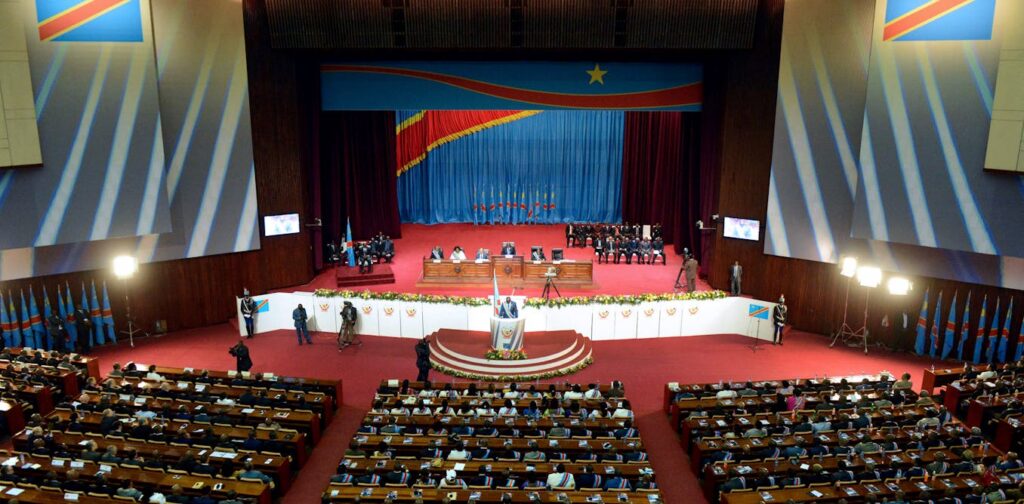
In May 2026, a disturbing incident unfolded in the National Assembly of the Democratic Republic of Congo, capturing the attention of the nation. A widely circulated video showed Deputy Micheline Mpundu concluding her address on a motion before exiting the podium. Second Vice-President Christophe Mboso, then presiding over the plenary session, publicly commented on her appearance in front of the entire chamber: “Thank you, colleague, she is very beautiful… isn’t she?”
He continued in Lingala, “Look at her yourselves,” laughing as he gestured with his hands, mimicking the contours of the deputy’s body, adding, “God created her” and “these are another man’s goods,” all under the laughter and applause of the hemicycle. The session proceeded as if nothing had happened.
Only after public outcry from political leaders, civil society activists, and human rights defenders—along with internal pressure from his own hierarchy—did Mboso issue a belated apology days later. No disciplinary action was taken against him.
This latest case of sexism and verbal violence raises a critical question: when will African parliaments, and particularly the Congolese one, stop being hostile spaces for the women they are meant to represent?
My doctoral research in political science examines gender dynamics within legislative bodies in Africa. This incident is not an isolated incident but a manifestation of a systemic issue. Instead of viewing it as a mere breach of conduct, we must recognize it as a structural problem. This article questions the gap between the commitments made on paper by the DRC authorities regarding gender equality and the harsh realities faced by women legislators in practice.
a regional pattern of parliamentary sexism
Parliamentary violence is part of a broader spectrum of abuses targeting women in politics across Africa and beyond. Before the Mboso incident gained widespread attention in Kinshasa, other documented cases of sexism had already surfaced. These incidents highlight a persistent problem that undermines women’s full participation in political decision-making at all levels.
Women’s representation in African parliaments surged in the early 1990s during the wave of democratization, bringing unprecedented numbers of women into legislative chambers. Between 1990 and 2010, the number of women legislators tripled—a statistic that initially inspired hope. Many believed that electing women to office would reshape institutional culture. That illusion was shattered quickly. The paradox lies in the fact that this increased presence was often perceived as a challenge to the established system.
Structural resistance emerged, frequently from male colleagues across party lines. Some openly argue that politics is a male domain, where women do not belong or have no place. The Inter-Parliamentary Union, a global organization of national parliamentarians established in 1889, has extensively documented this phenomenon. A 2016 global survey of women parliamentarians from 39 countries across five continents revealed that over 65.5% had experienced repeated verbal abuse and insults during their mandates—statistics that are deeply concerning.
What is particularly revealing about this study is how society judges women legislators. Their political work is often overshadowed by scrutiny of their appearance, marital status, or conformity to traditional roles such as motherhood or caregiver. This bias extends beyond the parliamentary chambers. It enters with the legislators themselves and sometimes manifests from the podium itself, as seen in the DRC case. A joint regional study by the IPU and the African Parliamentary Union (APU) in November 2021 confirmed that this reality persists, with insufficient progress in ensuring effective political participation for women.
The applause heard in the video is not incidental. It reveals that the problem is not Mboso alone—it is the system that produces and tolerates such behavior. Philosopher Kate Manne describes this as a mechanism of control that maintains women in subordinate positions, even within so-called democratic institutions. This control does not always require physical violence; gestures, words, and laughter—what scholar Mona Lena Krook terms semiotic violence—serve as constant reminders that, in the eyes of some colleagues, women legislators are seen first as bodies rather than lawmakers. This is precisely what Mboso did by mimicking the body of his colleague Mpundu.
The concept of coloniality of gender, developed by feminist theorist María Lugones, helps explain the naturalization of gender hierarchies as a colonial legacy. This sheds light on a contradiction: women legislators in the DRC are elected under the same constitutional framework as their male counterparts, yet they remain subject to patriarchal control systems that reduce them to something less than lawmakers. They have equal rights on paper but unequal dignity in practice.
notable cases across africa
The Mboso incident echoes other disturbing cases across the continent. In Senegal, Deputy Amy Ndiaye, who was pregnant, was slapped and kicked in the stomach during a 2022 parliamentary session, all caught on camera. In Nigeria in 2025, Senator Natasha Akpoti-Uduagha was suspended not for professional misconduct, but for speaking out about the sexual harassment she endured from the Senate President.
The experiences of Ndiaye, Akpoti-Uduagha, and Mpundu—three women from different African countries—are not coincidental. They demonstrate that while African parliaments may tolerate women’s voices, their dignity remains unprotected. Full respect for women in politics has yet to be achieved.
systemic sexism in the congolese parliament
On April 30, 2020, former Congolese Senate President Thambwe Mwamba publicly shamed a female senator, Bijoux Ngoya, during a plenary session broadcast on national television. He revealed private meetings they had held, insinuating that Ngoya had approached him to seek his support for her candidacy as Quaestor of the Senate, subtly accusing her of offering sexual favors. The session ended in chaos, with several lawmakers expressing outrage.
On July 15, 2021, during a constitutional debate, Deputy Christelle Vuanga dismantled her male colleague’s arguments. Deputy Nsingi Pululu interrupted her, stating simply in Lingala, “You are a woman.” This single phrase diminished her ability to engage in public discourse on a sensitive issue solely because of her gender.
The Mboso case is not surprising. The DRC has ratified international conventions, adopted laws, and signed commitments—but within the hemicycle, nothing has changed. The gap between legal provisions and real-world practice is well-documented. What is new is the continued pretense that this problem does not exist.
time for change in parliamentary culture
French feminist Simone de Beauvoir wrote in 1949 that women are defined as the other. In 2026, this otherness persists in the Congolese Parliament: elected women continue to be reduced to their bodies rather than their political contributions.
These incidents expose how patriarchal systems undermine democracy from within. As long as sexist behavior goes unpunished—evidenced by the unchecked laughter and applause in the Mboso video—parliament will remain a misogynistic space. Yet women make up 13% of the National Assembly in a country where they represent 51% of the population. Their underrepresentation cannot justify tolerating such behavior.
Other parliaments have taken steps toward change. Campaigns like #NotTheCost (NDI) and #NotInMyParliament (European Parliament) prove that cultural transformation is possible through concrete sanctions and victim protection. The DRC has strong laws, such as the 2025 Senate bill on violence against women. But a law without implementation remains a mere wish. Silence is no longer an option. Failing to sanction Mboso sends a clear message to all Congolese women considering a political career.