Senate speaker Sonko holds critical leverage over 2026 finance bill
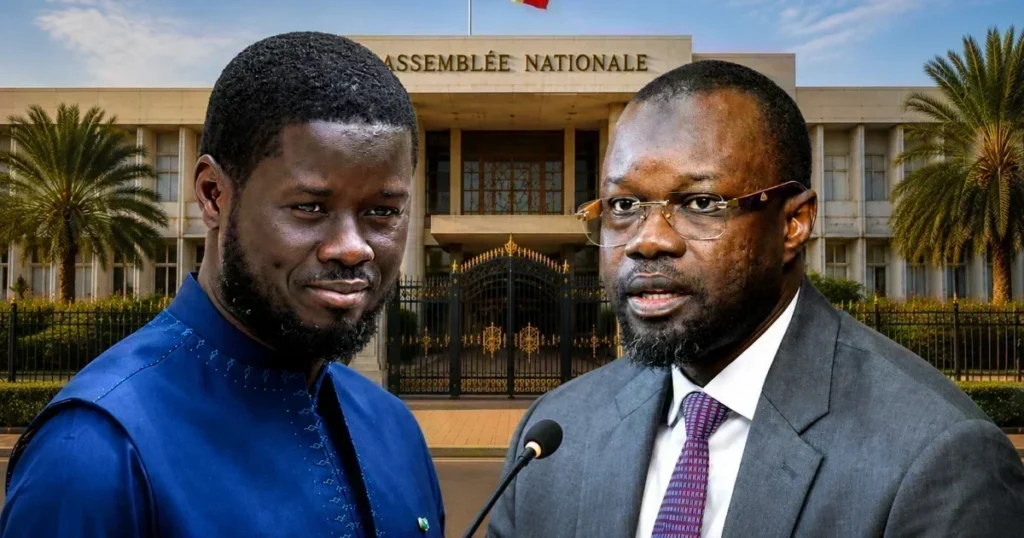
Ousmane Sonko, now Speaker of Senegal’s National Assembly, wields significant constitutional powers that could stall, alter or even torpedo the 2026 supplementary finance bill—legislation that will directly impact millions of Senegalese amid tight economic conditions.
The Constitution’s arsenal: Three ways to challenge the budget
Under Senegal’s constitutional framework, the National Assembly holds exclusive authority over both approving finance laws and scrutinizing government actions. With 130 seats out of 165—secured in the 2024 elections—the ruling Pastef coalition can single-handedly reject the bill in plenary session. But such a confrontation carries political risks: blocking the budget could place responsibility for a potential public finance freeze directly on Sonko’s party during ongoing IMF negotiations.
Article 60 of the Constitution further reinforces party discipline by automatically stripping any deputy who defects of their mandate. This safeguard limits the ability of Diomaye Faye’s coalition to peel off votes from the ruling group in the chamber.
In addition to outright rejection, deputies have a more nuanced option: strict amendment rules. Under Article 82, any amendment to a finance bill must either eliminate or reduce spending, or create or increase revenue. Members cannot add new programs or hike allocations, but they can deeply reshape government priorities by slashing proposed expenditures, including those tied to IMF commitments—all without rejecting the entire bill outright.
The executive branch has a countermeasure, however. The same article permits the government to demand a single vote on the entire text or on selected sections, accepting only the amendments it has proposed or approved. This forces deputies into a binary choice: accept the bill as drafted by the cabinet or face complete rejection.
Playing for time: A risky delay game
As Speaker, Sonko controls the legislative calendar—but Article 84 limits obstruction tactics. A finance bill must be placed on the agenda when requested by either the President or Prime Minister, severely curbing attempts to bury the text under procedural maneuvers.
Yet time is not on Sonko’s side. Article 68 gives the National Assembly a maximum of 60 days to pass finance bills. If the bill is not definitively approved by then—around mid-November 2026—the government may enact it by decree, incorporating any amendments passed by deputies and accepted by the President. The draft was submitted on September 18, 2026, so the clock is ticking.
A critical ambiguity remains: while the Constitution clearly addresses unapproved texts, it is silent on what happens after an explicit rejection. This legal gap could prompt a constitutional referral by at least one-tenth of deputies under Article 74, potentially delaying—or clarifying—the path forward.
Censure as a nuclear option
The executive still holds a powerful tool it has used before. Under Article 86, the Prime Minister, following cabinet approval, can tie the budget bill to a government confidence vote. If passed, the bill stands; if rejected, the government falls. The motion requires only a tenth of deputies to be admissible and an absolute majority—83 votes—to succeed. Pastef holds this majority comfortably.
If Prime Minister Ahmadou Al Aminou Lô chooses this route, Sonko’s deputies could not only derail the budget but trigger a government crisis—an extreme scenario with wide-ranging consequences, especially given the looming constitutional window for presidential dissolution.
December 2, 2026: A constitutional firewall
Article 87 bans presidential dissolution during the first two years of a legislature. Since the current Assembly was seated on December 2, 2024, it remains protected from dissolution until December 2, 2026—well after the budget deadline. President Faye has indicated that this threshold has not yet been reached.
The timeline creates a high-stakes sequence. The 60-day window for voting the supplementary budget expires in mid-November, just before the President regains the power to dissolve parliament. A prolonged budget deadlock would give Faye a compelling argument to justify dissolution, while smooth passage would strip him of that political lever.
Ultimately, Sonko possesses multiple constitutional avenues to block or reshape the 2026 budget—through outright rejection, targeted spending cuts, or a censure motion. Each path, however, carries substantial political costs in a fragile cohabitation between the presidency and the Assembly. What began as a legal debate is rapidly becoming a real-time test of Senegal’s new institutional balance.