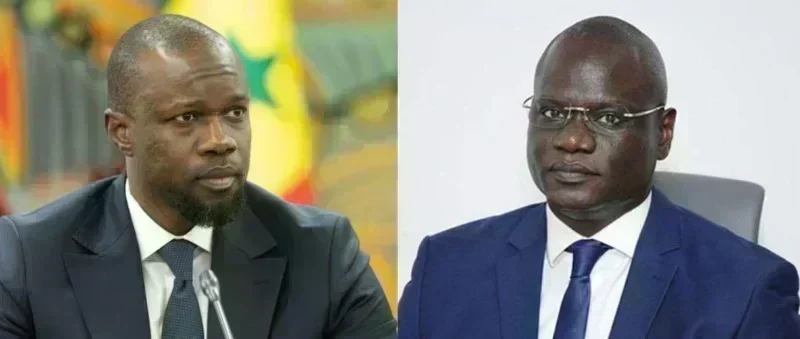
In just two years, Senegal’s Ministry of Higher Education has seen three leadership changes: Abdourahmane Diouf held the post first, followed by Daouda Ngom, and then Boubacar Camara, who took office on June 1, 2026.
A special parliamentary inquiry commission, scheduled for Monday, August 10, 2026, is expected to examine irregularities in the procurement and execution of contracts under the “One Student, One Laptop” program. Managed by the Ministry of Higher Education, Research and Innovation since 2017, the initiative has an estimated financial commitment of around 48 billion West African CFA francs. But the question on everyone’s lips is whether this investigation is indirectly targeting former minister Abdourahmane Diouf.
An issue that has simmered for months
The controversy is not new. As early as November 8, 2025, then-Prime Minister Ousmane Sonko publicly highlighted irregularities in the management of higher education programs, specifically questioning the oversight of the ministry under Abdourahmane Diouf’s leadership. Diouf responded by urging lawmakers to establish a parliamentary inquiry commission to fully investigate these matters—including the construction of five university campuses—while acknowledging shared responsibility alongside the Prime Minister.
The inquiry now under way covers a period stretching back to 2017, long before the current administration took office. That means it potentially encompasses the entire tenure of multiple ministers, including Abdourahmane Diouf, Daouda Ngom, and Boubacar Camara.
A backdrop of rising political tensions
The timing of this inquiry coincides with a noticeable rift between Sonko and Diouf. Once a key figure within the ruling coalition and leader of the Awalé party, Abdourahmane Diouf has since joined Kiiraay – Les Patriotes républicains, the party now backing President Bassirou Diomaye Faye. This political realignment has fueled speculation that the commission may be serving as a veiled instrument to settle scores rather than a genuine effort to uncover the truth.
The formal notice convening the extraordinary session does not explicitly name Abdourahmane Diouf. Instead, it frames the inquiry as a broad review of the entire 2017–2026 period, spanning nearly a decade of program management that could involve multiple ministers and senior officials within the Ministry of Higher Education. No individual names are cited in the official text.
While the timing of the inquiry aligns with Abdourahmane Diouf’s departure from the presidential camp and his subsequent alignment with Kiiraay, there is currently no factual evidence to confirm that Ousmane Sonko is deliberately targeting his former government colleague through this parliamentary process. Only the findings of the commission, once it is fully constituted and its conclusions made public, will clarify the exact responsibilities for managing the 48 billion West African CFA franc program.