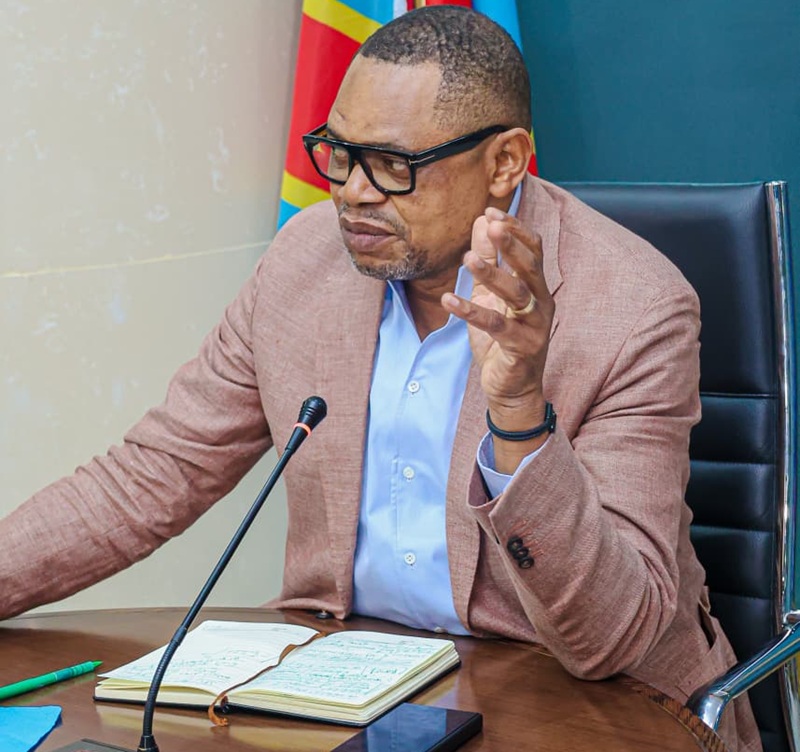
“Musuminyina katu wabula,” says a luba proverb meaning “he who perseveres always gets what he wants.” And Me José Mpanda Kabangu, Minister of Posts and Telecommunications, is following that logic. He is determined to achieve what he could not during his first ministerial post in September 2019 at the Ministry of Scientific Research and Technological Innovation: equipping the Democratic Republic of Congo with a sovereign satellite.
Indeed, in a decisive move to realise his project of acquiring a sovereign satellite for the DRC, Me José Mpanda Kabangu granted an audience on Friday, June 5, to a Chinese delegation from China Unicom and Genew Technologies. The discussions focused on the construction of this satellite as well as the deployment of fibre optics across the entire national territory. This meeting followed the recent mission undertaken by Minister José Mpanda to China in April.
In addition to the Chinese representatives, experts from the General Secretariat of PTNTIC, the Regulatory Authority for Posts and Telecommunications of Congo (ARPTC), the Congolese Fibre Company (SOCOF), the National Satellite Telecommunications Network (RENATELSAT), the National Remote Sensing Centre (CNT), as well as senior advisors to the Presidency and the Prime Minister’s office in charge of PTNTIC, were also part of this audience.
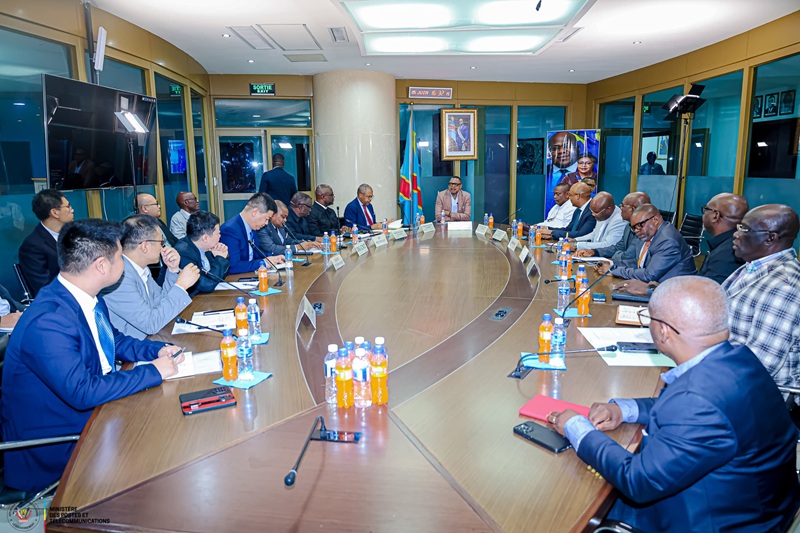
Minister José Mpanda explained that his trip to China was motivated by a desire to find solutions for his country, but that real discussions on the project had to be led by technical experts. This explains the presence of senior officials from these two Chinese firms in Kinshasa, where they will stay until June 19 to exchange with Congolese experts on two major projects: the sovereign satellite, for which a Memorandum of Understanding was signed in April, and the national fibre optic backbone, whose agreements were revised in 2025.
The discussions, which began on Monday, June 8, have three objectives:
- Technical and financial structuring: Validating the technical architecture of both projects, estimating costs, and finalising financing arrangements with the Ministry of Planning and the Ministry of Finance.
- Consultation and institutional alignment: The two Chinese firms must formally notify and present to stakeholders including RENATELSAT, SCPT, SOCOF, CNC, CNT, SG PTNTIC, ARPTC, the Presidency, and the Prime Minister’s office.
- Preparation of due diligence in China and next steps: Defining the scope and timeline, identifying Congolese delegates and sites to visit, producing deliverables before departure, and outlining the stages following due diligence.
Minister José Mpanda expects four results from these discussions:
- Validated technical solutions
- Finalised financing approach
- Aligned stakeholders
- Planned due diligence mission
It is worth noting that the Congolese institutions involved in this project include the Presidency, the Prime Minister’s office, the Ministry of Posts and Telecommunications, the Ministry of Planning, the Ministry of Finance, the Ministry of Infrastructure, the Ministry of Mines, and the National Cybersecurity Council (CNC), with technical entities such as the General Secretariat of PTNTIC, ARPTC, FDSU, SOCOF, SCPT, RENATELSAT, and CNT.