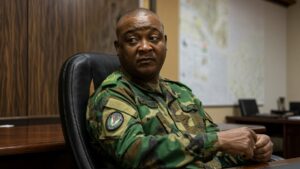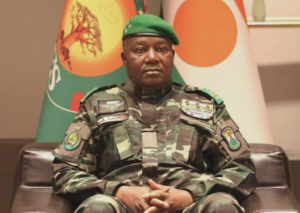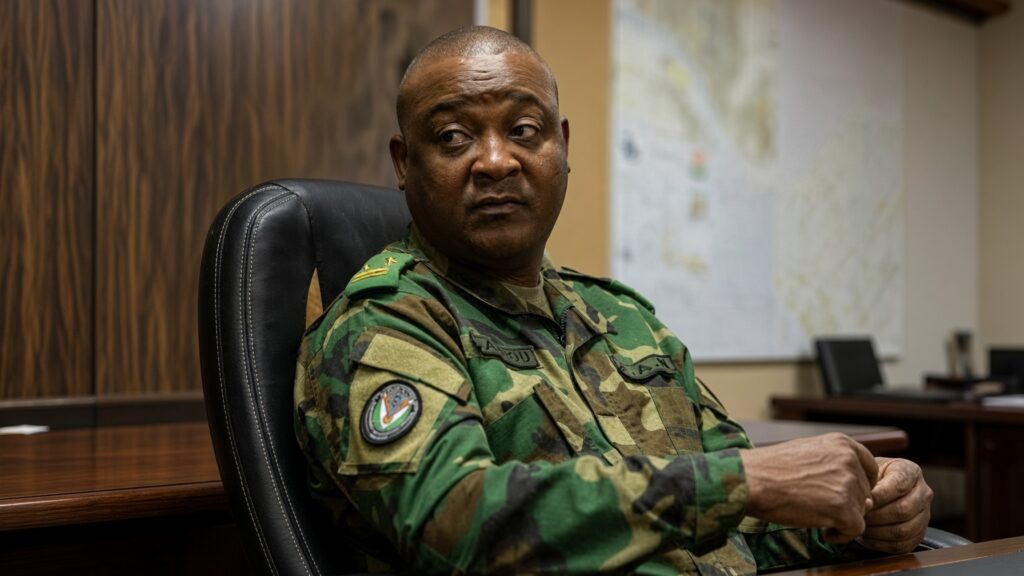
The air at the Nigerien Armed Forces headquarters in Niamey has turned cold. General Moussa Salaou Barmou, once the iron fist behind the 2023 coup and a key architect of Niger’s military junta, now finds himself under house arrest at his residence, stripped of his rank and influence in a sweeping purge that began in early September 2026.
This dramatic reversal did not occur in isolation. It followed a failed military mutiny at Base aérienne 101 on August 28–29, an event that exposed deep fissures within the very institution that brought General Barmou to prominence. Two weeks later, the general who once embodied unity in the junta is now the regime’s latest cautionary tale—a man caught in the widening dragnet of internal distrust and power consolidation.
From strategic coup leader to military outcast
General Barmou’s rise was meteoric. He played a central role in the July 2023 ousting of President Mohamed Bazoum, securing the loyalty of Niger’s elite special forces and positioning himself as a linchpin of the junta’s legitimacy. For years, he symbolized stability and influence—an officer who could bridge divides between factions and keep the military aligned under the banner of the National Council for the Safeguarding of the Homeland (CNSP).
But behind the polished facade of unity lay growing unease. The failed mutiny at Niamey’s key air base exposed vulnerabilities: not just in morale, but in loyalty. While Barmou has not been officially charged with direct involvement, his close ties to prominent officers raised inevitable questions. In the zero-sum politics of juntas, proximity to controversy becomes guilt by association.
A regime consumed by its own paranoia
The purge of General Barmou signals something deeper than a reshuffle. It is a calculated move to eliminate potential threats before they materialize—a preemptive strike against any challenge to the junta’s authority. President Abdourahamane Tiani, head of the CNSP, swiftly named General Mamane Sani Kiaou as the new chief of staff, shifting command to a more trusted figure within the ground forces.
This restructuring is not just about replacing one general with another. It reflects a broader strategy: tightening control over the military apparatus and silencing dissent before it can fester. The junta’s decision to bring in Russia’s Africa Corps for internal security support has further internalized the rift between reformists and hardliners—each side now arming itself with new alliances and competing loyalties.
Influence of external actors and internal fractures
The presence of foreign military advisors, particularly from Russia, underscores a critical turning point. While Africa Corps initially provided tactical support in quelling the mutiny, its expanded role has fueled suspicion. Some officers view it as a necessary stabilizing force. Others see it as a Trojan horse—one that allows foreign influence to seep into Niger’s chain of command and dilute national sovereignty.
General Barmou’s fall is not merely administrative. It is a warning: no one is beyond reproach, not even the architects of the regime. The junta is tightening its grip, and in doing so, it is consuming its own.
Loyalty in the era of perpetual suspicion
In the corridors of power in Niamey, the atmosphere is thick with distrust. Officers who once stood shoulder to shoulder now glance over their shoulders. The mutiny’s failure did not resolve the crisis—it deepened it. The junta’s response—targeted purges, house arrests, and sudden leadership changes—has done little to restore confidence.
Analysts warn that by purging its own, the junta is accelerating its decline. Alliances forged in the cauldron of a coup are fragile. Today’s trusted ally may become tomorrow’s disgraced enemy. The case of General Barmou illustrates a harsh truth: in a system built on coercion and survival, today’s victory is often tomorrow’s motive for elimination.
The paradox of junta rule: strength that becomes its undoing
Juntas are born in crisis, but they rarely survive reconciliation. When power is seized by force, it is maintained by fear. And fear demands enemies—real or imagined. The removal of Barmou wasn’t just about control; it was about sending a message: “You are either with us, or you are against us.”
Yet this strategy risks a dangerous spiral. Each purge undermines morale. Each executed threat emboldens the next. And each displayed act of force reveals the junta’s deepest insecurity: that it cannot rule by consent—only by coercion.
As the dust settles on this latest transition, one thing is clear: General Barmou’s fall is not the end of the crisis. It is a symptom of a regime that has lost its way—and in its frantic efforts to survive, may hasten its own collapse.