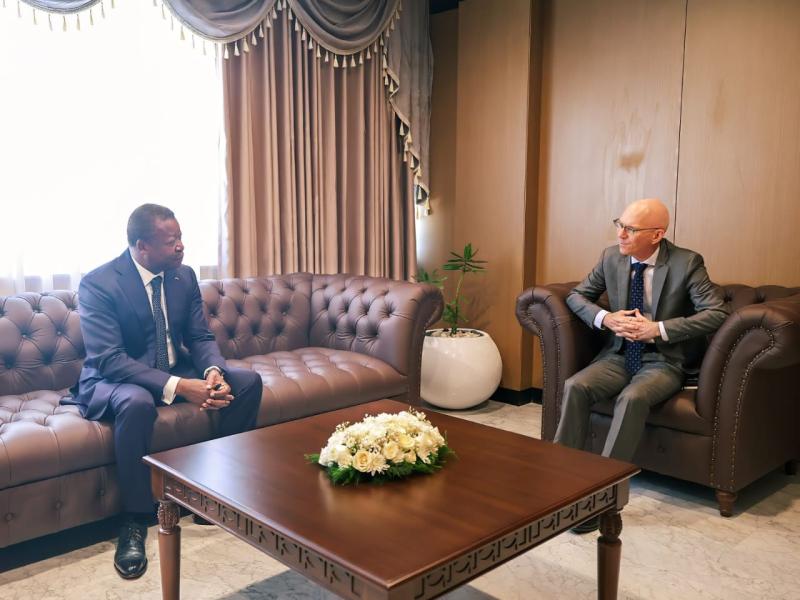
On Monday, 8 June 2026, the United Nations Special Representative for the Democratic Republic of the Congo and head of MONUSCO, James Swan, along with the UN Special Envoy for the Great Lakes region, Huang Xia, met with Togolese Council President Faure Essozimna Gnassingbé in Lomé. Gnassingbé serves as the African Union’s designated mediator based in Lomé.
The discussions focused on the progress of ongoing diplomatic initiatives and the UN’s contribution to the African Union-led mediation aimed at a lasting resolution to the crisis in eastern DRC. The two UN officials are in Lomé for the semiannual evaluation meeting of the AU mediation efforts in this part of the continent.
“The United Nations representatives commended Togo’s commitment to advancing peace, stability and peaceful conflict resolution across Africa. They affirmed their readiness to support the efforts of the Council President, who is the AU-designated mediator, in seeking a fair and sustainable solution to the crisis affecting this region,” the Togolese presidency stated.
Appointed as AU mediator for the eastern DRC crisis, replacing Angolan President João Lourenço, Faure Essozimna Gnassingbé has been holding multiple consultations with the United Nations in recent months to foster a coordinated approach to peace in the Great Lakes region.
James Swan’s presence in Lomé carries particular significance. Having taken up his post nearly two months ago, this marks his first participation in the semiannual review of peace initiatives under the African mediation led by Togo.
This meeting comes at a time when, despite the existence of the Washington Accord and successive evaluation sessions, the security and humanitarian situation in eastern DRC continues to worsen. This deterioration persists even as multiple diplomatic initiatives have been launched to resolve the crisis.
The erosion of trust between the parties, coupled with a lack of political will from certain regional actors, hampers the effective implementation of commitments. These remain major challenges for the mediators, notably the United States and the State of Qatar, who are urged to continue their efforts toward ending the current security crisis. This crisis is marked by the AFC/M23 rebellion, which Kinshasa accuses of being backed by Rwanda.
In response, voices at national, regional and international levels continue to call on the various protagonists to honour the commitments made under the peace initiatives. However, these appeals have so far yielded no noticeable results. The goal of bridging the persistent gap between ground realities and diplomatic progress on paper remains elusive. Each side continues to interpret the accord’s provisions according to its own reading, making its implementation increasingly hypothetical.
The same applies to the Doha process, overseen by the State of Qatar. Despite several rounds of talks, Kinshasa and the AFC/M23 rebellion still struggle to align their positions on key points of disagreement. The Montreux stage in Switzerland, which was expected to inject new momentum into this process, did not produce the desired outcomes. Commitments from that negotiation phase have not been fully respected, while the deteriorating security situation in the Middle East has also pushed this dossier to the background, further slowing mediation efforts.