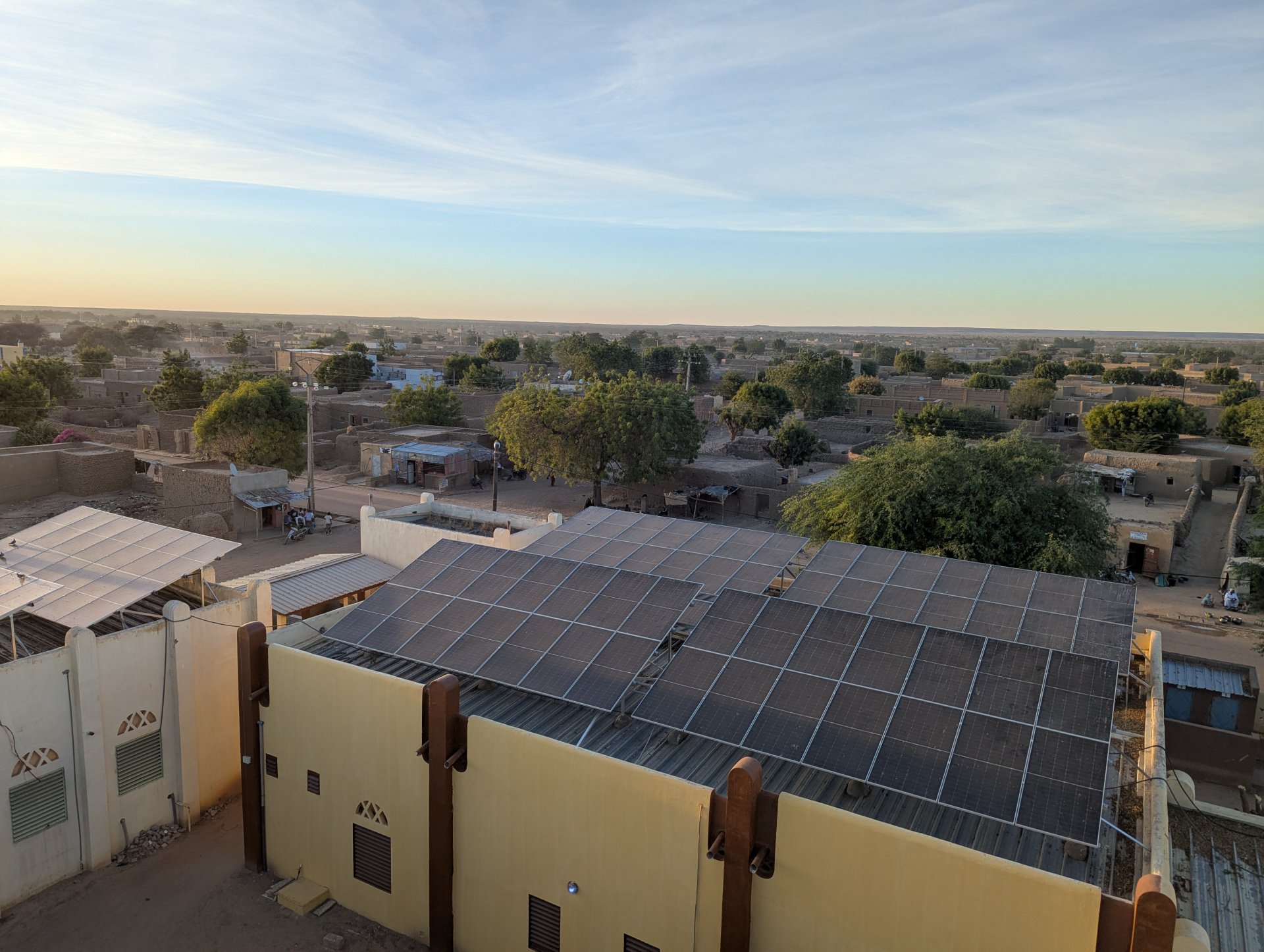
In the Tombouctou region of northern Mali, the hospital in Niafounké has been equipped with a modern solar panel installation. This shift toward renewable energy strengthens the facility’s independence and ensures that medical services remain uninterrupted in a remote area frequently impacted by instability.
Overcoming energy instability in the Sahel
Prior to this upgrade, the hospital was almost entirely dependent on a diesel-fueled thermal plant, which was prone to regular power failures. Medical teams had to rely on a backup generator daily, leading to high operational costs and inconsistent reliability. The new photovoltaic system now meets approximately 60% of the hospital’s total energy requirements, significantly decreasing its reliance on fossil fuels.
This energy transition allows for a substantial reduction in expenses related to generator maintenance and diesel procurement, enabling more funding to be directed toward patient treatment. It ensures the continuous operation of life-saving equipment, such as oxygen concentrators for neonatal and pediatric wards, emergency surgical and obstetric services, as well as laboratory tools, ultrasound machines, and the cold chain required for blood transfusions.
The technical setup features a 90 kWp capacity supported by a 210 kWh lithium battery storage system, alongside an 80 kVA backup generator. This hybrid configuration allows the hospital to switch seamlessly between solar power, the local municipal grid, and the generator, providing a stable 24-hour electricity supply.
Direct benefits for displaced populations
For those seeking treatment, this reliable energy source has a profound impact. Fadi, who was forced to flee her home in the village of Léré due to threats from armed groups, sought safety in Niafounké. “I escaped with my sister and children because we were ordered to leave the village,” she explains. “Today, I am here at the pediatric ward with my son, Ousmane.” In an environment defined by displacement and vulnerability, consistent access to healthcare is vital.
This project is part of the “Green Initiative,” a broader strategy by MSF to minimize its environmental impact while boosting operational resilience. For several years, the organization has been implementing hybrid solar systems across the Sahel and other global regions to reduce the logistical challenges and high costs of transporting diesel to isolated locations.
Improving healthcare quality through sustainability
Beyond the ecological advantages, the savings generated by lower energy costs are reinvested into medical care. Solar energy provides the stability needed for laboratories, cold storage, and essential hospital wards, which in turn improves the working environment for staff and the standard of care for patients.
In fragile humanitarian settings, solar power is more than just a technical upgrade; it serves as a tool for autonomy and hope. By integrating these solutions, MSF combines medical action with environmental responsibility to protect lives sustainably.
Since 2019, MSF has managed a pediatric project at Niafounké hospital, focusing on children under the age of 15. Additionally, the organization supports four community health centers and provides primary healthcare services to remote villages throughout the Gourma area in the Tombouctou region.