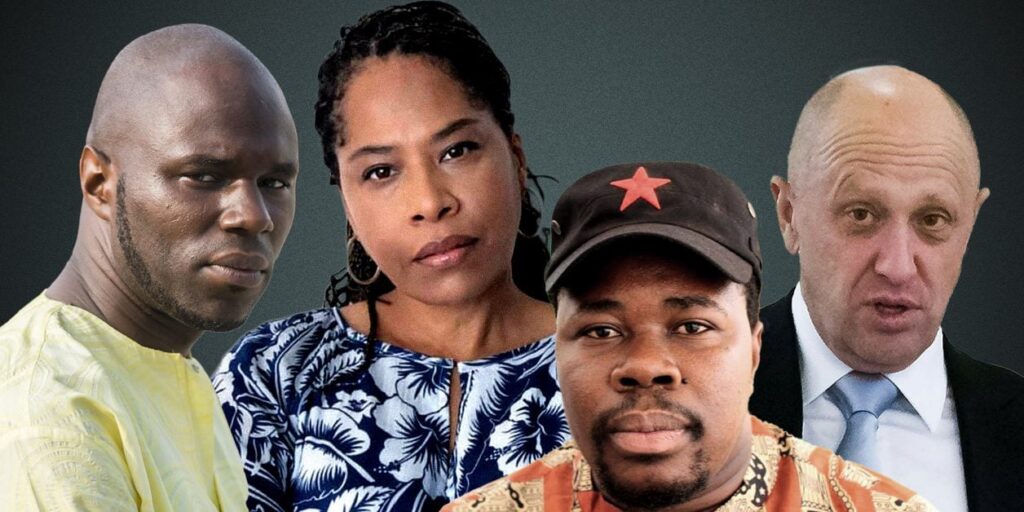
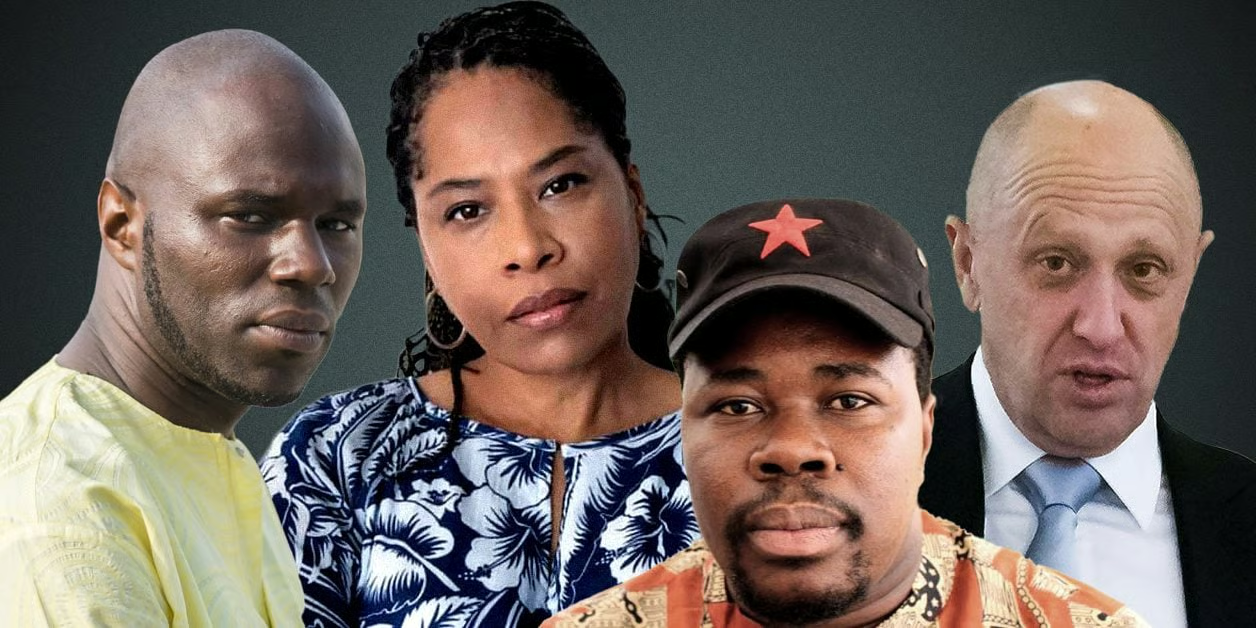
In the complex landscape of African geopolitics, a network of pro-Kremlin influencers has emerged, amplifying Russian narratives across the continent. At the heart of this ecosystem is Evgueni Prigojine, a close ally of Vladimir Poutine and financier of the Wagner Group. Through entities like the African Association for Free Research and International Cooperation (Afric), led by Mozambican psychologist-turned-activist José Matemulane and chaired by Prigojine associate Ioulia Afanasieva, Moscow extends its digital and ideological reach into Africa.
These operations rely heavily on media partnerships with panafricanist outlets such as Radio Révolution panafricaine and Afrique Média TV, based in Cameroon and owned by Justin B. Tagouh. Tagouh, who claims to have met Poutine during visits to Sotchi, serves as a conduit for pro-Russian messaging, often targeting French interests. The channel frequently hosts Kemi Seba, a Franco-Béninois activist whose fiery anti-Western rhetoric aligns with Kremlin objectives.
From Moscow to the Sahel: Kemi Seba’s shifting alliances
Kemi Seba, founder of the Pan-Africanist NGO Urgence Panafricaniste, has cultivated ties with Moscow’s nationalist circles, including Aleksandr Douguine, a key ideologue of Russia’s multipolar worldview. Seba’s engagements extend beyond ideology; he has met with Mikhaïl Bogdanov, Russia’s Deputy Foreign Minister for Africa and the Middle East, and delivered lectures at the Moscow State Institute of International Relations. Despite his public distancing from Evgueni Prigojine over proposed violent actions against Western symbols—actions he deemed counterproductive—seba continues to amplify pro-Kremlin narratives on social media.
His influence is particularly visible in Francophone Africa, where his condemnations of colonialism and Western policies resonate with local audiences. Seba’s expulsion from the Bénin in 2017 underscored his contentious role, yet his visibility has only grown through collaborations with Russian state-aligned media.
Nathalie Yamb: the “Dame de Sotchi”
Nathalie Yamb, a Swiss-Cameroonian commentator, has become one of Africa’s most vocal critics of France, earning the moniker “Dame de Sotchi” after her prominent participation in the 2019 Russia-Africa Summit. Yamb’s expulsion from Côte d’Ivoire in 2019 for her anti-French stance did little to dampen her influence. Reports link her to events organized by Afric in Berlin, co-hosted with the Foundation for the Protection of National Values—a group tied to Prigojine and directed by Alexander Malkevitch, a figure with alleged ties to Russian intelligence. Since Russia’s invasion of Ukraine, Yamb has openly supported the Kremlin’s military actions.
Yamb’s activism extends to political circles; she is associated with the Ivorian party Lider, whose Twitter account amplifies pro-Russian propaganda. While the party’s founder, Mamadou Koulibaly, officially retired, his March visit to Bamako—ostensibly to support Mali’s pro-Russian junta—highlighted the deepening ties between Moscow and African political movements resisting Western influence.
Mali: a hub for Kremlin-linked activism
In Mali, figures like Adama Diarra (aka “Ben le cerveau”) have become central to pro-Russian mobilization. As spokesperson for the Yerewolo – Debout sur les remparts movement, Diarra confirmed Wagner Group’s presence in Mali, aligning with the junta’s anti-French narrative. His role in organizing pro-Russian demonstrations reflects a broader strategy to legitimize Moscow’s influence in the Sahel. Since late 2021, he has overseen most such events in Bamako, often with the backing of local media and civil society.
The Central African Republic (CAR) serves as another battleground for Russian soft power. Fred Krock, director of the popular radio station Lengo Songo in Bangui, is a key Kremlin ally. Funded by Lobaye Invest—a Prigojine-linked mining entity—Lengo Songo amplifies voices of Russian officials in CAR, including former ambassador Vladimir Titorenko and Kremlin advisor Valeri Zakharov. Civil society actors like Blaise Didacien Kossimatchi and Harouna Douamba, both linked to pro-Touadéra platforms, further spread pro-Russian narratives, often funded by Lobaye Invest.
South Africa’s digital battlefield
While South Africa’s government maintains a neutral stance on the Ukraine war, digital spaces tell a different story. The Twitter account attributed to Duduzile Zuma-Sambudla, daughter of former president Jacob Zuma, has popularized the #istandwithrussia hashtag, amassing hundreds of thousands of shares. Most posts in this network denounce NATO and Western “imperialism,” echoing Kremlin talking points.
These influencers, whether through media, political alliances, or digital activism, are reshaping Africa’s information landscape. Their alignment with Russian narratives—often framed as anti-colonial or anti-Western—serves Moscow’s strategic goals, while challenging traditional power structures on the continent.