The recent state visit of General Abdourahamane Tchiani to Ankara has laid bare an unconventional arms procurement arrangement between Niamey and Ankara. President Recep Tayyip Erdogan has approved the immediate delivery of military equipment to Niger despite the absence of prior financial settlement. While this gesture may appear as a display of solidarity, it exposes the intricate web of a strategic partnership that places significant constraints on Niger’s national sovereignty.
Within the defense industry, the concept of unconditional credit prior to shipment is virtually nonexistent. Defense manufacturers universally require substantial upfront payments before proceeding with deliveries. The announcement made by Niger’s transitional leader on 4 June 2026 thus conceals a far more complex economic and geopolitical reality where no transaction is truly without cost.
The financial undercurrents of deferred payment arrangements
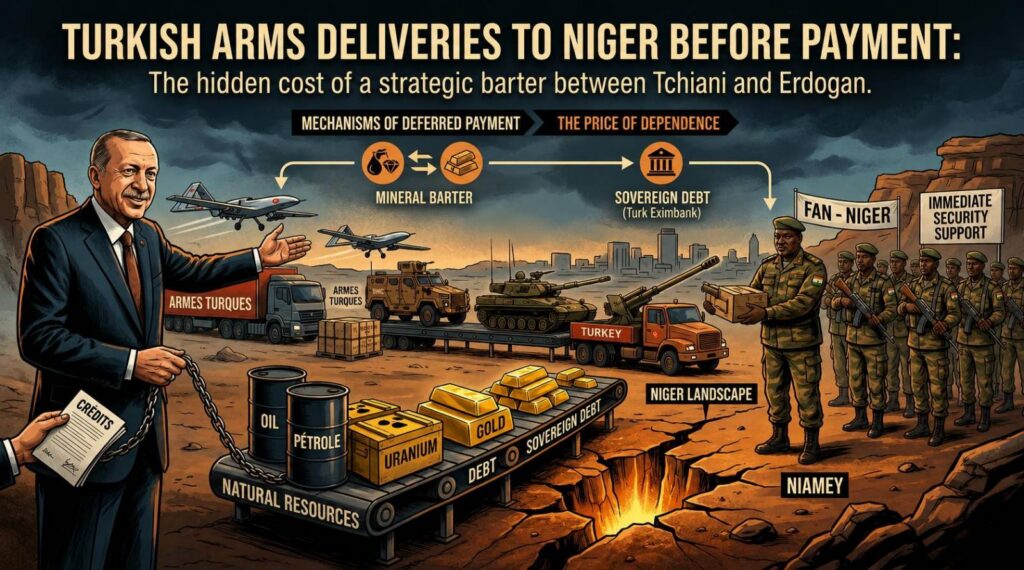
Global arms trade operates on an immutable principle: every delivered system must eventually be paid for, whether directly or through alternative means. To address Niamey’s immediate financial constraints, several compensatory mechanisms have been structured behind the scenes:
- Resource-for-arms exchange model: Niger’s subsoil is among the richest in West Africa, boasting substantial reserves of uranium, oil, and gold. By agreeing to frontload military deliveries, Ankara secures exclusive mining exploration rights or concessions for its national enterprises.
- Sovereign credit lines: These procurements are not gratuities. The invoices are backed by loans extended through institutions such as Turk Eximbank. Niger, in addressing its pressing security concerns, has effectively converted immediate operational needs into long-term financial obligations to Ankara.
The sovereignty cost of strategic barter
For General Tchiani, this alliance is essential to replenish the capabilities of the Niger Armed Forces following the withdrawal of Western troops. Yet, this pragmatic decision carries a steep long-term price for the nation’s autonomy.
The spectre of over-indebtedness looms large. By accepting Turkish drones, armored vehicles, and communication systems on credit, Niamey risks granting Ankara direct influence over its future economic and mining policies.
Potential strategic concessions expected
The barter arrangement may yield the following reciprocal advantages for Turkey:
- Priority access to Niger’s uranium and oil deposits
- Establishment of Turkish military logistics or operational bases
- Automatic diplomatic backing from Ankara in regional Sahel matters
Turkey’s Sahel strategy: securing influence through flexibility
For President Erdogan, the financial leniency extended to Sahel’s military regimes constitutes a high-yield geopolitical investment with three core objectives:
- To permanently displace Western powers from the region
- To counterbalance Russian influence, particularly through the Africa Corps, by positioning Turkey as the essential technology provider
- To secure sustained demand for its defense industry, a cornerstone of modern Turkish state power
Political gains, uncertain economic outcomes
General Tchiani has secured an internal political victory by acquiring military assets without immediately depleting state coffers. Yet, the illusion of independence collides with the stark reality of material dependence. Whether aligning with Moscow for security or contracting technological debt to Ankara, Niger has not escaped the cycle of foreign influence—it has merely exchanged creditors, at a price yet to be fully borne by its people.