Another blow to Niger’s security apparatus
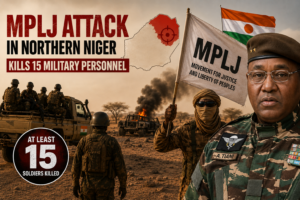
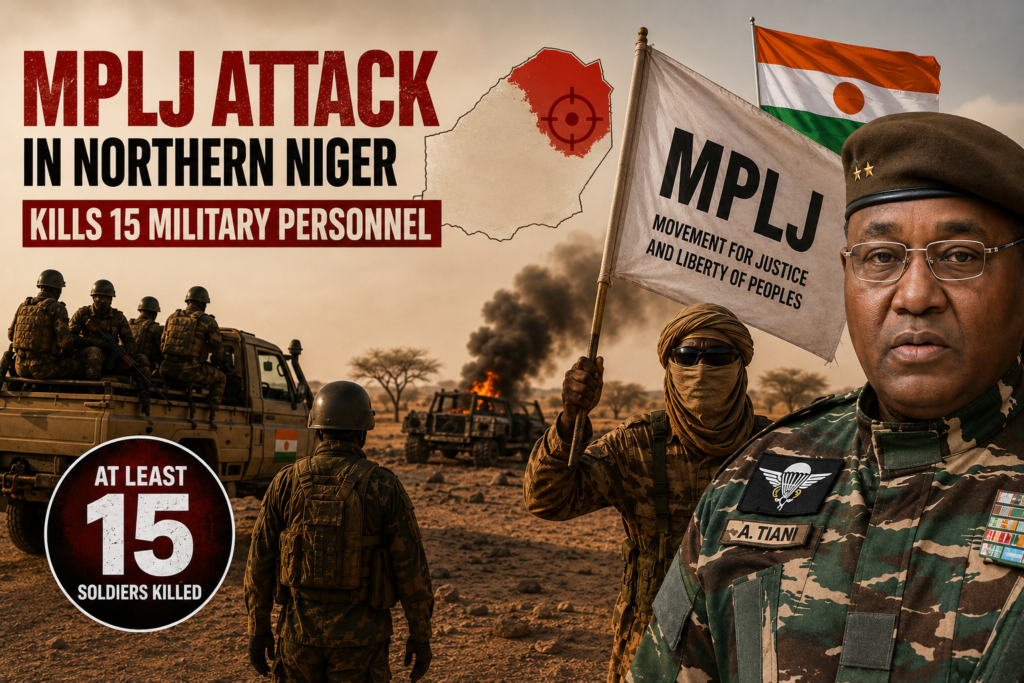
In the vast, lawless expanses of northern Niger, the recent dual assault carried out by the Mouvement pour la Justice et la Liberté des Peuples (MPLJ) has left at least 15 soldiers dead, casting fresh doubts on the military junta’s ability to safeguard its territory and citizens. The attack, claimed by the armed group, underscores a harsh truth: despite the rhetoric of sovereignty championed by the government under General Abdourahamane Tiani, the state’s grip on its borders and interior remains precarious.
The scale of the MPLJ’s operation highlights a critical flaw in Niamey’s security strategy. The vast desert and border regions of Niger, stretching across thousands of kilometers, present formidable challenges for any government seeking to assert control. With porous frontiers shared with several nations also grappling with insurgencies, unmonitored zones become fertile ground for armed factions to regroup, resupply, and launch attacks before vanishing into the terrain.
Beyond immediate responses: the need for a comprehensive security approach
The attack is not an isolated incident but a symptom of a deeper malaise. The current approach, heavily reliant on reactive military measures, fails to address the root causes of instability. Effective counterinsurgency demands more than firepower; it requires robust intelligence networks, sustained administrative presence in remote areas, cross-border cooperation, and proactive measures to prevent armed groups from establishing permanent footholds.
The incident also raises pressing questions about accountability. After years of shifting blame first toward former allies, then regional organizations, and neighboring states the government now faces a crisis of credibility. Will it redirect accusations toward Algeria, a key neighbor with whom relations remain tense? Or will it reassess its own strategic decisions? The tactic of externalizing blame has reached its limits, revealing structural weaknesses in the junta’s security doctrine.
Sovereignty redefined: the gap between rhetoric and reality
Since seizing power in July 2023, the military leadership has staked its legitimacy on a narrative of anti-colonialism and self-reliance. Yet for the communities living under constant threat, sovereignty means little if it does not translate into tangible security. The ability to move freely, earn a livelihood, and sleep without fear of attack remains an unmet promise, exposing a stark disconnect between diplomatic grandstanding and ground-level realities.
This paradox is starkest in the borderlands, where the absence of state authority has allowed armed groups to exploit the vacuum. While Niamey’s diplomats champion sovereignty on international platforms, the country’s peripheries suffer from a security void one that jihadist cells and rebel factions have increasingly filled. The irony is unmistakable: a government that prides itself on rejecting foreign interference struggles to assert control even within its own borders.
The limits of diplomatic isolation
The junta’s decision to sever ties with regional blocs and former partners has not gone unchallenged. The reality of insurgency in the Sahel ignores political boundaries. Groups like the MPLJ thrive in the ambiguity of transnational spaces, where weak governance and fractured alliances create opportunities. Without cooperation on intelligence-sharing, joint patrols, and coordinated responses, even the most determined military campaigns will struggle to contain the threat.
Criticism of military losses often overlooks the operational constraints faced by troops. Effectiveness hinges on factors beyond the battlefield logistical support, command structure, aerial reconnaissance, and long-term strategic planning. A single attack is rarely the fault of soldiers alone; it reflects systemic failures that demand urgent reforms rather than scapegoating.
Toward a sustainable path forward
The crisis gripping Niger is not merely a security dilemma it is a governance test. The military’s failure to restore stability since 2023 raises existential questions about its vision for the country. Can a junta, operating outside constitutional norms, deliver the stability it pledges? The answer may lie not in further diplomatic ruptures but in rebuilding alliances, restoring democratic institutions, and adopting a security strategy rooted in national consensus rather than confrontation.
Ultimately, sovereignty is not measured by the volume of anti-foreign rhetoric but by the state’s capacity to protect its people. For Niger, this means acknowledging that no amount of geopolitical posturing can substitute for a robust, adaptive, and inclusive security framework. The bloodshed in the north is a reminder that true authority begins at home and ends where the state fails to act.