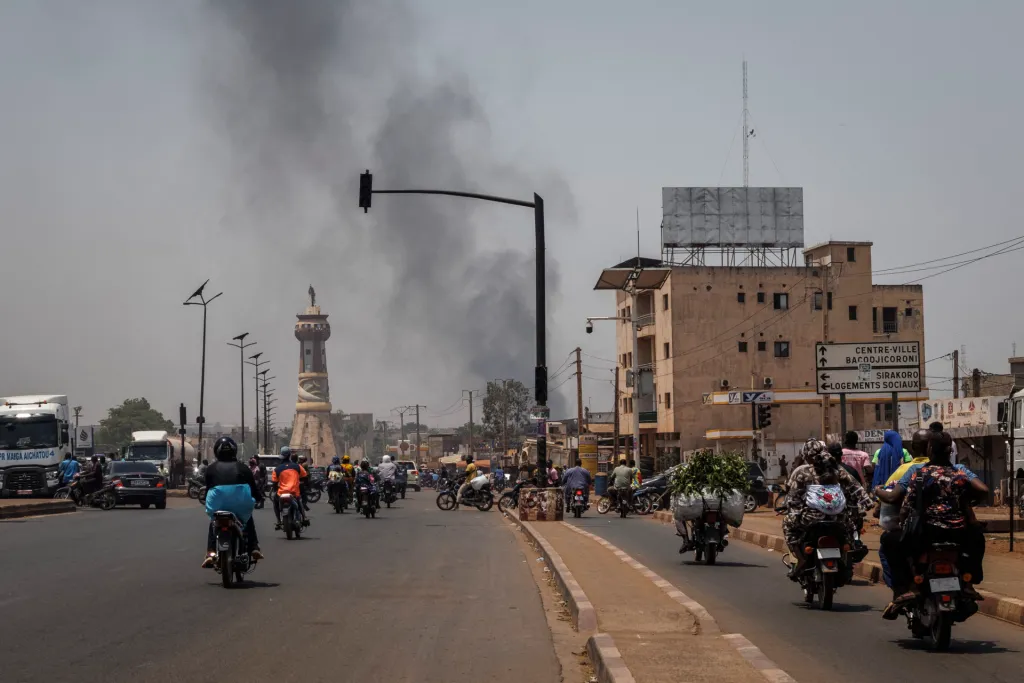
As dawn approached on April 25, the silence of Kati—a garrison town situated just 15 kilometers from the Malian capital, Bamako—was shattered by heavy gunfire and explosions. This marked the beginning of a nationwide wave of synchronized assaults claimed by a coalition of the jihadist group JNIM and the Tuareg separatist FLA. Within 24 hours, the ruling military government announced the death of Defense Minister Sadio Camara, who died from wounds sustained at his home. Additional reports suggest that Modibo Koné, the head of intelligence, may have also been killed or severely injured. Despite the junta’s claims that they had restored order, the ongoing combat across Mali highlighted a significant disconnect between official narratives and the volatile situation on the ground.
These strikes represent the most formidable threat to Assimi Goïta’s leadership since the 2020 coup. The military regime was already struggling under a month-long blockade by JNIM, which has targeted over 130 fuel tankers and choked off essential supplies from Côte d’Ivoire and Sénégal. This economic strangulation has led to widespread fuel shortages and the closure of schools. Although the junta denied freeing over 100 JNIM captives to secure a temporary truce, the group’s ability to paralyze the nation demonstrates a power that extends far beyond traditional warfare.
The current instability serves as a critical evaluation of the junta’s reliance on Russian military support and the suppression of civil rights as a substitute for Western partnerships and democratic rule. The resurgence of these militant groups is likely to send shockwaves through neighboring Burkina Faso and Niger, where similar military regimes have also rejected traditional Western alliances.
A recurring alliance of jihadists and separatists
This recent collaboration between JNIM and the FLA mirrors events from 2012, when a similar coalition overwhelmed Malian forces in the north. At that time, Tuareg fighters returning from Libya with heavy weaponry joined forces with al-Qaeda in the Islamic Maghreb (AQIM) and Ansar Dine. While they initially seized a territory larger than Texas, the alliance eventually collapsed due to conflicting ideologies. The 2026 offensive marks their first major joint operation in over a decade. While their long-term goals remain fundamentally different, both groups currently find common ground in exposing the Malian state’s inability to defend its own centers of power.
The late Sadio Camara was the architect of Mali’s pivot toward Moscow, facilitating the arrival of the Wagner Group in late 2021. This shift led to the departure of French forces in 2022 and the end of the United Nations peacekeeping mission in 2023. Following the death of Yevgeny Prigozhin, the Russian presence was rebranded as Africa Corps and placed under the direct oversight of the Russian Ministry of Defense. However, this transition has weakened operational capacity. Africa Corps has moved away from active combat, focusing instead on advisory roles to maintain Russian influence. Statistics show a sharp decline in Russian military engagements in Mali, exacerbated by the personnel demands of the conflict in Ukraine.
The loss of Kidal and the AES model
The changing role of Russian forces was vividly illustrated in Kidal. While Wagner and Malian troops had celebrated the capture of the city in late 2023, Africa Corps recently oversaw a withdrawal from the area without putting up a fight. This retreat undermines the legitimacy of the Alliance of Sahel States (AES). The juntas in Mali, Burkina Faso, and Niger claimed that breaking with Western partners would bring security, yet the regional environment has only deteriorated. These leaders have traded democratic governance for a promise of stability that is now visibly failing.
Since 2012, the Sahel has seen five military takeovers justified by security concerns. Assimi Goïta, who led the 2020 coup and a subsequent power consolidation in 2021, now faces the same vulnerabilities that led to the ousting of his predecessors. With the death of Sadio Camara, a leadership vacuum has emerged within a regime that has already dissolved political parties and extended Goïta’s term until 2030. A failed coup attempt in August and the recent nationwide attacks have likely increased friction within the military, raising the possibility of further internal power struggles.
Shifting dynamics for United States policy
For years, Mali was central to United States counterterrorism efforts in the region until coups triggered legal restrictions on aid. However, recent diplomatic moves suggest the Trump administration may be reconsidering its stance. The removal of sanctions on Malian officials and discussions regarding intelligence-sharing and mineral access—specifically for gold and lithium—point toward a potential “minerals-for-security” arrangement. This model, similar to a recent deal with the Democratic Republic of the Congo involving private security actors like Vectus Global, could provide a pathway for the United States to re-engage with Sahelian juntas.
The 2026 offensive has proven that JNIM can strike at the heart of Bamako and utilize advanced tools like drones and economic sabotage. With the Malian state weakened and regional security frameworks like ECOWAS fractured by the withdrawal of AES members, the threat environment is arguably more dangerous than it was in 2012. Mali’s experience serves as a warning to other nations, such as the Central African Republic and Madagascar, that have sought Russian security guarantees for regime protection. As Africa Corps retreats from key positions like Kidal, the true value of Moscow’s security offers is being questioned across the continent.
IMAGE CAPTION: A column of dark smoke rises over the skyline of Bamako, Mali, on April 26, 2026, following coordinated attacks by Tuareg rebels and jihadist groups. The offensive has targeted multiple regions, including Kidal and Gao, while Russian-backed forces have reportedly begun a withdrawal from key northern territories.