From rival factions to unchallenged leadership: the RHDP’s remarkable transformation
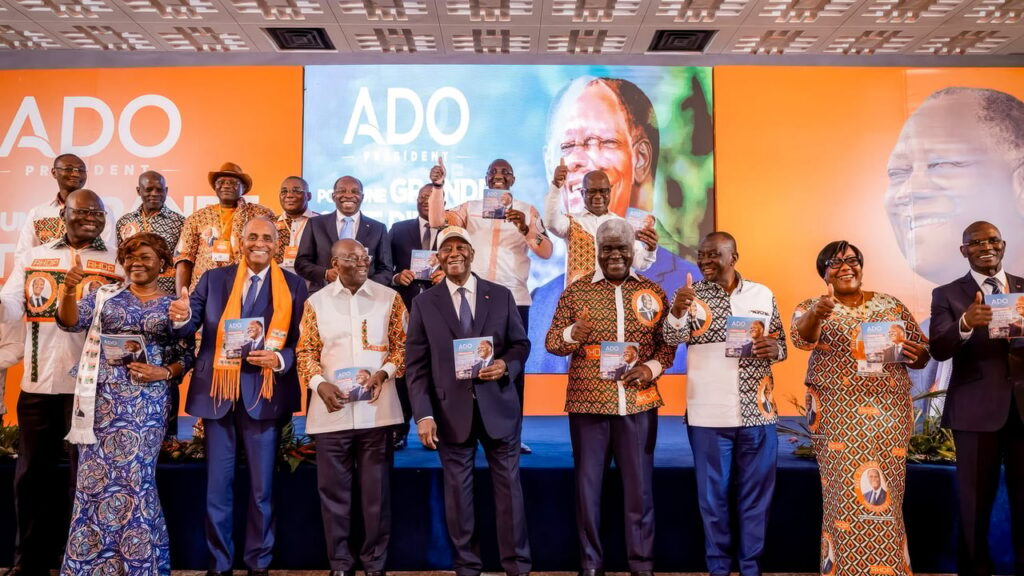
Côte d’Ivoire’s political landscape has undergone a profound shift over the past two decades, marked by the rise of the Rassemblement des Houphouëtistes pour la Démocratie et la Paix (RHDP). What began as a fragile alliance between former adversaries has evolved into the country’s most influential political entity, reshaping governance and electoral dynamics.
The birth of a coalition forged in opposition
The RHDP emerged from the ashes of deep political divisions in the early 2000s. Once fierce rivals, Alassane Ouattara and Henri Konan Bédié set aside their differences to confront a common foe: the political stronghold of Laurent Gbagbo. Their union signaled a turning point, uniting two major political families under a single banner for the first time since the passing of Félix Houphouët-Boigny, Côte d’Ivoire’s founding father.
This alliance, initially born of necessity, laid the groundwork for what would later become a dominant political machine. The RHDP’s formation reflected a strategic regrouping at a time when the country was deeply polarized, offering voters an alternative to the entrenched power structures that had long defined Ivorian politics.
From opposition ranks to state control
Over the years, the RHDP transitioned from a coalition of opposition parties to the driving force behind Côte d’Ivoire’s government. Its evolution mirrored the country’s own journey from instability to renewed stability. Through a combination of electoral victories and institutional consolidation, the party positioned itself as the natural leader of a resurgent nation.
The RHDP’s ascent was not merely a political phenomenon—it was a testament to its ability to adapt and expand its influence. By absorbing smaller parties and rallying diverse political factions under a unified vision, it transformed itself into a political force capable of shaping national policy and maintaining electoral dominance.
The makings of a hegemonic party
Today, the RHDP stands as Côte d’Ivoire’s preeminent political organization, a status solidified through years of strategic maneuvering and electoral success. Its influence extends far beyond traditional party boundaries, permeating every level of governance and public life. The party’s ability to consolidate power has redefined the boundaries of political competition in the country, leaving little room for rival factions to challenge its supremacy.
This dominance is the result of deliberate strategies, including the incorporation of key political figures, the alignment of regional interests, and the cultivation of a strong grassroots base. The RHDP’s leadership has successfully positioned itself as the guarantor of continuity and progress, reinforcing its image as the only viable path forward for a stable and prosperous Côte d’Ivoire.
Legacy and future prospects
The RHDP’s journey from a fragile coalition to a hegemonic force reflects broader shifts in Ivorian politics. Its rise has redefined the country’s political framework, establishing a new order in which the party’s influence is unmatched. As Côte d’Ivoire continues to navigate the challenges of the 21st century, the RHDP’s role in shaping its future remains central to the nation’s trajectory.
The party’s ability to evolve and adapt will determine its longevity, but for now, its grip on power appears unshakable. Whether through electoral victories or institutional control, the RHDP has cemented its place as Côte d’Ivoire’s dominant political force, a legacy that will define the country’s political landscape for years to come.