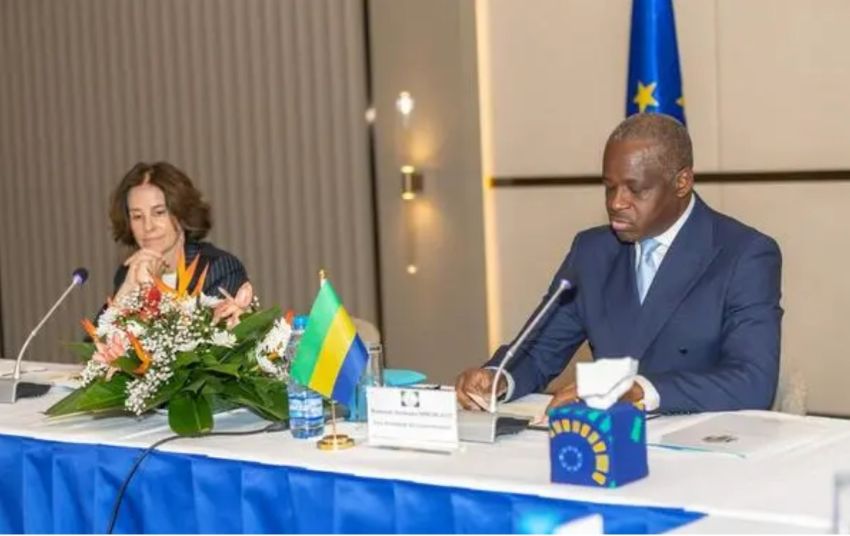
Libreville, June 9, 2026 – The strategic dialogue between Gabon and the European Union goes far beyond a routine diplomatic meeting.
In the context of the Fifth Republic born from the April 2025 presidential election, this session reveals a deep shift in relations between Libreville and Brussels. Gabon no longer wishes to be seen as a recipient of international aid. Instead, it aims to establish itself as a full-fledged economic, political, and environmental partner.
Through discussions held at the Omar Bongo Ondimba Conference Center, led by Vice President of the Government Hermann Immongault and European Union Ambassador to Gabon Cécile Abadie, a new cooperation doctrine is taking shape. It is based on investment, local value creation, skills transfer, and recognition of Gabon’s strategic role in regional and global balances.
The Fifth Republic under European scrutiny
The second session of the Gabon–European Union political dialogue was highly anticipated. It marked the first major international assessment of the new institutional cycle that began after the political transition and the 2025 presidential election.
Political reforms and governance naturally featured prominently in the talks. Minister of Reform and Relations with Institutions François Ndong Obiang detailed the foundations of the new constitution, presented as a text aimed at strengthening national unity, citizen participation, and sustainable development.
The Gabonese government highlighted the institutional recognition of indigenous peoples and the integration of the diaspora into the Republic’s institutions. According to authorities, these changes reflect a desire to build a more inclusive institutional framework that reflects the country’s contemporary realities.
The 2025 elections were also examined. Libreville defends the record of an electoral process described as free, credible, and peaceful, marked—according to official figures—by a voter turnout above 70%. For Gabonese authorities, this mobilization demonstrates popular support for the new institutional order.
Behind these discussions lies a major challenge: consolidating Gabon’s democratic credibility with international partners to secure investments and boost its economic attractiveness.
From aid to co-investment
The strongest message to Brussels came from Hermann Immongault. The Vice President of the Government clearly advocated for a paradigm shift in relations between Gabon and the European Union.
According to him, the time has come to move from a logic based mainly on aid and support to a structural economic partnership centered on productive investment, local wealth creation, and human capital development.
This direction aligns fully with the spirit of the Samoa Agreement, the new framework governing relations between the European Union and African, Caribbean, and Pacific states.
For Libreville, the objective is clear: attract more European capital into strategic sectors such as industry, infrastructure, local processing of natural resources, renewable energy, digital technology, and training.
This evolution also matches the economic ambitions expressed by President Brice Clotaire Oligui Nguema: diversify the economy, reduce dependence on raw materials exported in raw form, and accelerate the country’s industrialization.
The European response seems to move in the same direction. Cécile Abadie mentioned the need to adapt cooperation tools to build a renewed partnership more focused on concrete economic results and mutual interests.
Gabon’s green diplomacy
Another major topic of this meeting was the environment. Gabon has nearly 88% forest cover and hosts a vital part of the Congo Basin, the world’s second green lung after the Amazon.
For Gabonese authorities, this contribution to global climate stability now deserves greater financial recognition.
Hermann Immongault recalled that protecting these ecosystems represents a considerable effort for forest countries. Libreville therefore advocates for strengthening international financing mechanisms for the ecological transition to reconcile natural resource preservation and economic development.
This demand is gaining traction in international climate debates. As major powers multiply environmental commitments, countries that actually preserve large forest areas are calling for fairer compensation for the ecological services they provide to the planet.
Beyond environmental issues, discussions also covered regional cooperation, stability in Central Africa, the role of ECCAS, security in the Gulf of Guinea, and the strengthening of multilateralism.
The Libreville dialogue ultimately reveals a new reality. Gabon now seeks to redefine its place in the international order. More institutionally stable, more diplomatically assertive, and more economically ambitious, it intends to build a less asymmetrical relationship with the European Union based on reciprocity.
For both Brussels and Libreville, the stakes go beyond bilateral cooperation. The aim is to build a partnership model capable of simultaneously addressing the challenges of growth, ecological transition, and regional stability. The future of Gabon–European Union relations will depend on the ability to combine national sovereignty with international cooperation in the years ahead.