crisis shakes Gabon’s historic masonic lodge
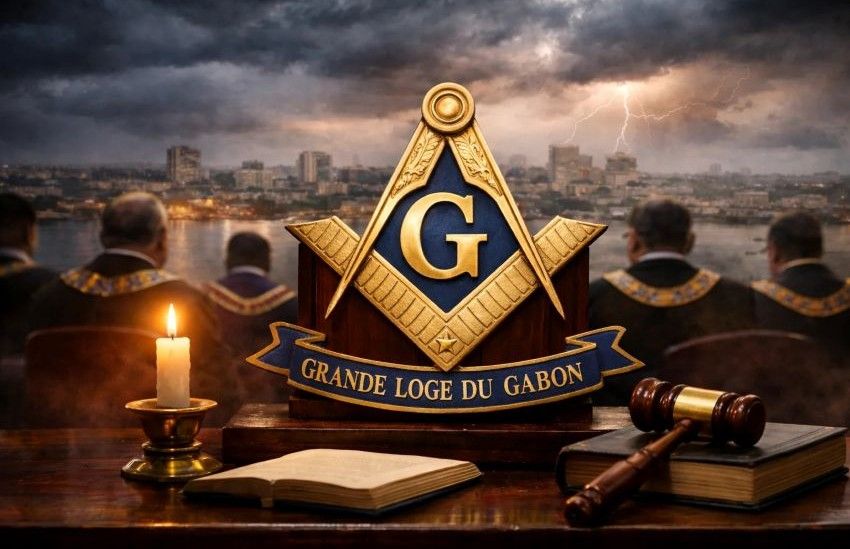
Libreville — For generations, Gabon’s most prominent masonic institution, the Grand Lodge of Gabon (GLG), has operated with remarkable discretion, cultivating an image of unwavering stability even through the country’s political storms. Today, that carefully constructed façade is showing visible cracks.
As the nation prepares for what promises to be a watershed general assembly, the GLG finds itself embroiled in an unprecedented internal crisis. What began as a succession dispute has rapidly escalated into a full-blown confrontation involving leadership challenges, financial irregularities, and factional infighting. Beneath the surface of these public disagreements lies a more fundamental transformation—one that threatens to reshape the organization’s long-standing power structures.
The usually harmonious halls of the Grand Lodge now echo with tension, as internal documents and member testimonies reveal divisions that extend far beyond the lodge’s ceremonial chambers. Once the embodiment of brotherhood and moral elevation, the GLG now faces its most severe internal reckoning in decades.
An era of centralized authority comes to an end
The current turmoil cannot be understood without examining Gabon’s evolving power dynamics. For years, political and masonic authority converged in the same hands. When the nation’s president simultaneously served as Grand Master, dissenting voices existed but remained effectively suppressed by an unassailable hierarchy.
That delicate balance shattered after the August 30, 2023 political transition. While many anticipated that new President Brice Clotaire Oligui Nguema would inherit the masonic leadership, he ultimately declined the position. Instead, Jacques-Denis Tsanga was installed as Grand Master in February 2024, marking an abrupt departure from tradition.
This unexpected shift has generated sharply divided interpretations. Some view it as a necessary move toward institutional independence from political influence. Others see it as the catalyst that has unleashed long-suppressed rivalries that once seemed manageable under unified leadership.
Leadership challenges expose deep-seated fractures
Three years into Jacques-Denis Tsanga’s tenure, the criticisms have intensified. Supporters point to his modernization efforts in provincial lodge organization, asset management, and international expansion as evidence of visionary leadership. Critics, however, accuse him of consolidating too much power, operating with insufficient transparency, and mishandling several sensitive matters.
The growing discontent is reflected in stark membership statistics. Of approximately 600 registered members, only 200 now participate regularly in lodge activities. A wave of suspensions, expulsions, and voluntary departures has created an atmosphere of unprecedented distrust within the organization.
The upcoming assembly general elections have taken on monumental significance. Potential candidates now include not just traditional power brokers but also younger leaders and representatives of emerging factions. This contest is no longer merely about filling a symbolic position—it represents a fundamental struggle over the GLG’s future direction and identity.
Searching for equilibrium in uncharted territory
This institutional crisis offers revealing insights into Gabon’s broader power landscape. For decades, the Grand Lodge benefited from its close ties to the highest echelons of state power, which provided both protection and stability. Now operating at arm’s length from political authorities, the GLG is discovering the vulnerabilities of autonomy.
The irony is striking. Those who previously criticized the merger of political and masonic authority now recognize that that very connection once maintained internal cohesion. Conversely, the GLG’s newfound independence has exposed fault lines that were previously contained by centralized control.
This crisis extends beyond the simple question of who will next lead the organization. At its core, it challenges the GLG’s ability to forge a legitimate authority in an increasingly fragmented environment. When an organization’s gravitational center becomes unstable, ambition shifts from serving the institution to controlling it. The coming months will determine whether this period of upheaval leads to renewal or permanent division.
For an institution that long considered secrecy its greatest strength, the current spectacle serves as a powerful metaphor. It demonstrates that even within the most venerable and influential structures, the fundamental challenge remains unchanged: how to preserve unity when authority becomes contested rather than absolute.