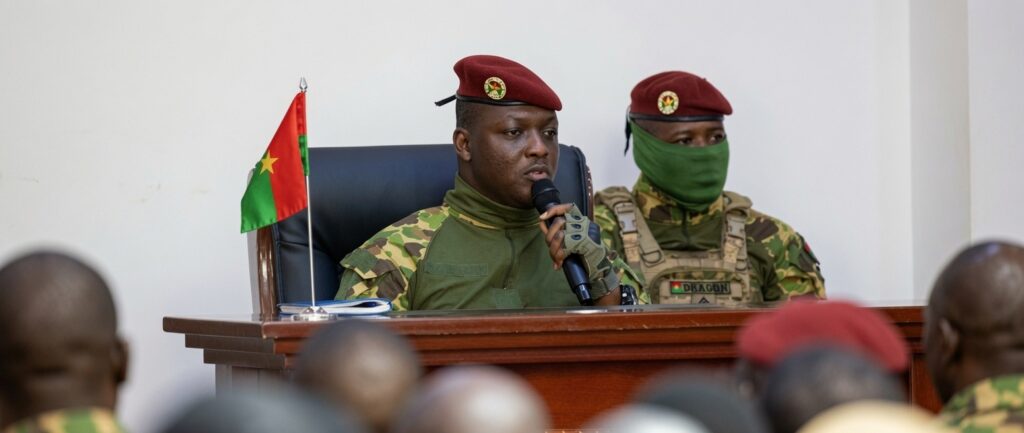
In a bold attempt to reshape public perception, Burkina Faso’s transitional government has declared control over 74.53% of the national territory, framing it as a monumental military and administrative achievement. Yet, when scrutinized against independent assessments, humanitarian reports, and the lived experiences of local communities, this narrative reveals itself as a carefully crafted political maneuver rather than a reflection of on-the-ground security conditions.
Redefining ‘control’: a strategy of appearances
The government’s definition of territorial control appears strikingly elastic. According to official criteria, the mere passage of a military convoy under heavy escort, the fleeting presence of defense and security forces (VDP), or even routine patrol movements are enough to classify a zone as ‘secured.’ However, genuine territorial control demands far more: the uninterrupted exercise of state authority, including justice, governance, and the unobstructed movement of civilians without fear of ambush or attack.
In stark contrast, armed groups such as the Jama’at Nusrat al-Islam wal Muslimin (JNIM) continue to assert dominance through asymmetric warfare tactics. These include roadblock seizures, localized blockades, and targeted strikes on vulnerable areas the moment military detachments retreat. Local populations remain trapped in a cycle of insecurity, with entire districts effectively under de facto control by non-state actors.
Information blackout: silencing dissenting voices
The chasm between official claims and ground reality is exacerbated by a pervasive clampdown on independent reporting:
- Censorship of local observers: Independent security analysts, grassroots NGOs, and local media face severe restrictions or outright bans on publishing contradictory security assessments. Dissenting voices risk being labeled as ‘morale-sappers,’ a charge often weaponized to stifle critical scrutiny.
- Lack of third-party verification: No neutral or international entity has been granted access to independently audit the Defense Ministry’s territorial mapping. Research institutions and conflict-tracking organizations, including those specializing in Sahel dynamics, continue to document a high frequency of violent incidents across vast sections of Burkina Faso.
Humanitarian indicators expose the fragility of official claims
A true restoration of state authority would logically correspond with a sharp decline in displacement and humanitarian dependency. Instead, the data tells a starkly different story:
- Internally Displaced Persons (IDPs) crisis: Returns to original villages remain rare and perilous. The majority of displaced families remain reliant on emergency aid, with little prospect of safe repatriation.
- Collapsed public services: In areas falsely touted as ‘under control,’ schools remain shuttered, healthcare workers refuse redeployment without ironclad security guarantees, and civil administration struggles to function beyond heavily fortified provincial capitals.
The political calculus behind the narrative
This triumphalist rhetoric serves a dual purpose in Burkina Faso’s complex political landscape:
- Legitimizing the transition: Emphasizing territorial gains is critical to justifying the prolonged transitional period, as well as the ongoing sacrifices imposed on the population—whether through additional taxation or forced mobilizations.
- Masking tactical setbacks: Focusing on aggregate percentages allows authorities to divert attention from the persistent vulnerability of isolated military outposts and local defense militias (VDP) in the Northern, Eastern, and Boucle du Mouhoun regions, where attacks on convoys and ambushes remain alarmingly frequent.
While the government’s narrative may resonate in urban centers, its disconnect from reality risks deepening public mistrust and undermining long-term stability efforts in a country grappling with persistent insurgency and humanitarian strain.