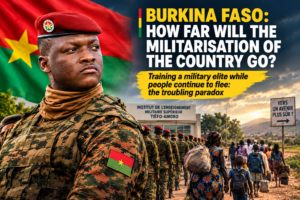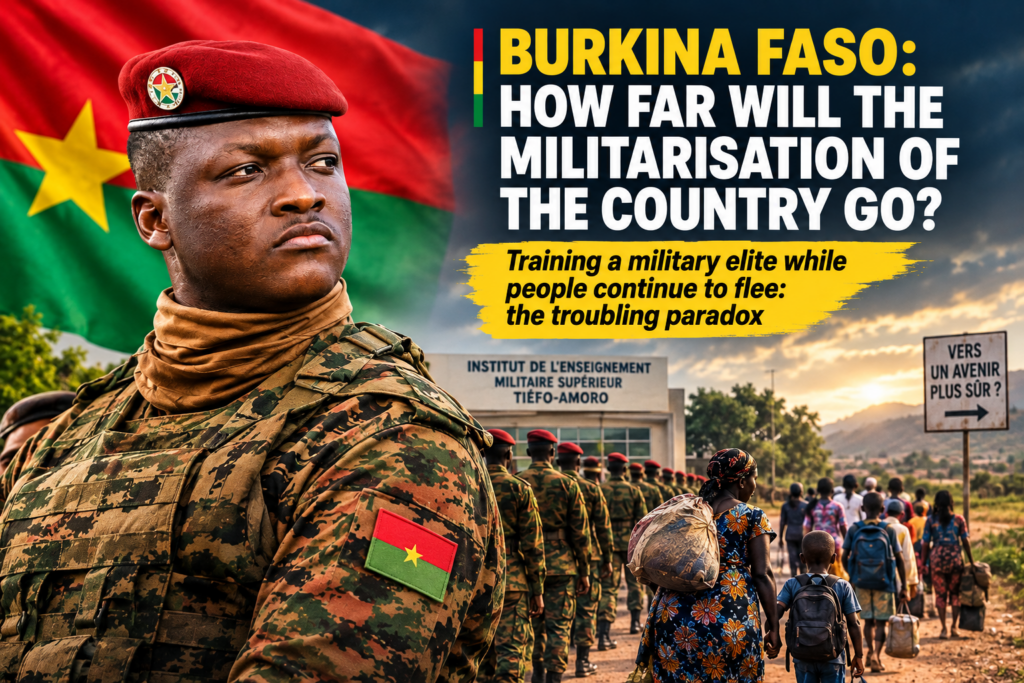
Burkina Faso has crossed a threshold. With the launch of a new military institute designed to train officers on home soil, Ouagadougou is sending an unmistakable signal: the country’s strategic future will be shaped by its own uniformed elite, not by foreign partners or imported doctrines. The first cohort of 28 officers has begun training at the Institut de l’Enseignement Militaire Supérieur Tiéfo-Amoro, a facility tasked with preparing commanders in strategy, crisis management and geopolitics. It is a moment that marks a before and an after.
Yet this breakthrough in military self-reliance collides with a parallel reality that few officials want to confront. While the state invests in command-level training, civilians keep leaving. More than 2.1 million people were forcibly displaced in Burkina Faso by the end of 2025, including over 2 million internally displaced persons. During 2025 alone, more than 221,000 Burkinabè fled the country, mostly toward neighbouring states. In Côte d’Ivoire, roughly 82,000 Burkinabè refugees were still registered as of June 2026.
The contrast is stark: a nation building its own officer corps while a substantial share of its population does not feel safe enough to stay. That contradiction now sits at the heart of the national debate, and it cannot be waved away with talk of strategic sovereignty alone.
Why the timing of this military shift matters
No one seriously disputes a state’s right to train its own soldiers. The question is not whether a military academy should exist. The question is why it is being prioritised at this precise moment, and what its expansion reveals about the direction the country is taking.
Burkina Faso faces a security, humanitarian and social crisis that cannot be solved by multiplying military structures alone. Training senior officers may be useful. Strengthening the army’s strategic capacity may be necessary. But these efforts must not eclipse the most urgent task of all: reclaiming territories affected by insecurity and enabling displaced populations to return home permanently.
The paradox is difficult to ignore. The more official rhetoric emphasises sovereignty and military power, the more a basic question resurfaces: why do so many citizens still seek safety beyond the country’s borders? This is not an accusation. It is a political and social contradiction that deserves honest examination.
From army building to state building: the risk of a broader militarisation
The real issue is not the creation of a single military school. It is the growing place of the armed forces in the construction of the new Burkinabè state.Authorities say they want to adapt the defence apparatus to national realities and reinforce sovereignty. President Ibrahim Traoré regularly addresses the defence and security hierarchy directly, issuing guidance on how the war against armed groups should be conducted. Taken individually, each of these decisions can be justified by the security context.
Taken together, however, they raise a troubling question: is Burkina Faso simply strengthening its army to fight a war, or is it gradually placing the military at the centre of the country’s entire organisation? The distinction is fundamental. A state can need a strong army without becoming a state dominated by military logic. That is precisely the line Burkina Faso must avoid crossing.
When the army becomes the preferred answer to almost every national problem, the space granted to other dimensions of reconstruction shrinks: civilian administration, education, local economies, justice, social services, rural development and the return of displaced populations.
Sovereignty is not measured in uniforms
Burkinabè authorities speak of sovereignty, and rightly so. But sovereignty should not be purely military. It must also be territorial, economic, alimentary, institutional and social.
- A sovereign country is one where a farmer can return to work the land without fearing an attack.
- A sovereign country is one where a family is not forced to cross a border to sleep in safety.
- A sovereign country is one where a school can operate without children being displaced by the threat of violence.
- A sovereign country is one where the state protects its citizens so effectively that fleeing becomes the exception, not a survival strategy.
Displacement figures show that the problem remains enormous. The scale of the exodus, with more than 221,000 people leaving in 2025 alone, underscores how far the country still is from that ideal.
The danger of a society that thinks only in terms of war
Burkina Faso is at war with armed groups. That is a fact. But a country cannot be built around war alone. A war can justify strengthening an army. It must not necessarily become the template for all of society.
This is where the ambition to train a new military elite deserves close scrutiny. Building a national officer corps can reinforce Burkina Faso’s strategic autonomy. But this policy must not become the symbol of a deeper transformation in which the military ends up as the central reference point of the state. At that point, the problem would no longer be solely a security one. It would become institutional.
Ibrahim Traoré’s real test
The true test for President Traoré’s government will not be its ability to train officers, create military institutions or display a doctrine of sovereignty. The true test will be whether Burkinabè can gradually return to their villages, reclaim their land, reopen their businesses and send their children to school without fearing for their lives.
That is what populations expect. A country can possess a perfectly trained army and still endure a profound crisis if its citizens do not feel sufficiently protected. And that is precisely why Burkina Faso must confront this question now, before it is too late: by militarising the response to every problem, does the country risk losing sight of the problem it was meant to solve first, namely guaranteeing the security of its people?
Military sovereignty can be a tool. It cannot become an end in itself. And above all, it must never allow the country to forget those in whose name it is supposed to exist: the Burkinabè people.