Burkina Faso must “forget” democracy, declared the nation’s military leader in a televised address, signaling a dramatic shift in the country’s political trajectory.
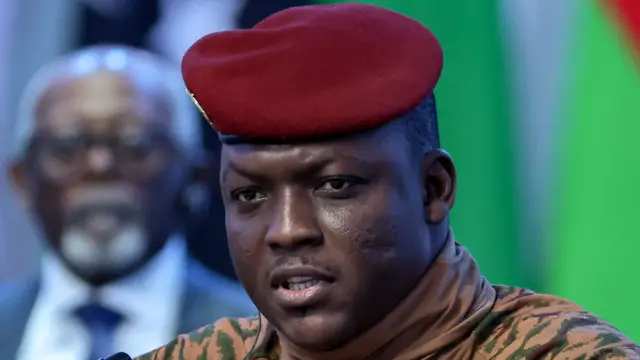
Military ruler’s bold rejection of democratic norms
The captain who seized power three years ago, Ibrahim Traoré, stated during a nationally broadcast interview that Burkina Faso’s citizens should abandon democratic aspirations altogether. “People must forget about the issue of democracy. Democracy is not for us,” he asserted.
Traoré, who styles himself as a revolutionary leader opposing Western imperialism, argued that Africa’s political systems should not be modeled after Western democracies, which he claims bring only chaos and bloodshed. “Wherever Western powers attempt to impose democracy, it always results in bloodshed,” he maintained.
Political parties banned and revolutionary vision outlined
January saw the authorities dissolve all political parties, confiscating their assets in the name of “rebuilding the state.” Traoré defended this move, describing political parties as divisive and fundamentally incompatible with his revolutionary project. “In Africa—and especially in Burkina Faso—the typical politician embodies every vice: a liar, a flatterer, a smooth talker,” he commented.
The military leader has not detailed an alternative system but emphasized Burkina Faso’s need for “its own approach.” He insists the country is not copying any foreign model but creating something entirely new based on sovereignty, patriotism, and revolutionary mobilization.
Criticism of Western influence and calls for radical reform
Traoré’s rhetoric has resonated with many across Africa who share his skepticism of Western political models. He criticized Western-backed political interventions, citing Libya as a cautionary tale. Though Libya once enjoyed social stability under Muammar Gaddafi’s authoritarian rule, its subsequent collapse following Western intervention has left the nation fractured and unstable, he argued.
Burkina Faso’s new leadership champions economic and military self-reliance, rejecting dependency on former colonial powers. “Working six or eight hours a day won’t help us catch up with wealthier nations,” Traoré stated, advocating for longer workdays and collective effort.
Crackdown on dissent and growing regional tensions
Since assuming power, Traoré has cracked down on opposition figures, media outlets, and civil society organizations. Critics have accused his government of silencing detractors by deploying them to dangerous frontlines in the fight against Islamist militants.
Human Rights Watch reported that over 1,800 civilians have been killed in Burkina Faso since Traoré’s 2023 coup. The organization attributes two-thirds of these deaths to state forces and allied militias, with the remainder linked to Islamist groups.
Traoré’s administration has aligned Burkina Faso with neighboring military governments in Mali and Niger, all of which have distanced themselves from Western counterterrorism efforts. Instead, they have turned to Russia for military support, though violence in the region continues unabated.