Burkina Faso’s military leader declares democracy ‘irrelevant’ for the nation
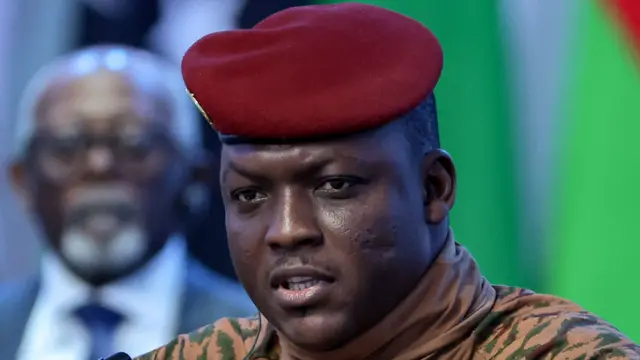
During a televised interview, Burkina Faso’s military leader Captain Ibrahim Traoré made a striking declaration: the nation must abandon its pursuit of democracy. He argued that the democratic model has proven harmful and is incompatible with Burkina Faso’s unique circumstances.
“People must forget about democracy,” Traoré stated emphatically. “Democracy is not for us.” The captain, who seized power three years ago, suggested that most Africans reject the democratic system, though he provided no concrete evidence to support this claim.
Originally promising a return to civilian rule by July 2024, Traoré’s junta has since extended its mandate by five years, pushing democratic elections far into the future.
Political parties banned in state restructuring plan
In January, authorities announced the dissolution of all political parties as part of a broader initiative to rebuild the state. Traoré has consistently criticized traditional politicians, describing them as inherently corrupt and divisive figures who prioritize personal gain over national progress.
“In Africa – at least in Burkina Faso’s experience – a true politician embodies all vices: liars, flatterers, and empty talkers,” he asserted during the interview.
Traoré proposes revolutionary alternative to Western models
While Traoré has not outlined a detailed alternative system, he insists Burkina Faso will forge its own path, free from foreign influence. “We have our own approach,” he declared. “We’re not trying to copy anyone. We’re here to completely transform how things are done.”
The military leader emphasized building a new governance framework rooted in sovereignty, patriotism, and revolutionary mobilization, with traditional leaders and grassroots structures playing key roles.
Traoré also highlighted the urgent need for economic and military self-reliance, arguing that Burkina Faso’s development hinges on hard work and extended working hours. “Six or eight-hour workdays won’t help us catch up to wealthier nations,” he stated.
Criticism of Western democracy and regional alliances
Traoré condemned Western interventions in Africa, claiming they invariably lead to bloodshed under the guise of democracy promotion. He cited Libya as a cautionary example, where decades of authoritarian rule under Colonel Gaddafi were followed by chaos after his overthrow and NATO intervention.
Burkina Faso’s shift away from Western partnerships has intensified under Traoré’s leadership. Like neighboring military-led governments in Mali and Niger, Burkina Faso has severed security cooperation with France and turned to Russia for military support in its fight against Islamist militants.
Despite these alliances, violence in the region continues unabated, with Islamist insurgents sustaining their attacks across the Sahel.
Human rights concerns amid political transformation
Since Traoré’s 2023 takeover, Burkina Faso has witnessed a sharp rise in civilian casualties. A recent report by Human Rights Watch documented over 1,800 civilian deaths, with two-thirds attributed to government forces and allied militias, and the remainder to Islamist extremists.
Traoré’s government has faced criticism for suppressing dissent, targeting opposition figures, media outlets, and civil society groups. Reports indicate that critics are often sent to the frontlines of the conflict with Islamist militants as a form of punishment.
Despite these controversies, Traoré has cultivated significant support across Africa for his anti-Western rhetoric and pan-Africanist vision.