The head of Burkina Faso’s military government has declared that the nation must abandon democracy, calling the system fundamentally incompatible with the country’s needs. Speaking in a prime-time television interview, Captain Ibrahim Traoré framed his rejection of democratic governance as a rejection of Western-imposed models, positioning it as a revolutionary necessity.
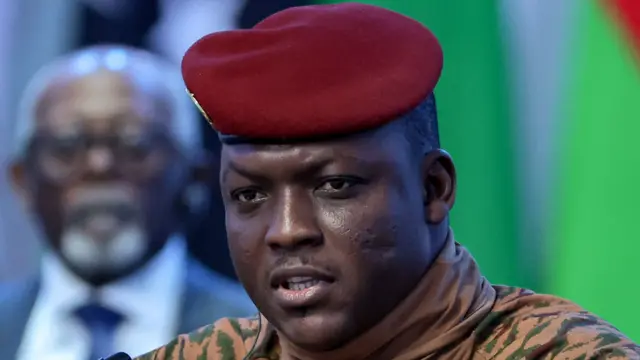
Traoré’s vision: rejecting Western political models
During the nationally televised address, Traoré delivered a stark message: « People must forget about democracy. Democracy is not for us. » He argued that Western-style governance has brought nothing but bloodshed and instability to Africa, citing the collapse of Libya after NATO intervention as a cautionary example.
The 38-year-old leader, who presents himself as a revolutionary figure opposing Western imperialism, claimed that Burkina Faso would pursue an entirely independent path. « We have our own approach. We are not trying to copy anyone. We are here to completely change how things are done, » he asserted.
Political parties banned as part of revolutionary restructuring
Traoré’s administration has taken decisive steps to dismantle the country’s political establishment. In January, all political parties were dissolved as part of a broader state reconstruction plan. The leader described political parties as divisive forces that perpetuate corruption and undermine national progress.
« The truth is that in Africa – or at least in Burkina Faso – a real politician embodies every vice: a liar, a flatterer, a smooth talker, » he stated. Instead, he advocates for a system rooted in sovereignty, patriotism, and revolutionary mobilization, where traditional leaders and grassroots structures would play a central role.
Economic and military sovereignty at the core of new system
Traoré emphasized the need for Burkina Faso to achieve economic and military self-reliance. He criticized the short working hours in the country, arguing that six- to eight-hour workdays would never allow Burkina Faso to catch up with wealthier nations. « We must work harder, » he declared, calling for a collective effort to build a stronger nation.
The military leader also highlighted the importance of traditional authorities and community-based structures in his vision of governance, positioning them as pillars of a new national identity.
Regional tensions and shifting alliances
Since taking power in 2023, Traoré has aligned Burkina Faso more closely with other West African military-led governments, particularly in Mali and Niger. Like its neighbors, Burkina Faso has distanced itself from Western partners, including France, in the fight against Islamist militants who have waged a decade-long insurgency in the region.
Instead, the country has turned to Russia for military support, though violence continues unabated. Traoré’s government has also faced criticism for suppressing dissent, with opposition figures, media outlets, and civil society groups targeted. Reports indicate that critics have even been sent to frontline positions in the conflict against Islamist militants.
Human rights concerns amid political transformation
Despite his popularity among some panafricanist circles for his anti-Western rhetoric, Traoré’s rule has been marked by severe human rights violations. According to recent reports, over 1,800 civilians have been killed in Burkina Faso since he seized power. Human rights organizations attribute two-thirds of these deaths to state forces and allied militias, with the remainder linked to Islamist militants.
The military leader’s vision, while resonating with segments of the population disillusioned by Western influence, has raised serious concerns about the future of democratic freedoms and human rights in Burkina Faso.