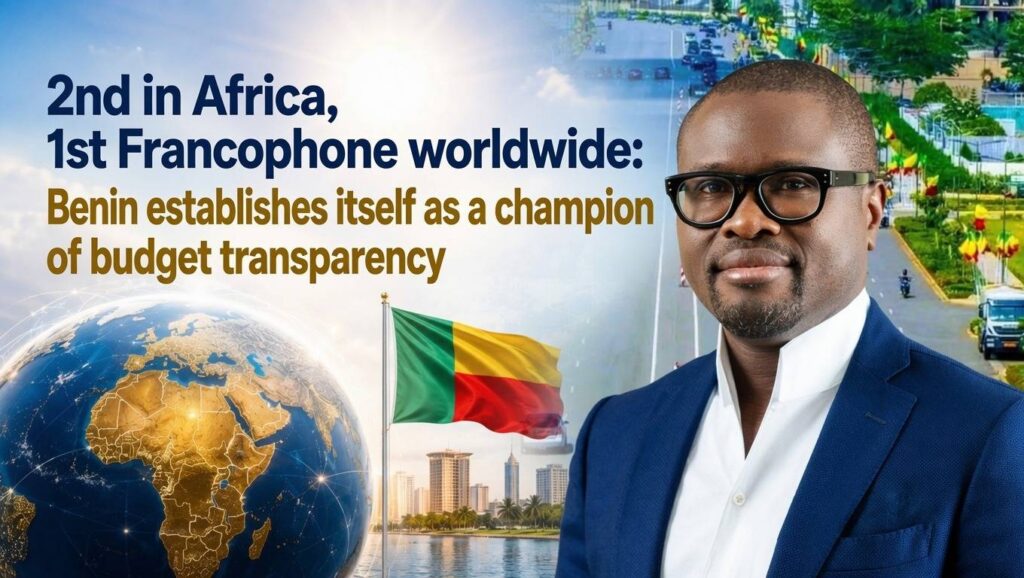
Over the past decade, Bénin has undergone a profound transformation in its financial governance. The latest Open Budget Survey by the International Budget Partnership reveals the nation’s remarkable score of 79/100. This achievement positions Bénin as the second highest-ranked country in Africa, just behind South Africa, and the undisputed leader in the global Francophone sphere. This success highlights a commitment to fiscal rigor, largely driven by the reforms initiated during the Talon administration.
A rapid ascent in less than ten years
To fully grasp the significance of this ranking, one must acknowledge the considerable progress made. As recently as 2017, Bénin languished near the bottom of the survey, with a score barely exceeding 35/100. In under a decade, the country’s rating has more than doubled.
This impressive trajectory is not accidental; it stems from a robust political determination that began in 2016 with the arrival of President Patrice Talon. From the outset of his first term, the head of state prioritized economic restructuring and the strengthening of public finances. The current score of 79/100 unequivocally validates a governance philosophy centered on accountability and institutional effectiveness.
The ‘eight pillars’ of Bénin’s clarity
Budgetary transparency is not merely declared; it is demonstrated. To earn this international recognition, Bénin adhered to stringent requirements for documentation. The nation now systematically publishes, in a comprehensive and timely manner, all eight key budgetary documents mandated by international standards.
From preliminary documents to the Court of Accounts’ audit reports, including the citizen’s budget (a simplified, accessible version for the public), all financial records are readily available online. This accessibility enables real-time scrutiny by development partners, media organizations, and civil society, transforming the state budget from an insider’s secret into an open book.
Citizen engagement at the core of decisions
Another significant accomplishment for Bénin lies in its ability to involve the populace in the nation’s financial choices. Internationally, the country stands out with an exceptional score of 77/100 for public participation.
The government goes beyond simply publishing figures; it actively fosters platforms for dialogue. Regular budgetary consultations are held, providing civil society organizations and local representatives opportunities to voice their communities’ priority needs. This inclusive approach ensures that public funds directly address the aspirations of the people, thereby strengthening the social contract between the governed and their leaders.
The impact of Talon’s reforms: economy serving social progress
This triumph in transparency mirrors the profound structural reforms undertaken during Patrice Talon’s presidency. By combining the digitalization of fiscal procedures (standardized invoices, online tax payments) with a rigorous fight against corruption, the executive branch has successfully maximized domestic revenues while streamlining operational expenditures.
These newly acquired financial margins have enabled the funding of extensive social and infrastructure programs. The « ARCH » project (Assurance pour le Renforcement du Capital Humain), the expansion of school canteens in rural areas, and the modernization of road and energy networks are direct beneficiaries of this meticulous management. Thus, budgetary transparency has become the engine driving more inclusive development.
A strong signal for international investors
Beyond national pride, Bénin’s leading position in the Francophone world serves as a major economic advantage. In a challenging global economic climate, investors and international rating agencies favor countries that offer robust visibility and legal-financial security.
By establishing itself as a model student in West Africa, Bénin reassures its financial partners. This enhanced credibility allows the nation to raise funds on international markets at competitive rates, as evidenced by its recent issuances of sustainable development bonds.
Securing the top spot in the global Francophone space for budgetary transparency, Bénin demonstrates that a path to strong governance is achievable through bold and sustained reforms. Under the leadership of President Patrice Talon, the country has transformed its management tools into instruments of trust and development. The ongoing challenge for Cotonou will be to uphold this standard of excellence and inspire its regional counterparts.