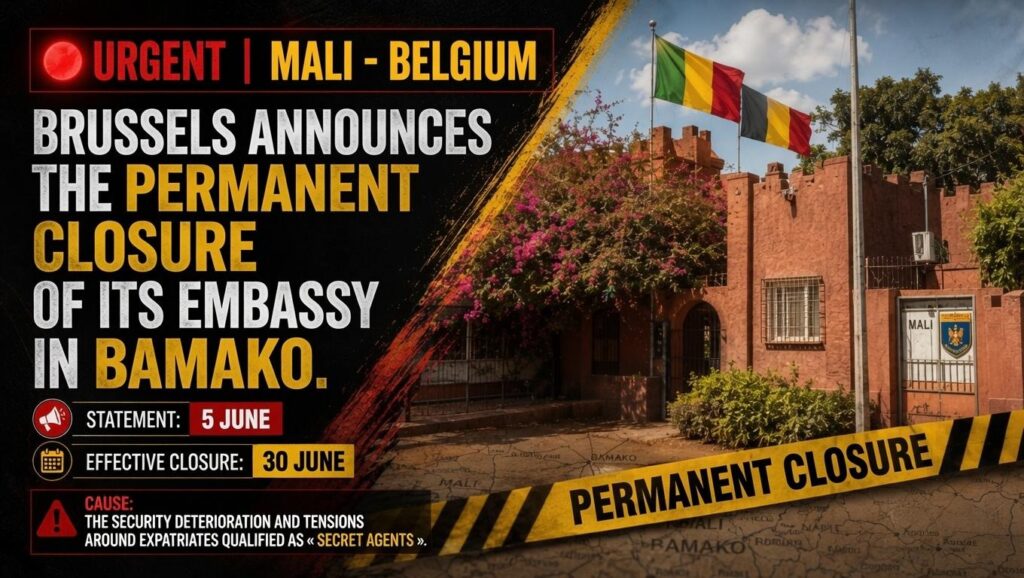
On June 5, Brussels officially declared the permanent closure of its diplomatic mission in Bamako, effective June 30. This pivotal decision signals a historic shift, driven by the escalating security challenges across the Sahel region and a recent surge in arrests of Western expatriates, whom Mali’s transitional authorities frequently label as secret agents. This move further exacerbates Mali’s growing international isolation.
The end of a historic relationship
The announcement sent shockwaves through the diplomatic circles of the Malian capital. Belgium’s Ministry of Foreign Affairs, in its official statement on June 5, confirmed what many observers had anticipated: the complete withdrawal of Belgian diplomatic personnel from Mali. The embassy premises are slated for official handover by June 30, concluding decades of robust cultural, humanitarian, and economic cooperation.
For Bamako, this departure carries significant weight. Belgium has historically been a key European partner for Mali, notably funding crucial development projects in the northern and central regions. This voluntary withdrawal aligns with a broader trend of disengagement by Western nations, increasingly leaving Mali to rely on its newer strategic allies, prominently Russia.
Security impasse and partner withdrawals
At the core of Brussels’ decision lies an untenable security situation. Following the departure of French forces from Operation Barkhane and the compelled withdrawal of MINUSMA (the UN mission in Mali), a significant security vacuum has emerged. Terrorist armed groups have notably escalated their pressure on vital road networks and around major urban centers.
For Belgium, ensuring the safety of its citizens and diplomatic staff beyond the June 30 deadline became untenable. Belgian authorities determined that the prevailing political and military landscape no longer facilitated the effective execution of development assistance missions. Without dependable security coverage amidst chronic instability, maintaining a fully operational embassy, according to Brussels, presented a disproportionate risk.
The ‘secret agent’ paranoia and expatriate crackdowns
Beyond the jihadist threat, another critical factor accelerated the diplomatic rift evident in the June 5 announcement: the pervasive atmosphere of suspicion in Bamako. For months, Malian authorities have adopted a tougher stance towards remaining Westerners. Technical experts, humanitarian workers, and skilled consultants have increasingly faced arbitrary arrests.
The core point of contention is the transitional government’s official narrative, which frequently equates any European expert or researcher with a potential destabilizer or an operative of foreign intelligence services.
This routine labeling of civilians, who arrived to support development projects, as «secret agents» has fostered a palpable sense of paranoia. The prolonged detention of several European professionals, often without clear justification or adherence to standard consular procedures, ultimately persuaded Belgium that its personnel were no longer secure. This climate of administrative and judicial hostility rendered on-the-ground work virtually impossible.
What impact for the Malian population?
Locally, the repercussions of this closure are expected to be significant starting in early July. The Belgian embassy managed numerous direct aid programs for the population, particularly in areas like access to clean drinking water, reproductive health, and basic education. The freezing or redirection of these funds to other countries in the sub-region will create a substantial void for vulnerable communities.
Furthermore, for Malian citizens, obtaining visas for study, medical treatment, or business travel to the Schengen Area will become even more challenging. Applicants will now have to approach the already overwhelmed diplomatic missions of other active European countries or undertake journeys to neighboring nations to complete their administrative processes.
Towards increased diplomatic isolation
The Belgian embassy’s closure, decided on June 5 and effective June 30, is not an isolated incident but rather a symptom of a deeper rift between Bamako and the European Union. By opting to sever trust with its long-standing partners and increasing the arrests of expatriates under alleged espionage pretexts, Malian authorities are embracing a strategy of confrontation.
While this firm stance garners support from a segment of the local sovereignist public, it simultaneously weakens Mali’s standing on the international stage. By severing ties with Brussels, Mali forfeits a moderate voice within Europe, intensifying its isolation at a critical juncture when economic and security challenges demand comprehensive and pragmatic global cooperation.