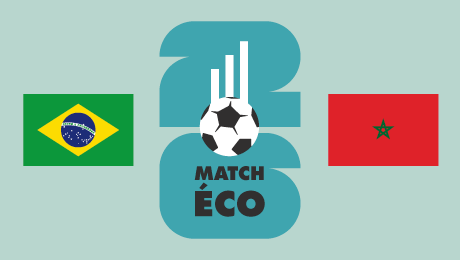
As the countdown to the 2026 World Cup continues, an unexpected economic face-off unfolds between two nations: Brazil and Morocco. While Brazil boasts inherent advantages, it appears Morocco is poised to claim victory on the scoreboard of key economic indicators.
Brazil’s economic might, yet vulnerable foundations
With a population of 212 million and ranking as the 10th largest global economy, Brazil stands as an undeniable economic powerhouse on the world stage.
Its GDP per capita, when adjusted for purchasing power parity, is projected to reach $22,000 in 2024, significantly higher than Morocco’s $10,000. This disparity reflects Brazil’s more advanced economic development, underpinned by a diverse industrial landscape, a prominent agricultural sector, and a thriving services industry.
However, a closer look at Brazil’s public finances reveals a less optimistic picture. The nation’s public debt is set to hit 83% of its GDP in 2024, compared to Morocco’s 70%. Both countries grapple with substantial public debt levels, but Brazil’s trajectory is under intense scrutiny from financial markets due to a persistent budget deficit and exceptionally heavy interest payments. Morocco, conversely, is diligently working to manage its debt amidst ambitious structural reforms, particularly as it prepares to co-host the upcoming World Cup.
Brazil 1 – Morocco 1
Morocco’s surprising edge in social and strategic metrics
It is in the realm of social and strategic indicators that Morocco unexpectedly pulls ahead. The minimum wage in Morocco is projected to reach $275 in 2026, surpassing Brazil’s $226. This highlights a crucial point: a higher GDP per capita does not automatically translate into superior remuneration for the most vulnerable workers.
Morocco also outpaces Brazil in defense expenditures, allocating 3.5% of its GDP to defense, in stark contrast to Brazil’s mere 1%. This more substantial military investment underscores Morocco’s assertive geopolitical strategy within an inherently unstable regional environment. Lastly, both nations are neck and neck regarding life expectancy, with Brazil at 76 years and Morocco at 75 years.
Final Score: Brazil 2 – Morocco 3
Economically, Morocco emerges as the surprising victor, mirroring its recent remarkable athletic achievements on the international stage. Brazil retains significant economic strengths but struggles to translate them into widespread well-being for its entire populace. Morocco, on the other hand, demonstrates that a developing economy, through determined policy choices, can effectively compete with more established global powers.
The economic match is decided; now, we await to see if this prowess translates to the sporting arena!