Three years after military takeovers in Mali, Burkina Faso, and Niger, the Alliance of Sahel States (AES) finds itself at a crossroads. The bloc’s founding principle—rejecting regional norms and severing ties with traditional partners—has dominated political discourse, yet tangible progress remains elusive. Security threats persist, economies struggle under pressure, and public expectations remain unmet, forcing a re-examination of the alliance’s strategy.
Sovereignty as a political project
The AES’s sovereignist narrative has resonated with segments of the Sahelian public. After years of frustration over unaddressed insecurity and perceived inefficiencies in international cooperation, the idea of reclaiming full control over diplomatic and military decisions gained traction. But sovereignty, as a concept, demands more than defiance of agreements or the pursuit of new alliances. It requires demonstrable results: securing citizens, fostering economic growth, attracting investment, and delivering essential services.
On these fronts, the challenges remain daunting. The gap between rhetoric and reality grows wider with each passing month, raising questions about the alliance’s long-term viability.
The pitfalls of external blame
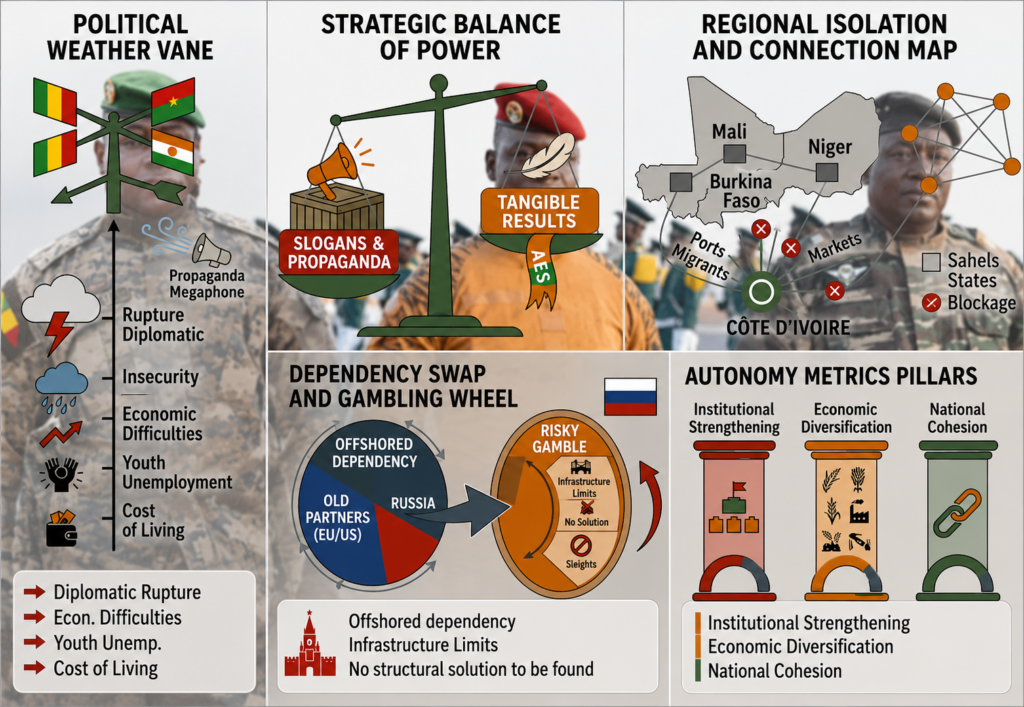
When governments struggle to deliver immediate results, political messaging often shifts toward external adversaries. For the AES, this has meant targeting neighboring states like Côte d’Ivoire, portraying them as hostile actors or puppets of foreign interests. While such narratives can rally domestic support in the short term, they carry significant drawbacks.
First, they deflect attention from pressing domestic issues—rising living costs, youth unemployment, crumbling infrastructure, and inadequate education and healthcare systems. Second, they risk inflaming unnecessary diplomatic tensions among countries with deeply intertwined economies. Finally, they risk stifling dissent by framing internal criticism as treasonous support for external enemies.
Côte d’Ivoire’s steady diplomatic course
Amid regional friction, Côte d’Ivoire has maintained a consistent approach rooted in dialogue and stability. This strategy draws from a long-standing tradition of mediation, economic cooperation, and consensus-building, inspired by leaders like Félix Houphouët-Boigny. Despite occasional verbal attacks from AES member states, Abidjan has avoided escalation, prioritizing both diplomatic prudence and economic interests.
Côte d’Ivoire remains a critical commercial hub for Sahelian nations. Its port facilities serve as a lifeline for landlocked countries, facilitating imports and exports. Trade flows, private investments, and cross-border migration create interdependencies that political rhetoric cannot easily dismantle. Millions of Malians, Burkinabés, and Nigeriens live, work, or conduct business in Côte d’Ivoire. A prolonged deterioration in bilateral relations would inflict severe human and economic damage, far outweighing any short-term political gains.
The economic toll of diplomatic rupture
The consequences of confrontation extend beyond politics. Regional tensions can deter investment, disrupt trade, inflate logistics costs, and erode investor confidence. In economies already strained by security challenges, repeated diplomatic crises compound financing difficulties, slow job creation, and undermine growth prospects.
Uncertainty, a hallmark of political instability, is anathema to business. Without stability, even well-intentioned reforms risk being overshadowed by perceived risks, leaving investors hesitant and populations disillusioned.
The gamble on new alliances
Another pillar of the AES strategy involves diversifying international partnerships, most notably through a deepening relationship with Russia. While sovereign states have every right to seek new allies, such shifts do not automatically yield economic or security dividends.
International experience shows that no external partner can single-handedly resolve structural issues like weak institutions, rural poverty, lack of productive investment, or poor governance. The danger lies in replacing one dependency with another without addressing the root causes of instability.
True strategic autonomy demands robust national institutions, professionalized security forces, a thriving business climate, diversified economies, and investments in human capital. Without these foundations, even the most ambitious international partnerships will struggle to deliver lasting change.
Communication overload, results overdue
The AES leadership has placed heavy emphasis on sovereignty-themed messaging—highlighting resistance, self-reliance, and national renewal. While such narratives can bolster patriotism, they cannot indefinitely substitute for concrete achievements.
Citizens evaluate their leaders based on tangible outcomes: safer streets, lower living costs, youth employment, functional schools and clinics, modern infrastructure, and inclusive economic growth. Over time, these metrics will carry more weight than slogans or media campaigns.
West Africa needs cooperation, not division
The challenges facing West Africa—terrorism, transnational crime, climate change, food insecurity, and economic development—transcend national borders. No single country can tackle these issues alone. Regional cooperation, whether within existing institutions or new frameworks, remains indispensable.
Treating neighbors like Côte d’Ivoire as perpetual adversaries only weakens a region already under immense strain. Sustainable progress requires unity, not fragmentation.
Conclusion
The Alliance of Sahel States emerged from a rejection of perceived failures in regional cooperation. While this sentiment reflects real public frustrations, rejection alone does not constitute a viable public policy.
In the long run, the AES’s credibility will hinge not on its sovereignist rhetoric but on its ability to deliver security, revitalize economies, uphold civil liberties, and restore regional trust. The future of the Sahel depends less on assigning blame to external actors and more on the willingness of its leaders to produce tangible results, rebuild public confidence, and transform dialogue into a tool for stability rather than confrontation.