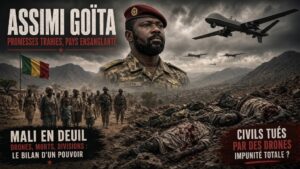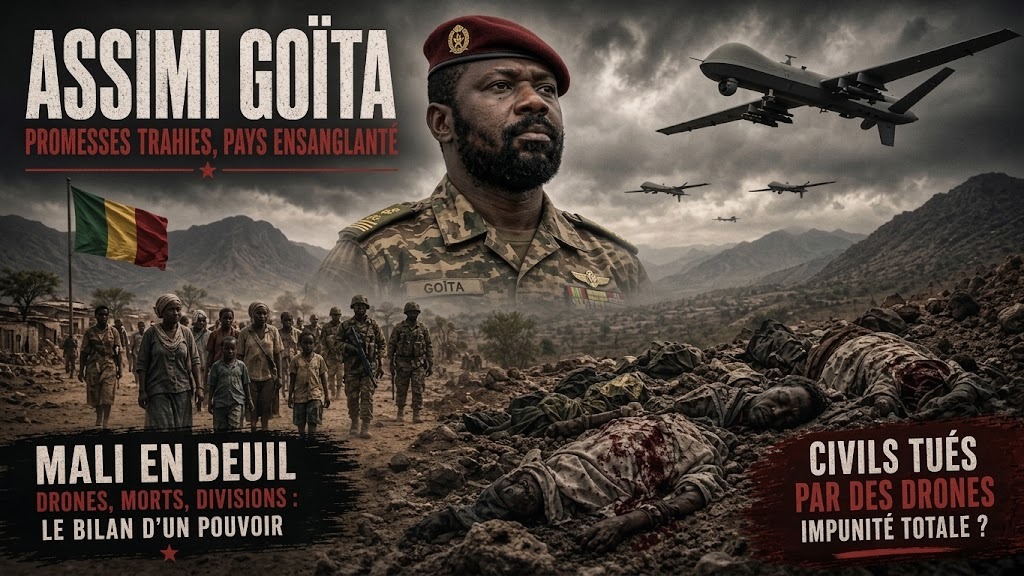
The drone has become a familiar sight in Mali’s skies — and, for many villagers, a symbol of dread. What was pitched as a precision tool for hunting armed groups has instead left a trail of civilian deaths that is now fueling a widening public argument over who, if anyone, answers for the loss of innocent life.
A conflict fought from a distance, paid for up close
Malian authorities have spent years building up their air power to counter armed groups. Turkish-made Bayraktar TB2 and Akinci drones, alongside combat aircraft, now fly missions for the Malian Armed Forces and their Russian partners in the Africa Corps.
In theory, this hardware allows strikes on identified targets from a safe distance. On the ground, the picture is far darker. Between September 2023 and September 2026, 731 civilians are said to have died in 199 strikes, based on ACLED data cited in a joint investigation by Jeune Afrique and Bellingcat, with The Sentry contributing.
Those figures do not mean every victim was individually identified or that legal responsibility for each strike has been established. They do, however, suggest the scale of civilian loss tied to this air campaign.
The most sensitive question: what did operators see before firing?
Investigators reconstructed twelve strikes independently, cross-referencing satellite imagery, video, photographs, munition debris, witness accounts and geolocation data. In those twelve cases alone, they counted 146 civilian deaths.
Some of the most troubling material concerns what those behind the screens knew before pulling the trigger. One phrase reported in the investigation captures the accusation bluntly: “They saw the children, and they fired anyway.”
If verified, such conduct would raise serious concerns under core principles of international humanitarian law — above all the duty to distinguish between fighters and civilians, and the obligation to take every feasible precaution to spare non-combatants.
But the issue reaches far beyond the operators themselves. It runs through the entire chain that produces a strike: intelligence gathering, target identification, mission approval, munition selection and the final order to fire.
Who pulls the trigger — and who answers for it?
This is where the investigation applies real pressure. Mali’s air war involves multiple players: Malian forces, Russian personnel from the Africa Corps, and, in the case of the Turkish drones, actors tied to their acquisition and deployment.
That overlap makes assigning responsibility extraordinarily difficult. Who identifies the target? Who confirms it is military in nature? Who authorizes the strike? Who oversees the operation at the moment of firing? And, most critically, who is held to account when a strike hits civilians?
These questions carry particular weight in a conflict where Malian authorities routinely describe their air operations as actions against armed groups.
Precision technology does not equal civilian protection
The arrival of drones was long sold as the dawn of cleaner, more accurate warfare. An operator can watch an area remotely, track a target and choose the moment to strike without exposing soldiers to enemy fire.
Yet technology does not erase human error, and it cannot guarantee that intelligence is correct. In a region where armed groups move among civilians, villages are isolated and information is often patchy, confirming with certainty that someone is a fighter can be extremely hard.
The investigation highlights the gap between the sophistication of the weapons and the vulnerability of the people living in conflict zones. For those on the ground, a drone overhead does not distinguish a fighter from a herder, a trader or a child.
A war that leaves lasting marks
The available data point to a major shift in Mali’s air war. According to the figures cited in the investigation, the number of strikes causing civilian casualties has risen sharply compared with previous years.
This escalation comes as violence against civilians remains a major problem across the Sahel. Armed groups themselves are responsible for numerous attacks on civilians and possess growing drone and explosive device capabilities.
For Malian families, however, the distinctions between different technologies and different chains of command change nothing about the end result: when a strike hits a village, lives are lost.
The limits that must be drawn around a powerful weapon
The question raised by these revelations is not merely about the military effectiveness of drones. It is also about the boundaries that should govern their use.
As Sahelian armies acquire ever more advanced air capabilities, accountability becomes unavoidable. A weapon able to strike from several kilometers away does not relieve the user of the duty to verify the target.
In Mali, the hundreds of deaths recorded in the data cited by the investigation serve as a reminder of an essential truth: in any technological war, the distance between the person pressing the button and the person who dies can be vast. Responsibility, however, does not vanish with distance.