Who are the Tuareg and Arab groups pushing for northern Mali’s independence?
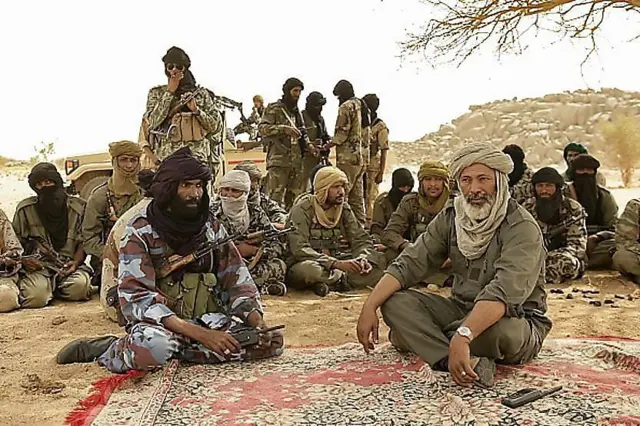
The Front de Libération de l’Azawad (FLA), a separatist movement uniting Tuareg and Arab factions, has forged an alliance with the Jamaat Nusrat al-Islam wal Muslimeen (JNIM)—a group linked to Al-Qaeda—to launch a fresh military offensive this weekend. Their goal: to reclaim control of northern and central Mali currently held by government forces.
This latest offensive comes just two months after the FLA and JNIM coordinated attacks across Mali on April 25, striking deep into the country’s center. Kati, a key military stronghold near Bamako, became a battleground, sending shockwaves through the transitional government. The Malian Defense Minister was killed, and the intelligence chief was severely wounded.
Following the April assaults, the FLA briefly seized Kidal, a city of immense strategic and symbolic value for the Malian army and its Russian-backed allies. The city had been under government control since 2023, marking a rare military triumph in the region. Though government forces reclaimed Kidal shortly after, the episode highlighted the growing threat posed by the separatist alliance.
The Malian government has since escalated its countermeasures, deploying additional troops and investing heavily in military hardware. On June 4, authorities announced a $12.4 million bounty for the capture or elimination of JNIM and FLA leaders, signaling their determination to dismantle the insurgency.
Meanwhile, social media accounts and Sahel security analysts report renewed mobilization among the FLA, with recruitment drives targeting communities in northern Mali ahead of the upcoming offensive. The situation remains volatile, with both sides preparing for a prolonged conflict.
Who makes up the FLA?
The Forces de Libération de l’Azawad (FLA) emerged on November 30, 2024, in Tinzaouatene, a northern Mali town bordering Algeria. The movement is the result of a merger between several separatist Tuareg and Arab armed groups, all united by a single objective: the independence of the Azawad.
The Azawad refers to a vast region spanning Gao, Tombouctou, Kidal, and Ménaka. Its bid for statehood dates back to 2012, when the Mouvement National de Libération de l’Azawad (MNLA) declared independence—a move later reversed under international pressure. The MNLA is one of the founding factions of the FLA.
The FLA succeeded the Cadre Stratégique Permanent pour la Paix, la Sécurité et le Développement (CSP-PDA), itself formed from the merger of multiple separatist movements. Key components included:
- The MNLA, a long-standing Tuareg rebel group
- The Haut Conseil pour l’Unité de l’Azawad (HCUA), another Tuareg-led faction
- Rebel factions of the Mouvement Arabe de l’Azawad (MAA)
- The Groupe d’Autodéfense Touareg Imghadien et ses Alliés (GATIA), initially pro-government but now aligned with the FLA
The roots of Tuareg unity trace back to 1988 in Libya, where the Mouvement Populaire de Libération de l’Azawad (MPLA) was founded by exiles. Its leader, Iyad Ag Ghali, now heads the JNIM and remains a pivotal figure in the region’s armed movements.
The FLA’s political leadership is spearheaded by Bilal Ag Acherif, born in Kidal in 1977. As the movement’s president, he plays a central role in shaping its strategy and governance. His deputy, Alghabass Ag Intalla, oversees military operations and serves as the liaison with the JNIM. Intalla hails from a prominent Ifoghas clan, his father, Intallah Ag Attaher, having been a traditional leader until his death in 2014. Mohamed Ramadane serves as the FLA’s spokesperson.
What does the FLA want?
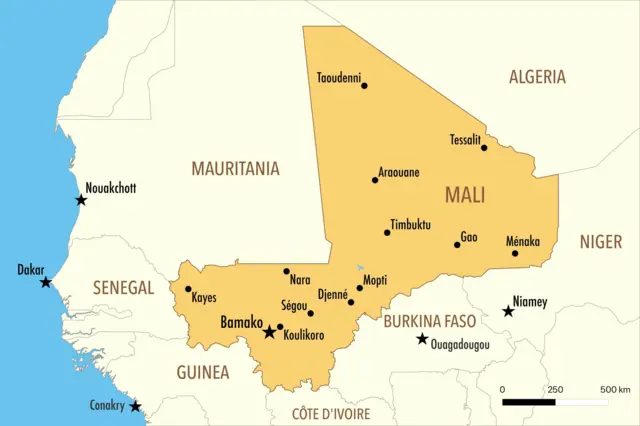
Tuareg and Arab communities in northern Mali have long opposed Bamako’s rule, fueling armed rebellions in 1962, the 1990s, and again in 2012. The FLA seeks to establish the Republic of Azawad, a homeland for roughly two million Tuareg scattered across West and North Africa—a consequence of colonial fragmentation.
The movement accuses the Malian government of systemic political, economic, and cultural marginalization. Despite the region’s vast natural wealth—including salt, uranium, gold, diamonds, and phosphates—infrastructure development in education, healthcare, and basic utilities remains severely lacking.
In a recent statement, Acherif emphasized the historical legitimacy of Azawad’s independence, declaring, “The Azawad was annexed to Mali without regard for its status as an independent civilization.”
The Malian government has accused neighboring Algeria and Mauritania of supporting the FLA, though Algeria previously mediated the 2015 Algiers Peace Accords between Bamako and northern armed groups. Mali withdrew from the agreement in January 2024. Ukraine, Mauritania, and France have also been implicated in allegations of backing the FLA.
The FLA’s military strength remains difficult to gauge, but Ramadane claims the group maintains a “strong presence” from the Mauritanian to the Algerian border. Key bases are reportedly located near Kidal and Tinzaouatene.
Between 2024 and 2025, the FLA reportedly deployed kamikaze drones in several attacks. However, the group frequently showcases images of armed fighters in pickup trucks traversing the desert, underscoring its hybrid warfare tactics.
How have FLA-JNIM relations evolved?
Iyad Ag Ghali, the JNIM’s leader, was once a leading figure in the Tuareg rebellion before shifting allegiance to radical Islamist groups in the late 1990s. The current alliance between the JNIM and FLA, however, is a recent development.
In May 2024, Ag Intalla reportedly initiated talks between the CSP-PDA and the JNIM, leading to an unofficial “non-aggression pact.” By July 2024, the CSP-PDA, with JNIM’s support, launched an assault on Malian and Russian Wagner mercenary forces in the battle of Tinzaouatene.
The JNIM later criticized the FLA for failing to acknowledge its role in the conflict. By March 2025, reports emerged of joint operations against Malian and Russian troops following negotiations in late February. After the April 25 attacks, both groups publicly acknowledged their partnership.
The FLA framed the alliance as a “strategic convergence” to overthrow Mali’s military government, while the JNIM described it as a pragmatic alignment after the Tuareg expressed willingness to embrace sharia law.
Acherif told Al Arabiya Al Hadath that despite ideological differences, the two groups share a common enemy and operate in overlapping territories. “There are ideological gaps, but we are discussing local solutions,” he stated. However, the durability of this partnership remains uncertain due to fundamental ideological and strategic divergences.