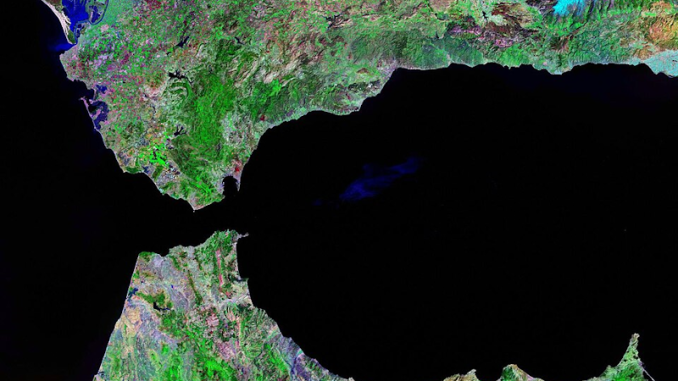
Diplomatic ties between Morocco and the United States have entered a new phase of strategic alignment. Since late July, Washington has signaled growing support for Rabat’s positions on both the Western Sahara dispute and the status of Ceuta and Melilla—a shift that could reshape geopolitical dynamics in the western Mediterranean and place Spain in uncharted diplomatic waters.
The momentum follows a recent migratory surge at Ceuta, where tens of thousands crossed into the Spanish enclave in less than 24 hours, straining relations between Rabat and Madrid and testing Europe’s border security framework.
The evolution reflects broader U.S. interests: sustained political backing for Morocco’s autonomy plan for Western Sahara, deepening economic cooperation, and alignment on regional security priorities. For Rabat, this partnership is increasingly vital—not only to preserve past gains but to advance claims over Spanish-controlled territories long disputed by Morocco.
Western Sahara: A cornerstone of Moroccan-American relations
In December 2020, the U.S. formally recognized Morocco’s sovereignty over Western Sahara in exchange for the normalization of Moroccan-Israeli relations. The move marked a historic turning point in a decades-old conflict pitting Rabat against the Polisario Front.
Six years later, Morocco is doubling down on this diplomatic victory. Infrastructure development in the territory—including the unveiling of the Donald J. Trump Highway, linking Tiznit to Dakhla—serves as a visible reminder of U.S. endorsement and a strategic effort to lock in American support ahead of sensitive international negotiations.
The Moroccan strategy hinges on maintaining Washington’s backing for its autonomy proposal, which remains the kingdom’s preferred framework for resolving the conflict. Analysts note that Rabat views U.S. political endorsement as essential to shaping a final settlement favorable to its interests.
Economic incentives fuel U.S.-Morocco partnership
The alliance extends beyond geopolitics. In late July, the U.S. Ambassador to Morocco traveled to Laâyoune, the administrative heart of Western Sahara, to finalize a U.S. grant funding the construction of a hydrogen and ammonia production unit. The project underscores a convergence of interests: U.S. support for Moroccan-led development, trade opportunities for American firms, and alignment on energy security in North Africa.
Morocco has positioned itself as a key partner in Washington’s broader economic and strategic vision for the region, blending political alignment with tangible investment incentives.
Polisario under scrutiny in U.S. Congress
A new legislative push in Washington is raising concerns among supporters of the Polisario Front. Two U.S. lawmakers have proposed classifying the movement as a foreign terrorist organization, citing alleged ties to Iran. The initiative comes amid heightened U.S. scrutiny of Tehran’s regional influence and a broader effort to counter perceived Iranian networks across the Middle East and North Africa.
Independent analysts, however, find no verified evidence linking the Polisario to Iran or Hezbollah. They argue that Rabat is leveraging the anti-Iran sentiment in Washington to reframe the Western Sahara conflict in a way that aligns with U.S. strategic priorities.
“Morocco consistently frames regional conflicts—especially those involving Israel—as part of a broader struggle against Iranian influence,” said one regional analyst. “It’s a narrative designed to resonate in the current U.S. political climate.”
Ceuta and Melilla: A shifting U.S. stance
The most consequential development may be Washington’s evolving position on Ceuta and Melilla. For decades, the U.S. has regarded the two Spanish enclaves as undisputed territories of Spain. Recent signals suggest a potential re-evaluation.
“Senior U.S. officials have made unusually direct statements suggesting they no longer view Ceuta and Melilla as definitively Spanish,” noted the analyst. While still unofficial, such remarks signal an implicit shift toward Morocco’s long-standing claim over the territories.
For Morocco, the enclaves represent occupied land. For Spain, their status is non-negotiable. An overt U.S. tilt toward Rabat’s position could introduce a new fault line between Washington and Madrid, undermining Spain’s traditional security assurances within NATO and bilateral alliances.
The Ceuta migration crisis: A strategic lever
The timing of this shift coincides with a sudden surge of migration into Ceuta. Within a single day, nearly 50,000 people crossed into the Spanish enclave, overwhelming local authorities and drawing urgent EU attention.While speculation swirled about whether the crisis was spontaneous or orchestrated, most observers agree it was initially organic before being politically exploited by Morocco. Analysts describe it as a largely spontaneous event later amplified and directed to send a clear message to Madrid.The episode served as a blunt reminder: from Rabat’s perspective, the status of Ceuta remains unresolved.Spain’s balancing act in a changing landscape
Spain is now navigating uncharted waters. Prime Minister Pedro Sánchez recently visited Algeria—a key regional ally of the Polisario Front—to strengthen energy ties. While the move may raise eyebrows in Rabat, analysts argue it does not signal a fundamental shift in Madrid’s long-standing support for Morocco’s autonomy plan for Western Sahara.Rather, the Ceuta crisis reflects a distinct territorial dispute—one rooted in historical tensions between Spain and Morocco, not a realignment of Spain’s regional policy.A potential threat to Spain’s strategic guarantees
The broader risk for Spain is systemic. If the U.S. were to formally endorse Morocco’s claims over Ceuta and Melilla, it would challenge the foundations of Spain’s security architecture—built on alliances with the U.S. and NATO.While an immediate crisis is unlikely, analysts warn that over time, the evolving U.S.-Morocco dynamic could create conditions for a future political renegotiation of the enclaves’ status—one that Spain may not be prepared to confront.Washington, Rabat, and Madrid: A tense triangle
The unfolding scenario reveals a recalibration of power in North Africa. Morocco is leveraging its strategic partnership with the U.S. to consolidate gains on Western Sahara and, increasingly, on Ceuta and Melilla. Washington appears to prioritize economic and geostrategic interests, while Spain faces a less predictable transatlantic partner.For Rabat, this moment represents a window of opportunity. For Madrid, it poses an unprecedented strategic challenge. Two long-separate disputes—Western Sahara and the status of Spanish enclaves—are converging into a single diplomatic battleground: the struggle for U.S. influence in the Maghreb and the reconfiguration of alliances in the western Mediterranean.