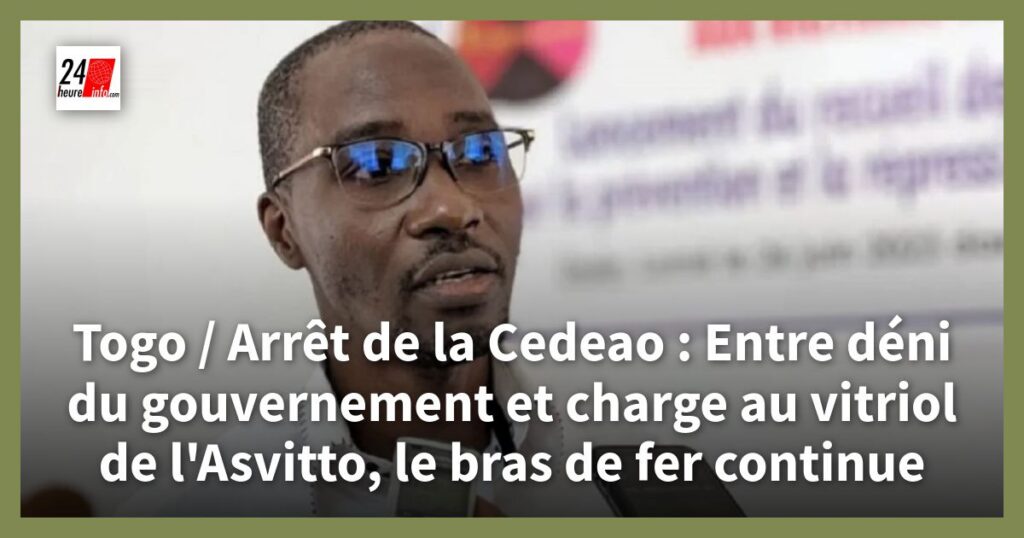
The decision by the ECOWAS Court of Justice regarding Togo’s constitutional amendment continues to spark intense debate in Lomé. While the Togolese government dismisses the ruling outright, the Association of Victims of Torture in Togo (ASVITTO) has launched a scathing attack, labeling the move as state-sponsored gangsterism.
Government dismisses regional court’s authority
The Togolese authorities swiftly countered the ECOWAS Court’s ruling, arguing that the regional judiciary lacks the power to oversee internal constitutional matters or intervene in national constituent processes. This legal stance aims to render the court’s decision irrelevant within Togo’s borders.
ASVITTO accuses government of constitutional coup
The civil society group fired back on social media, dismissing the government’s defense as a futile attempt to evade accountability. In a statement, ASVITTO condemned what it called a constitutional coup, warning that those behind it are now trapped in their own desperation.
The organization highlighted a pattern of defiance, stating that the authorities have repeatedly ignored ECOWAS rulings, including those calling for the release of political prisoners. Despite multiple community court orders mandating their freedom, detainees remain behind bars in Lomé.
« What remains unchanged is their long-standing habit of disregarding and disrespecting ECOWAS decisions, » the statement read.
Calls for decisive action against state-backed violations
ASVITTO has escalated its campaign, directly urging ECOWAS to intervene decisively. The group demands immediate enforcement of judgment ECW/CCJ/JUD/01/26, issued in January, which declared Togo’s 2024 constitutional reform incompatible with the African Charter on Democracy, Human and Peoples’ Rights.
The NGO condemned the ongoing state-backed constitutional violations in the region, declaring, « This form of state gangsterism must come to an end. »
Political deadlock leaves detainees in limbo
The standoff persists, with the government clinging to its legal arguments while civil society accuses it of undermining regional commitments. Meanwhile, the detained activists—still incarcerated despite the court’s rulings—await a resolution that extends beyond rhetorical battles. Their fate remains unresolved, caught in the crossfire of legal defiance and international pressure.