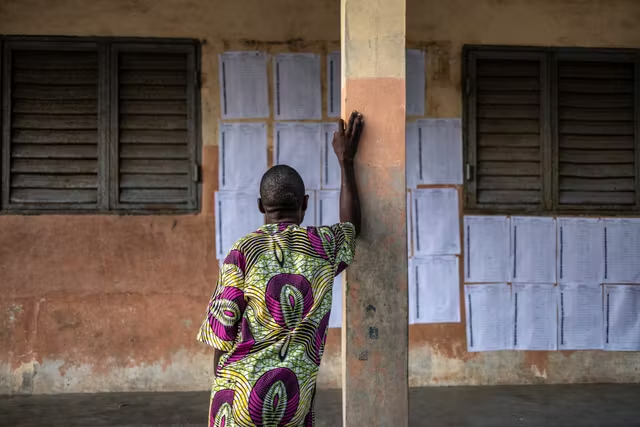
“Rigged from the start,” “one-sided ballots,” “incumbents coasting to victory.” These phrases have become familiar refrains across Africa, where 2025’s presidential elections saw opposition forces systematically sidelined before campaigns even began. The pattern held true in recent votes, including those in Djibouti on April 10 and Benin on April 12. In Djibouti, incumbent President Ismaïl Omar Guelleh secured a sixth term with 97.8% of the vote, while in Benin, Romuald Wadagni—handpicked successor to Patrice Talon—clinched 94% of ballots. Both results revealed starkly lopsided contests devoid of credible opposition.
In Djibouti, rising opposition figure Alexis Mohamed abandoned his candidacy under mounting pressure. While he cited safety concerns as a deterrent, the decisive barrier proved to be “nomination fees”—costs so steep they effectively barred all but the most well-funded contenders. Observers branded the process “a hollow ritual,” where financial hurdles did the heavy lifting of silencing dissent.
When cash trumps democracy
This is no isolated incident but a continent-wide trend. Candidates across Africa routinely face exorbitant campaign expenses that dwarf average incomes, creating an uneven playing field where only the wealthy—or those backed by powerful elites—can realistically compete. The phenomenon has sparked debates over whether elections still function as mechanisms for democratic choice or have devolved into “auctions for power.”
Financial barriers manifest in multiple forms: staggering registration fees, mandatory deposits, and hidden legal costs that can reach hundreds of thousands of dollars. For opposition hopefuls lacking institutional support, these figures translate into insurmountable obstacles. The result? A growing roster of elections where incumbents face no meaningful challenge, their victories predetermined by systems rigged in their favor.
Who bears the brunt?
Independent analysts warn that this financial throttling of opposition voices risks eroding public trust in electoral integrity. When only candidates aligned with ruling parties can afford to run, voters lose faith in the process itself. “The message is clear,” notes one political commentator. “To compete, you need deep pockets—not principles.”
The implications stretch beyond individual races. A continent once celebrated for its democratic resilience now grapples with a creeping normalization of exclusionary practices. As nomination fees climb higher, the space for genuine political competition narrows, leaving citizens with fewer alternatives at the ballot box.