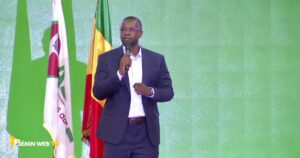
Senegal’s political landscape has been shaken by a bold public statement from Lansana Gagny Sakho, a technocrat long aligned with the movement led by Ousmane Sonko. The former government official now openly regrets his past association, suggesting he would never have joined the movement had he foreseen the economic mismanagement that followed. His remarks strike a sharp contrast with the executive branch and signal a growing rift within the political alliance.
Direct criticism of economic management
Lansana Gagny Sakho’s intervention is far from a mere difference of opinion. He explicitly blames the current economic trajectory of Senegal on flawed decision-making, directly implicating the Prime Minister in the country’s mounting challenges. Observers have noted a slowdown in key economic indicators, strained public finances, and recurring doubts from international partners about the clarity of budgetary policies since early 2024. His critique arrives at a pivotal moment when debates over debt sustainability and public account revisions dominate discussions in Dakar.
The government, which has itself acknowledged a more severe financial legacy than initially reported, now faces scrutiny over its ability to reverse the situation. A former ally’s criticism carries particular weight, disrupting the unified front presented by the ruling coalition since Bassirou Diomaye Faye’s election victory.
Political fallout within the ruling coalition
Lansana Gagny Sakho’s words reflect a profound disillusionment. By stating he would not have backed Ousmane Sonko if he had anticipated the outcome, he frames his departure as both personal and political. Such a rupture holds significance in a movement like the Patriots of Senegal for Work, Ethics, and Fraternity (PASTEF), which has built its influence on strong militant discipline and unwavering loyalty to its leader.
The move risks deepening internal divisions within the presidential camp. For months, dissenting voices—including intellectuals and technical experts who supported the March 2024 transition—have voiced concerns over the government’s approach. Criticisms range from its confrontational communication style to the perceived sluggishness of structural reforms promised during the campaign. Lansana Gagny Sakho’s statement crystallizes these frustrations, giving them a tangible face.
Testing the cohesion of the presidential camp
The true impact of Lansana Gagny Sakho’s remarks remains to be seen. Politically, his influence does not match that of the ruling party, yet his words resonate beyond his person. They expose a climate where internal fractures are becoming audible and where economic performance is emerging as the primary benchmark for evaluating the government’s actions. Investors, donors, and regional partners are closely monitoring these developments.
The response from the presidential camp—or its absence—will be closely watched. Ousmane Sonko, known for his direct rhetoric, has multiple avenues to counter the criticism. However, a verbal confrontation with former allies could reinforce perceptions of a defensive administration. Ultimately, the debate transcends the Prime Minister’s persona: it tests the coalition’s ability to weather internal criticism without fracturing. In the coming weeks, the government’s economic and budgetary policies will provide the most concrete answers to these challenges.