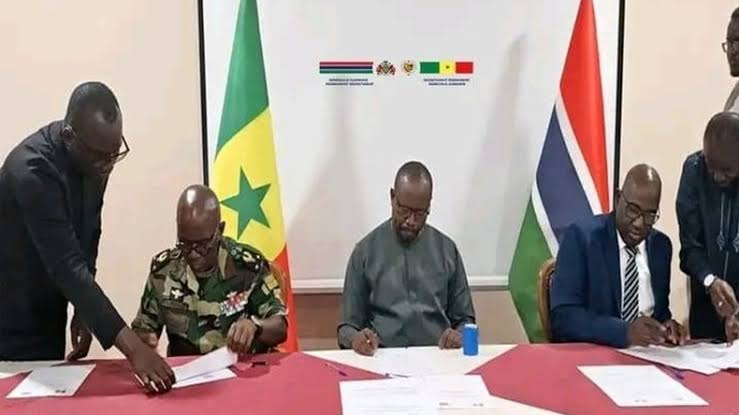
Senegal and Gambia have achieved a historic milestone in resolving their long-standing border dispute by finalising a definitive agreement on the delimitation of their shared frontier. The breakthrough, announced by the Permanent Secretariat of the Senegal-Gambia Border Commission, follows a tense standoff near Bullock just two weeks prior.
Behind the recent tensions near Bullock
Tensions flared on July 16 when Senegalese military personnel dismantled a section of a Gambian military post’s fence near Bullock. Banjul condemned the move as a “provocative” act violating its sovereignty, while Dakar maintained the structures were unlawfully encroaching on its territory. The incident threatened to reignite long-standing grievances over the undelineated border, which has historically been a source of friction between the two nations.
Joint efforts to secure the border
To prevent further escalation, both countries have agreed to resume joint demarcation and boundary densification operations starting August 15. These efforts, which were halted in June due to logistical challenges, involve installing new boundary markers to clarify the exact border line. The initiative aims to bring long-overdue clarity to a frontier that has long been blurred by agricultural activities spilling over into disputed areas.
As part of the campaign, awareness campaigns will be conducted for communities living along the border, where cross-border farming has frequently led to disputes. Authorities have set September as the deadline for completing the operations, during which they will also verify Gambia’s claim that its Bullock military camp lies within Senegalese territory.
Strengthening relations through diplomacy
The agreement underscores the commitment of both nations to resolve their differences through bilateral dialogue rather than confrontation. While the technical aspects of border demarcation remain critical, the resolution reflects a broader desire to preserve a relationship built on deep historical ties, economic interdependence, and shared security interests in West Africa. For both Senegal and Gambia, this accord marks a significant step toward stability and cooperation in the region.