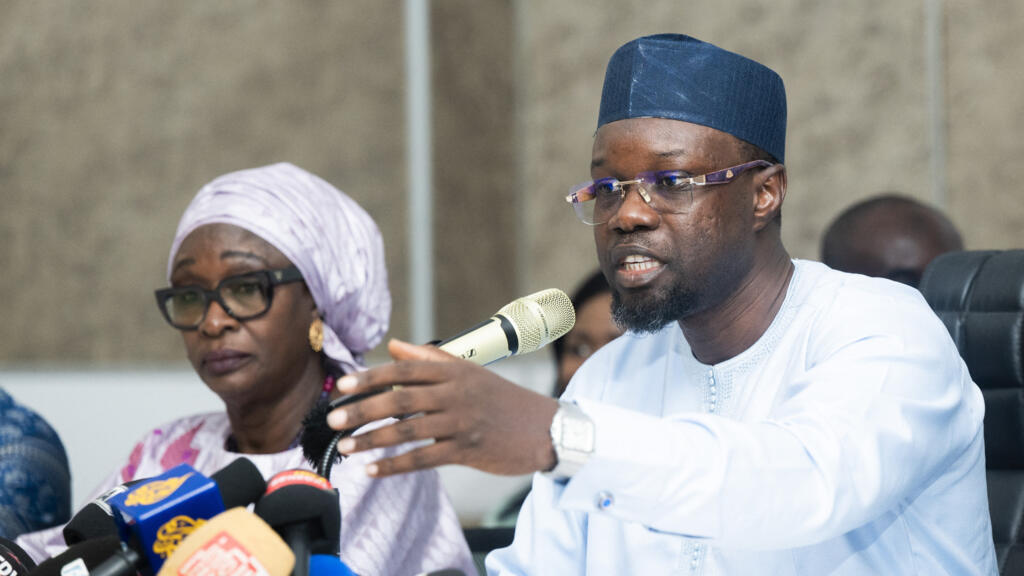
Just one week after his dismissal by President Bassirou Diomaye Faye, Ousmane Sonko, the former Prime Minister and influential leader of Pastef, has initiated a strong political counter-offensive. During a press conference in Dakar, Sonko launched severe criticisms against President Faye, while emphasizing that he has no intention of destabilizing state institutions.
However, Sonko did not shy away from highlighting Pastef’s significant parliamentary majority, a powerful asset that grants the party the ability to challenge the current governmental team through a motion of no-confidence. He characterized the prevailing political climate as a form of cohabitation, recalling that he had forewarned the President about this potential scenario months ago, but his concerns went unheeded.
Furthermore, Sonko expressed strong disapproval of the new government, which is now led by Prime Minister Al Amine Lô. He argued that the executive lacks fundamental political legitimacy, famously stating, “We have a government that possesses no political foundation.” He firmly dismissed any claims of a broad coalition backing the administration, labeling the government’s reliance on a “technocratic” image as a mere disguise for its political isolation. Sonko insisted that Pastef holds the sole popular mandate within the majority, underscoring its position as the nation’s leading political force, directly chosen by the electorate. He concluded that governing without Pastef is tantamount to governing without the will of the people.
A significant challenge for the presidential camp
The Senegalese executive now faces a precarious political landscape. The absence of Pastef from the government creates a substantial political hurdle for President Diomaye Faye’s administration. As the country’s dominant political force with a comfortable parliamentary majority, Pastef’s non-participation ushers in a unique form of cohabitation, even within the broader presidential coalition. While President Faye retains his constitutional powers, the successful implementation of his agenda will largely depend on his ability to maintain a cooperative relationship with Pastef’s parliamentary representatives.
Beyond merely the cabinet’s composition, the core issue of political stability now looms large. Observers are questioning the executive’s capacity to secure legislative approval for its proposed bills and to push forward announced reforms without the direct involvement of the majority party in governmental management.
Analytically, President Bassirou Diomaye Faye appears to have distanced himself from the foundational narrative that brought him to power. He now governs within an unusual space—a formally legitimate authority that is narratively adrift. While constitutional, his power is orphaned, disconnected from the historical context that imbued it with meaning beyond routine state administration.
Conversely, Ousmane Sonko, with Pastef’s 130 deputies in the National Assembly, maintains an unwavering voice, a preserved memory, and an overwhelming popular mandate. He stands not as a conventional adversary, but as the guardian of the original political story, ready to assert at any moment, “We were here before, and we will be here after.”
More than cohabitation: a political rupture
The political dynamic unfolding in Senegal is unprecedented in the nation’s history. It is not a typical cohabitation, which usually involves a president facing an opposing parliamentary majority. Instead, this situation presents a more intricate and potentially perilous scenario: a fracture within the very movement that propelled the current leadership to power. The head of state finds himself at odds with a party that commands an absolute majority of 130 out of 165 parliamentary seats, a party that explicitly refuses to participate in the government.
The pressing question remains: how can a technocratic government, lacking its own parliamentary foundation, effectively govern when Pastef holds the absolute majority in the Assembly, with Ousmane Sonko himself as its leader, and simultaneously orchestrates a nationwide mobilization of a million activists? The resolution—or lack thereof—to this critical question will unfold in the coming weeks and months, playing out in the streets, within state institutions, and behind the closed doors of the Presidential Palace.